Search This Blog

Wednesday, October 12, 2016

Rain, Blossoms, Kiwifruit and Persimmons

Today it was dark and gloomy in the pens, because it rained almost all day long, but the monotony of the droning patter of falling rain was broken by the look and feel and color and flavor of unusual fruit.


Bow slept almost all morning, because what else can you do when the world is so dark and wet outside?


It was quite warm out when I went for my walk in the afternoon, but the petals of the latest blossoms on the cherry tree had been stained pink by the bruising they received in the rain,


By the path in the pasture, there were two persimmons so ripe that they had fallen to ground by one of the taller trees.


The smallest and most bountiful persimmon tree had more of its fruit ripe for the picking.


Dripping with rain, the persimmons looked very appetizing.


I picked the ripe ones and brought them home to Bow, so soft to the touch they were almost falling apart.


Bow ate the pulp and gently spit out the seeds into my hand. There were a lot of seeds!


For dessert with dinner tonight, I served Bow one of the four kiwifruit that his friend who brings the bananas gave him last week. They were not ripe then, but they are starting to ripen now.


Bow had never had kiwifruit before, so when he requested it, he called it "something else."


The kiwifruit was so good, Bow almost forgot to use the spoon I provided, but he was very polite and handed me the empty plate and spoon when he was done.


It can be very dark in the pens when the sun is not shining, but life is never dull when there is new and interesting fruit to eat.


Thursday, October 6, 2016

Perpetuities in a Nutshell


Bow in the Outer Pen this Morning Enjoying a Persimmon I Picked for Him
At the farthest corner of my land, surrounded by brambles and blackberry thorns, is a tiny persimmon tree that is covered with fruit.

It's the Smallest Persimmon Tree on My Land, But It Bears More Fruit than the Others

It's the smallest persimmon tree on my land, but it bears much more fruit than the others. The other trees usually lose all their leaves by the time the fruit is ripe, and they stand tall and naked, with only a few orange globes hanging from them, which is why I refer to them as my Halloween Trees.

This image is from a post in 2014
None of these trees were planted by me, and they sprang up on their own, because I did not mow the pasture. The landscape of my land changes every year, I think that change is more natural than everything remaining at a stand still, so I wonder about those who are agitating to try to stop climate change.

A View of My Pasture at Sunset a Couple of Days Ago
If you look at the picture of my pasture at sunset, neither the fruiting mulberry in the foreground nor the cedars and pines in the background were there when I bought the property -- and they were not planted by me.

The Weigela Blossoms day before yesterday
It has been unseasonably warm lately, and not only the service berry and the cherry and the apple tree have been blossoming, but on the Weigela bush the fruit and the brand new blossoms are growing side by side.


What if it really is getting warmer here, and what if it has something to do with "global warming"? Does that mean we can do anything about it, or that -- even if we could -- we should?


If change is the natural state of things, should we try to artificially stop the change, preventing bigger harvests and easier living conditions in temperate areas? Why?

I know of people who want to freeze everything, keeping it all the same, because, after all, people and animals depend on the status quo. When a large business goes belly up, they try to keep it afloat at the public's expense, for the sake of the workers and of the economy. But the workers and the economy would be just fine, if you just left everything alone to decay and die and be reborn in the natural course of life. There are business cycles. There are climate cycles, There are winners and losers every time something changes. If you try to help the losers at the expense of the winners, you will eventually bring everybody down.

Take the current state of the Congo. Not very safe for either humans or other great apes. So what do conservationists do? They try to send money to the Congo to help to keep everything the same. Meanwhile they try to destroy the ability of private apes in the United States to keep eking out a living in a new environment. But the greatest hope for non-human apes to survive is among humans in the United States. 

And then there are the researchers who actually believe that some rich donor is going to provide them with funding for their project in perpetuity. But every single time, the particular business that this donor depends on falls on hard times, and there goes their revenue in perpetuity. No business can last forever. The economic climate is constantly changing. It's natural.

When I was taking Trusts &Estates in law school, I happened on a tiny book called Perpetuities in a Nutshell.  For me, it was just a study aid, but it was a good one, and the title was so catchy that it stuck with me.

Here is what I can tell you about perpetuities in a nutshell: Nothing lasts forever. Things change constantly. If you take advantage of those changes that work in your favor, then you can always find a way to survive and sometimes even to thrive.


This means that instead on insisting on having the fruit you have always had under the circumstances that it has always ripened, you look around and see what fruit happens to be ripe for the picking right now.

The Ripe Persimmon

One of the persimmons on the tiny tree was already ripe, so I picked it and brought it home to Bow. I have been told that persimmons should not be eaten until after the first frost, but in that case, why do they ripen without a frost? Surely in some areas it never freezes.


Bow was not particularly hungry. It was not long after breakfast. But he accepted the persimmon from me and ate of it delicately.


What if the warming trend in Missouri continues, making the outdoors safe for chimpanzees here year round? Wouldn't that be a wonderful thing for chimpanzee conservation in the US? Why would you want to reverse this trend for the sake of other animals elsewhere on the globe? If everything had always stayed the same throughout our own history, would any humans have ever left Africa? Do you want to reverse that trend, too? It just does not make any sense. 


Progressives accuse conservatives of wanting to "halt progress." But isn't that exactly what progressive conservationists are trying to do to climate change on this planet -- halt progress? There is really no telling where nature is going with this. It is unlikely that we can stop it, But we can help ourselves and the animals we love by adapting to the change. The entire history of life on this planet is a history of natural migration and natural adaptation. 

Sunday, October 2, 2016

Is it Spring Again, yet?

We each have an internal timetable that may or may not match objective reality. Cicero warns us that we have to act our age, or we will appear foolish. For every thing there is a season, the Old Testament intones. But what if you don't feel like the season you are allotted?


Yesterday was the first of October. The air was a bit chilly in the morning when I went for a walk. But I was amazed by the blossoms that greeted me! The honeysuckle flowers were not that surprising.
Honeysuckle on the First of October

 They had not bloomed that day, and soon they would be gone.  After all, two days earlier there were still plenty of yellow butterflies fluttering about.


But the lily white blossoms that I spotted in the serviceberry bush were brand new!

Serviceberry blossoms on the first of October

How did they suddenly decide to bloom forth when the weather turned cooler?

A closer look at the serviceberry blooming


And then I saw the cherry blossoms trembling in the cold breeze! So much bigger and more splendid than the serviceberry blooms, they seemed to proclaim that spring had finally sprung!


These fresh, newly opened blossoms had sprung forth on only one spot on the otherwise bare tree.

Cherry Blossoms on the First of October

What did they know that everyone else did not know? Were they answering a call of nature at odds with the nip of frost in the air?


Not to be outdone, the tiny, baby apple tree that we planted only last fall was suddenly showing a big pink blossom. This tree has yet to give fruit, and I don't believe it even bloomed this spring.


What makes flowers burst forth out of season?


 Is it foolish to want to give fruit when everything else is preparing for a long winter?

Blackberry blossom trying to bring forth fruit on the first of October

 Or do each of us  live by a different timetable, so that those who did not bloom in the spring get a second chance in the fall?

Friday, September 30, 2016

Bow Tries a Guava


Then, again, maybe there is such a thing as an acquired taste, after all. No sooner had I come to the conclusion that Bow knows instantly exactly what he likes, I was presented with a counterexample.


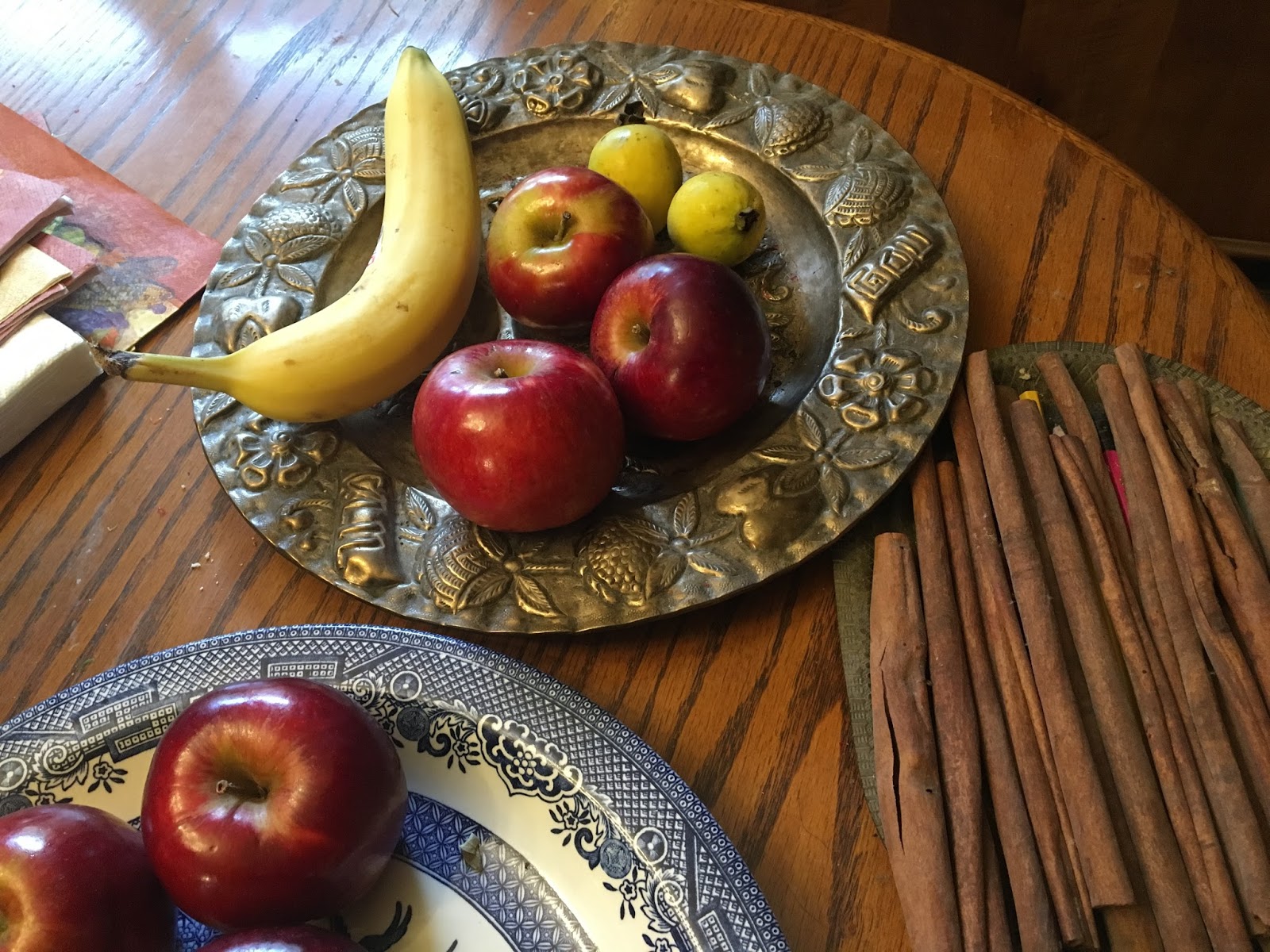
Now that it's fall, there is a variety of fruit available at the store, including pomegranates, avocados, and guava. I am not really that big a fan of guava, but this time the fruit looked so small that it seemed unusually attractive.


The guava fruits are so small this season, they look like lemons next to the apples and the bananas. Yesterday, I offered Bow a guava. He took a sniff of it, and then he gestured with it toward my mouth. He wanted me to eat it. So I did, pausing every so often and offering some to him. He kept sniffing in my mouth, but he refused to eat the guava. "Well, that's that," I thought. "He doesn't like guava."

But then later in the afternoon Bow's friend who brings the bananas came by, and I offered her a guava, too. When Bow saw that his friend was enjoying the guava, he suddenly became very interested. '

"Bow do you want some guava, too?" I asked him. This time, when I offered him the fruit, he started eating it. In fact, he took it with him to sit on the other side of the door from his friend. They each ate their guava while looking at one another through the grid. I guess that's what you might call social eating.


Saturday, September 24, 2016

Knowing What You Like


The importance of knowing what you like cannot be overestimated. Bow, for one, knows exactly what he likes and by extension, what he does not like. He likes his yogurt thick and his corn sweet.


The yogurt I made came out so thick this week it was almost like a soft cheese. But Bow did not complain. He ate it all up.


On  the other hand, he refused the corn at lunch today without tasting it, because he could already tell it was not sweet, just by the smell.


How did Bow know? Is it right to judge what you like without even trying it? I think it's more natural to do so than we are led to believe. How do Monarch butterflies know what they like? Do they have to try it first?


This has been a bad year for milkweed, but a good year for Monarch butterflies. The milkweed didn't blossom in my pasture, and I did not get to see the Great Spangled Fritillary butterflies on the purple milkweed blossoms day after day, the way I did last year and the year before. But on the other hand, I've seen quite a few Monarchs in my pasture, and this one even let me get very close.


How did the Monarch know that it liked goldenrod flowers? Did it have to take a taste first?


I wonder about things like that as I watch the animals on my land. For instance, you know that book What Young Chimpanzee's Know about Seeing? Well, yesterday, I began to wonder what squirrels knew about seeing. This one squirrel was holding stock still on the back of a tree trunk, as if it hoped to remain invisible, but I could see it clearly, because we were on the same side of the tree.


"Is it hiding from me?" I wondered. But then as soon as it climbed down from the tree and came into the visual range of a nearby squirrel, that other squirrel started chasing it. Were they playing hide and seek? Had it been hiding from a conspecific, and not a human?


Two common buckeyes were locked in an embrace as I followed them around in the field.


How did they choose each other? There are so many common buckeyes, after all. That's why they are called "common". How did they make the selection? Was it love at first sight? Tough question.


There's absolutely nothing wrong with knowing what you like -- and what you don't like. For Bow, thick yogurt is something he knows he likes. Whether it's an acquired taste or a innate preference would be hard to say, even for Bow. But it's certainly not a result of trial and error. If he didn't like it, he wouldn't eat it. He would not even try.


Thursday, September 22, 2016

A Fall Bouquet for Bow


Fall comes every year. This year, the first day of fall is today, September 22. It's still pretty warm out, but somehow the animals and plants outside sense that it is time to get ready for winter.


In fact, they have been getting ready for the past week now.


The wasps on the goldenrods are stocking up for the winter. 


The honey bees on the white wildflowers are doing the same.


The pipevine swallowtail is in such a hurry to meet all its deadlines, that it flits right past me in the field.


It won't stay in one spot long, but it will pause long enough for a clear view.


An American Lady butterfly, a little worn in the wings, enjoys the goldenrod flowers.


Them a Common Buckeye and the American Lady Butterfly socialize together on the swaying goldenrods.


A fuzzy little caterpillar makes its way on the ground among the fallen leaves.


And then there is the dogwood all decked out with faux berries, an unmistakable sign of fall. 


The dogwood tries to dupe us into thinking its bright red drupes are luscious fruit, while the dogs frolic under its branches.


The tiniest butterflies, the eastern tailed-blue and the pearl crescents, hold social balls on the gravel road.

There are still so many flowers blooming out today, that I decided to gather a bouquet and present it to Bow in a vase. Bow was interested.


He began taking out the flowers.


I thought he was getting all excited about the flowers, but actually it was the vase that he wanted.


"Hey, what's in that vase?" Bow seemed to be wondering. "Nothing, after you took all the flowers out!" I wanted to say. "It's just an empty vase now." But we didn't actually say any of that. We just acted it out. 


Once he had made sure that the vase was really empty, Bow handed it back to me.


I think that's sort of how it is when we expect something special to happen on the first day of fall. It's just a date. It's a day of the year. It's an empty possibility, until you fill it with something. It's like any other empty vessel.

Sunday, September 18, 2016

Sometimes It's Good to Laugh

Not everything turns out exactly the way we plan.


We might go to great extremes to get one political candidate nominated by our party, only to have to accept another in his stead. We might work very hard, anyway, to try to help the nominee get into the debates, even though he was not our first choice. We might then learn that our party and all its ideals will be kept out of the national debates altogether. 


.
It might rain all day long almost every day, so that we cannot go out to play.


And then when we do finally go out to play, the pollen may be so high that it does crazy things to our system.


But if we have a sense of humor about it, and someone to laugh with, it is always better.


This will all blow over soon. Hang on in there and remember to laugh.


We just might survive it all, anyway. Who knows, there might be a meteor coming.

    Related Stories