I am a primatologist who spends twelve hours most days in the company of a thirteen year old chimpanzee named Bow. I am also an editor with Inverted-A Press.
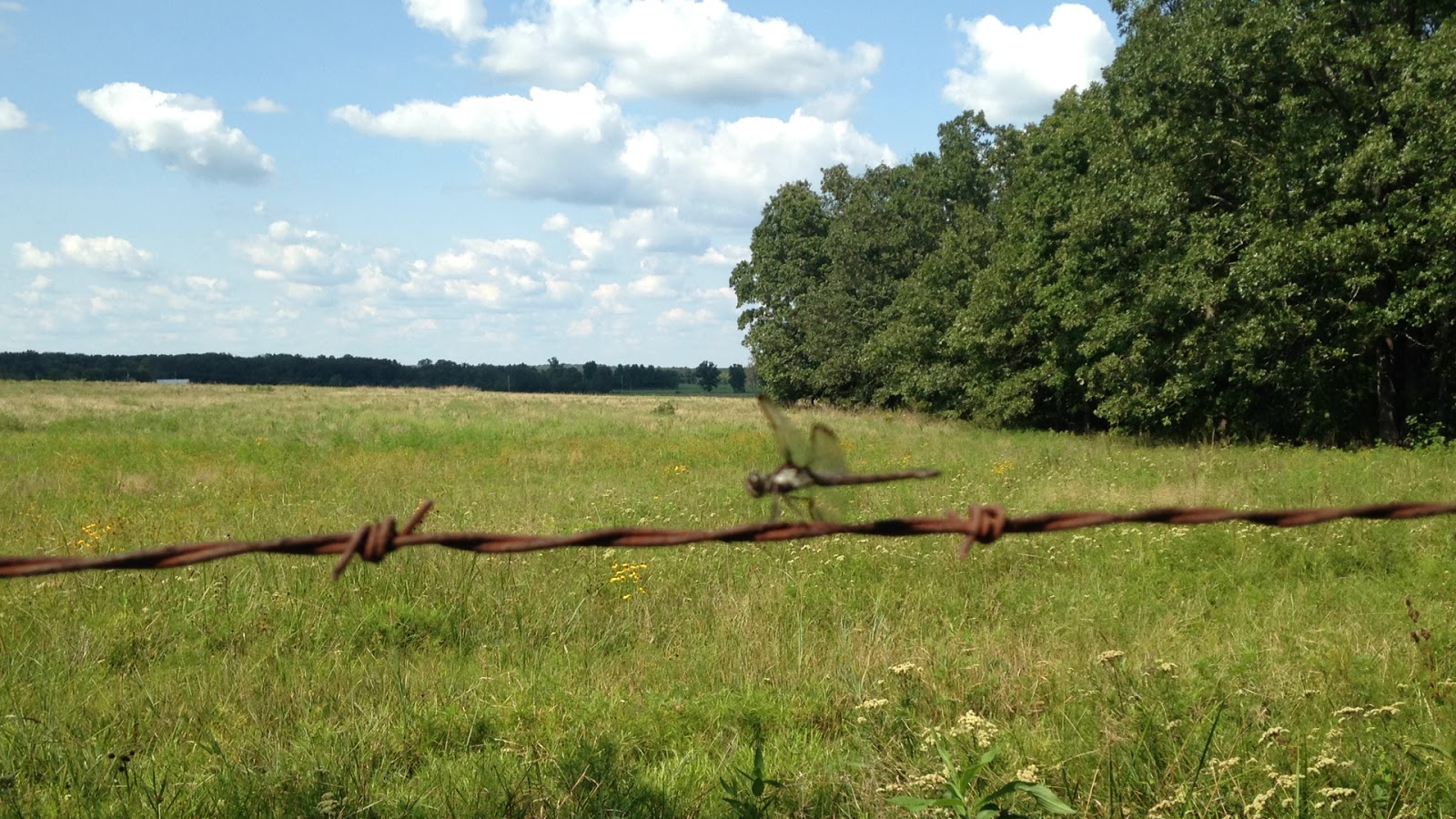
Yesterday, I spotted both a dragonfly and a damselfly in about the same place. The dragonfly was delicately balanced on the barbed wire that separates my land from the neighbors. The beautiful backdrop to the dragonfly was a landscape I do not own, but am lucky enough to enjoy anyway, from a distance.
The damselfly was less than a foot away, on a poison ivy leaf.
Now I have written about the difference between dragonflies and damselflies before. In that post, we established that the damselfly is as distantly related to a dragonfly as a human is to a rhinoceros,
But at the time, I only spotted a damselfly, and had no dragonfly to compare it with. Yesterday, I was given an opportunity to observe them both closely in a very similar environment.
At first, I noticed only the dragonfly, which was bigger and more active than the damselfly. It kept taking off from the barbed wire, only to return over and over again to the same spot.
Dragonfly in flight
It would get so small in the distance, then grow back in size as it came in for a landing, making its final approach.
Dragonfly coming in for a landing
This happened over and over again, and meanwhile, the damselfly was so quiet and demure and still, that I hardly noticed it.
But it was in almost the same place.
Nobody thinks that because dragonflies and damselflies are so distantly related, they should be kept apart for the purity of their races or cultures. They can hang out side by side, and there is no problem.
You might argue that it is because the two species occupy a different ecological niche -- one preferring barbed wire to perch on and the other poison ivy -- they pose no threat to each other.
But I have seen animals as distantly related as the great spangled fritillary butterfly and the common honey bee feeding side by side on the same flower.
A bumblebee, a honey bee and a great spangled fritilalry
And I have also seen animals as closely related as bumblebees and honeybees share the same flowers with the great spangled fritillary butterfly, and there was peace and harmony, and all went well.
And yet if someone suggests that bonobos and chimpanzees might be able to live together if they knew each other well and agreed to the arrangement, some experts frown. And for humans to live in the same environment as either species is verboten. It would be unnatural, they say. Why? Don't you think we evolved in pretty much the same environment? Don't you think we occupy the same niche? Don't you think there are also humans in Africa in a more or less natural setting? You might as well segregate the honey bees from the bumblebees and the damselflies from the dragonflies.
Of course, there are conflicts between similar animals occupying the same niche. But most of the differences between chimpanzees and bonobos are cultural. And if we are raised in a similar culture, we can get along with others who are not exactly the same as we are. At least we can, if we choose to.
Yesterday I came across a beautiful insect in the grass. At first, I thought it was a dragonfly. But on closer inspection I was not really sure. Something about it was like no other dragonfly I had seen.
I got in as close as I could, and I tried to film it, but it was hard to focus on something so small for too long.
Later, I posted the photo below and asked my friends on Facebook to tell me what this insect was called. Some thought it was a dragonfly just as I had initially believed. But my friend Arle identified it as a damselfly, a close relative of the dragonfly.
Somebody else asked: "Are damselflies like mayflies?" I answered that they were quite different, as mayflies are in the order Ephemeropteroida, because they are short-lived, but damselflies, like dragonflies, are in the Odonata order. Arle agreed, He also noted: "They are about as closely related as I am to a rhinoceros." This was a startlingly vivid way to consider phylogenetic relationships, and I think it's a mental exercise well worth the effort.
Every once in a while, someone I know will exclaim that we cannot be more closely related to Bow than Bow is to a monkey, because Bow "looks like a monkey", and we don't. In fact, Bow does not look any more like a monkey than we do, but there is a psychological effect in place that makes us always view ourselves as unique, and anyone who is different from us as more similar to all the others who are different from us. I don't know what this effect is called, but it should have a name.
All living things on earth are related. Somewhere in the tree of life, you will find our kinship with the ox-eye daisy.
But the relationship to the daisy is so very distant, that we might as well not be related at all. On the other hand, the damselfly, the mayfly, the rhinoceros, the chimpanzee and man are all more closely related to each other than each of us is to a daisy. This kinship is formalized by biologists by saying that we all belong to the Kingdom animalia. whereas the daisy belongs to a different Kingdom, Plantae. We're all animals, and the daisy is a plant. So far, so good. Most people can recognize the difference between a plant and an animal, without ever having studied biology.
Can you tell which is the plant and which the animal in this picture?
Most people will also agree that insects, (Kingdom: Animalia, Phylum: Anthropoda, Class: Insecta) are more closely related to each other than to any vertebrate (Kingdom: Animalia, Phylum Chordata. Clade: Craniata, Subphylum: Vertebrata). We have an almost instinctive sense of how those differences break down, which is why when I saw the damselfly I knew at once it was an insect. I had no need to look that up. Where it gets trickier is assessing relatedness between and among beings very different from ourselves, and maintaining objectivity regarding beings very similar to ourselves.
So the rhinoceros is classified phylogenetically like this:
It's all exactly the same until you get to the order! And the mayfly and the damselfly also share everything until you get down to the order, which is where they diverge. They are both insects and so very different from us, but when you look at it from their perspective, they are about as different as a rhinoceros is from a man.
So much for differences. Now let's compare similarities. The dragonfly and the damselfly share an order, Odonata, but they diverge at the suborder. The dragonfly is from suborder Anisoptera, whereas the damselfly is suborder Zygotoptera.
Family Tree of the Order Primates from Wikipedia
But humans and chimpanzees are much more closely related to each other than the damselfly is to the dragonfly, because we do not simply share an order, Primates, but we also share a family, Hominidae (Great Apes) and a subfamily, Homininae, and a tribe, Hominini. The only thing we do not share is a genus. So yes, we are different species. But much more closely related than a dragonfly to a damselfly.
Family Tree of Odonaraptera from Wikipedia
Most phylogenetic classification presupposes binary bifurcations as you can see in the trees above. But real life can actually get much more messy. The other day I met a man who told me a long story about how his family tree crossed-over several times, along the lines of the popular song, "I am my own grandpa." This involved marriage and in-laws, but it can also happen with plain genetic relationships. In reality, after humans and chimpanzees split into two groups, it is also known that they continued to interbreed for a period of time, so they may be even more closely related than a simple phylogenetic bifurcating tree can show.
If dragonflies and damselflies are less closely related than chimpanzees are to humans, why is it so hard for us to tell the difference between the two, whereas we see the physical difference between humans and chimps so clearly?
I think it's the same reason that we tend to think we look very different from all our family members, but an outsider can spot the family relationship very clearly just by looking at us. I have had complete strangers tell me I look just like my mother, and my daughter has had the same experience when people compared her to me, but we do not think we look anything alike. The differences are what we notice, not the similarities. To see how closely we resemble chimpanzees, we should ask an outsider, someone very different from us, like the damselfly, how hard it is to tell us apart.
To a damselfly, humans and chimps probably look the same




 Posts
Posts


