


The damselfly was less than a foot away, on a poison ivy leaf.

Now I have written about the difference between dragonflies and damselflies before. In that post, we established that the damselfly is as distantly related to a dragonfly as a human is to a rhinoceros,
http://notesfromthepens.blogspot.com/2015/05/the-damselfy-and-phylogentic.html
But at the time, I only spotted a damselfly, and had no dragonfly to compare it with. Yesterday, I was given an opportunity to observe them both closely in a very similar environment.
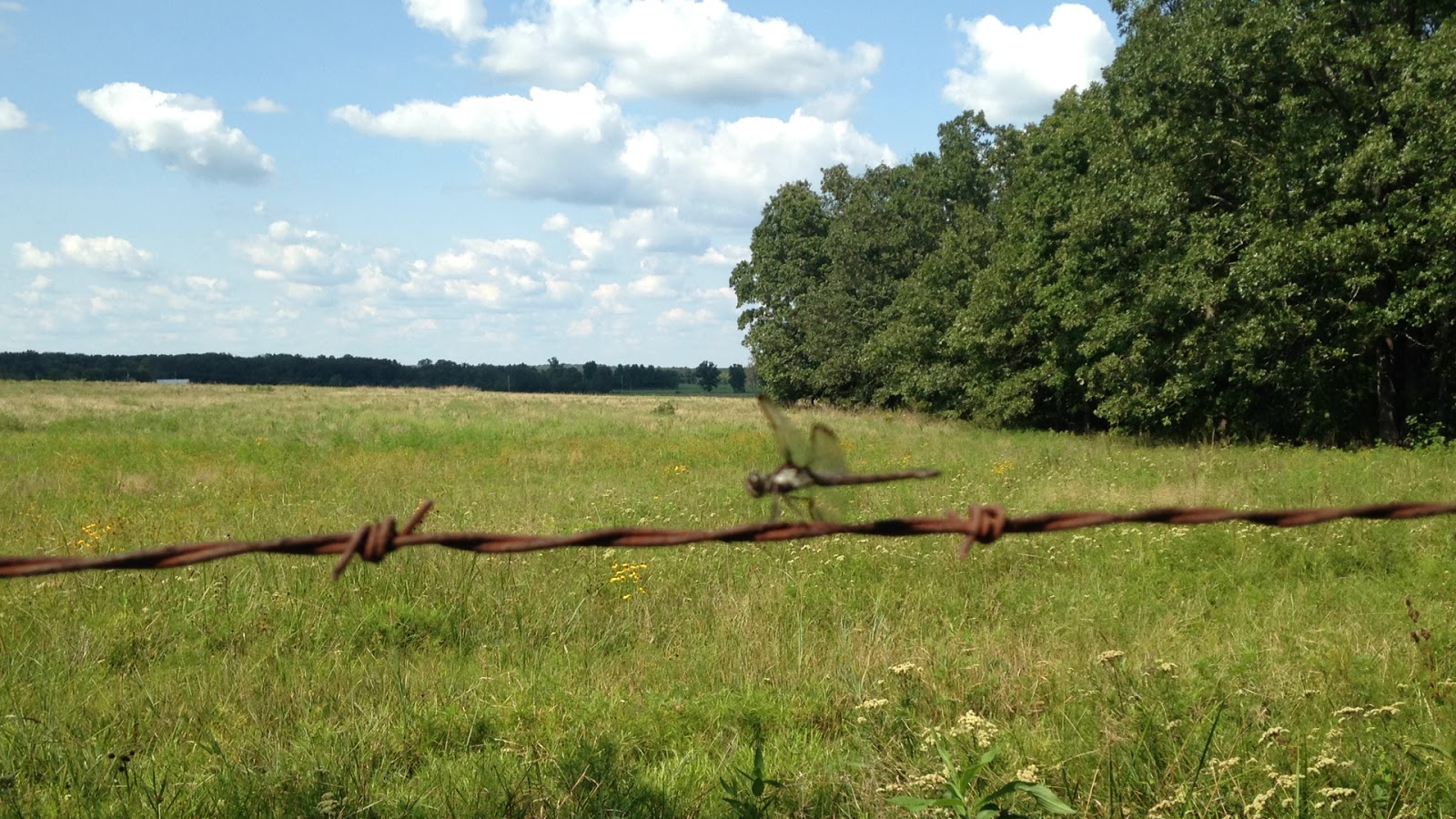
At first, I noticed only the dragonfly, which was bigger and more active than the damselfly. It kept taking off from the barbed wire, only to return over and over again to the same spot.
 |
| Dragonfly in flight |
It would get so small in the distance, then grow back in size as it came in for a landing, making its final approach.
 |
| Dragonfly coming in for a landing |

But it was in almost the same place.
Nobody thinks that because dragonflies and damselflies are so distantly related, they should be kept apart for the purity of their races or cultures. They can hang out side by side, and there is no problem.

You might argue that it is because the two species occupy a different ecological niche -- one preferring barbed wire to perch on and the other poison ivy -- they pose no threat to each other.

But I have seen animals as distantly related as the great spangled fritillary butterfly and the common honey bee feeding side by side on the same flower.
 |
| A bumblebee, a honey bee and a great spangled fritilalry |
And yet if someone suggests that bonobos and chimpanzees might be able to live together if they knew each other well and agreed to the arrangement, some experts frown. And for humans to live in the same environment as either species is verboten. It would be unnatural, they say. Why? Don't you think we evolved in pretty much the same environment? Don't you think we occupy the same niche? Don't you think there are also humans in Africa in a more or less natural setting? You might as well segregate the honey bees from the bumblebees and the damselflies from the dragonflies.


 Posts
Posts


