I am a primatologist who spends twelve hours most days in the company of a thirteen year old chimpanzee named Bow. I am also an editor with Inverted-A Press.
When Bow was little, we arranged his words on menus. So Bow was used to picking out food items from the menu. And for those things that were not on the menu, he used "Something Else". Now Bow can spell any word he knows, but occasionally, when faced with an unidentified food, he says that he wants "Something Else". That's what happened yesterday when I offered him leftover takeout. He called it "Something Else" when requesting it.
Bow gets very excited about the possibility of eating restaurant food. He remembers when he used to go out to eat with us, and he knows where those styrofoam containers originate. The entire dining out experience is evoked by the appearance of those little takeout boxes.
But then at other times, Bow can be very coy about what he wants. When he knows that it's not quite time for dinner and no food is being displayed to him, he will ask me over and over again for other things which are readily available, like his blanket, before he ever admits that what he actually wants is food.
Yesterday, frustrated by his asking for things he clearly did not want, I asked him pointedly: "Bow, what do you want?!"
He paused for a moment as if to think about it, and then answered back with a typical question:
"?נו מה יש" -- "Well, what is there?" -- Meaning -- What is available? What's on the menu?
Unless something is being offered, sometimes Bow does not even bother to ask. Forced choice is sadly a part of all our lives. When we ask people what they want, they will rarely tell us. Instead, they ask what is on the menu. That's why it's so important to list Libertarian candidates by name in the polls.
There is no differentiating core from outer layer.
There is no concern over seeds or less tasty fibers.
Bow likes to examine every part of the apple, to see what is there, but when it gets small enough to slip it into his mouth, he does so, and the apple disappears.
There is only one part of the apple that Bow does not eat: the stem.
When he is done with the apple, Bow hands me the stem.
To many, the apple can be divided into slices and eaten in parts, or even shared among friends. But a little apple is too small for Bow to subdivide. Portion size will vary.
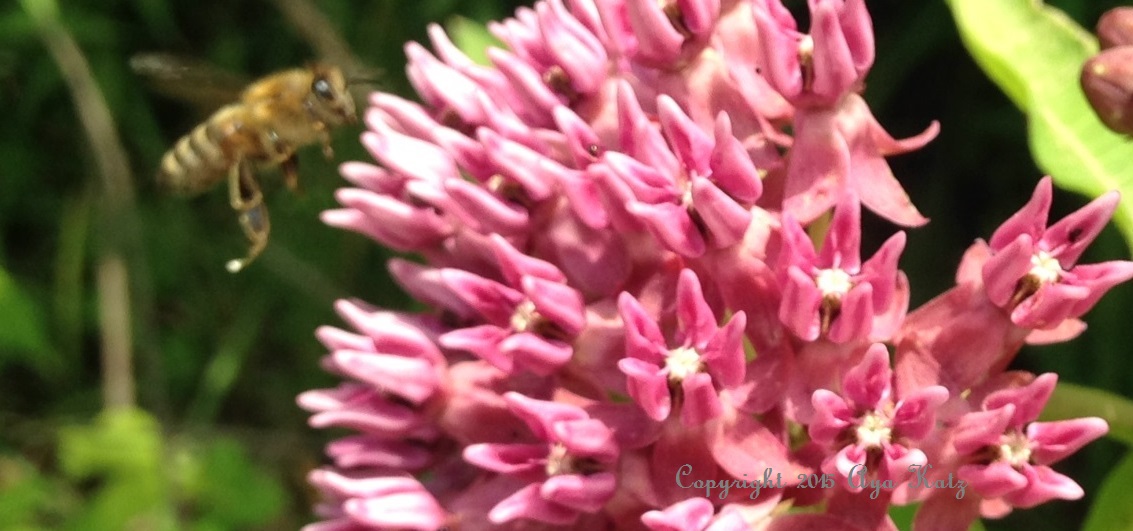
To most of us, the milkweed flower is an indivisible whole, a poof of color in an otherwise drab field.
But to the bee, the contents of each individual floret of which the complex flower consists is the meal being attacked.
The bee can visit more than one floret per feeding, but it can't possibly finish harvesting the contents the whole flower. And this is true even though the bee is bringing food home to the hive, and not consuming it all on the spot.
I have stood there and watched a bee flit from one floret to the next.
But as many times as it comes in for that landing, it still cannot cover the entire flower.
There is enough food in a single milkweed flower for a whole hive full of bees.
One size does not fit all, and the portions you purchase or consume are an individual matter. But there is a movement afoot among government officials to suggest that portion size is something that is immutable and dictated from above.
A couple of recent items made me think of that. One was a picture of a school assignment, in which a math problem was posed: "Luis ate 2/3 of his pizza and Marty ate 1/2 of his, but Marty ate more pizza that Luis. How is that possible?" In a childish handwriting, the student replied: "Marty's pizza was bigger." Then in a green marker, an adult -- presumably the teacher -- wrote: "That is incorrect. Marty could not have eaten more pizza, because 2/3 is always more than 1/2."
Now I don't know if this was a real example of a teacher/student interaction or a hoax, but it would not surprise me if there are teachers who don't realize that pizzas can vary in size. We are fast approaching a world where everything is standardized, and portions are set by the government.
Then there are officials who want to ban super-sized sodas on the ground that they are "not healthy", but if you want to drink that much, you should have to buy two regular sodas. Or the federal regulator who forbade a manufacturer from labeling a low carb snack bar as "healthy" because it had "too many calories."
Portion size varies. How much of anything you eat also varies. How much you need to eat varies. How do the regulators know if the soda or the snack bar are going to be shared with a friend or not? How do they know you won't save some for later? Do they know how big you are or high your metabolism? They don't! It varies.
My daughter and I regularly ask for doggy bags every time we eat out. Yes, restaurant portions seem to be designed for people at least twice our size. But this does not upset us or cause us to waste the food or eat until we burst. We just have the other half the next day, and it makes the meal more economical.
Even a bee knows when it has had enough, and their food is loaded with sugar! Why on earth do they assume portion control is something individual humans cannot manage?
This morning, we ran out of the cereal that Bow and I usually have for breakfast. When I went to pour Bow out a bowl of Oatmeal Squares,after he asked for cereal, there were none left. So I went for the Special K that came in a variety pack, one of those small personal-sized boxes.
Bow didn't like it. He played with his cereal, but most of it remained uneaten. When something like that happens, there's nothing to do about it, but just clear away the full bowl. I can't force Bow to eat it. I don't encourage discarding uneaten food, and had he asked for something else, after wasting the cereal, he would not have gotten it, but Bow did not seem hungry, so he just let me clear without making further demands.
Later on, he asked to go outside. It is still cold out, but not as cold as before, so I agreed. I unlocked the door that leads to the hall that leads to the airlock that leads to the outer pen. Bow went into the hall, and I was following, when I felt something with my bare foot. I looked down, and I noticed there were a few flakes of Special K Cereal on the floor.
"What's this here?" I asked, in a kind of annoyed tone of voice.
Bow came back in from the hall, saw the flakes, picked them one by one off the floor and discarded them in the empty potty. I didn't tell him to do that, and I was a little surprised.
"Okay, then." I said, and we proceeded down the hall to the outside.
The trash can on my side of the inner pen this morning after breakfast
We don't have a trash can on Bow's side of the inner pen, because he's likely to knock it over during a display. We only have the potty, and it took years of work to get him not to knock that over. But Bow understands what trash is, where it goes, and that I get annoyed by crumbs on the floor. So while I didn't tell him to help clean up, he figured out on his own what would make me pleased enough to proceed with our journey to the outside.
Bow did not stay outside long because it is cold
Is that language use? Yes and no. Bow didn't just understand what I said, which was a question about what it was that I felt with my foot on the floor. He also understood how I felt about it, that it was very likely to ruin the possibility of my cooperating with him about going outside, and he understood what he needed to do to fix it. That's more than many an autistic human child would be able to get out of what little I said.
Bow has great insight into human nature, but he still is not trustworthy
Please, don't misunderstand. I am proud of Bow, of his obvious intelligence and his great ability to cooperate creatively with me, but this does not mean that I would trust him enough to leave the door to the outer world unlocked. Bow is Bow. He's cunning, crafty and has his own ideas, that do not always coincide with mine. There's a reason the door from the inner pen does not lead directly to the outer pen. Bow can dance circles around me and around Project Bow volunteers, and I designed it this way to prevent him from doing just that. People get very disoriented by how fast chimpanzees can be. We are slow pokes compared to them, and communicating and cooperating requires them to slow themselves down to our level.
Bow can outsmart me, so I have to stay on my toes
Many people treat chimpanzees as if they were disadvantaged and slightly backward human beings. Sometimes well meaning friends post a meme attributed to Jane Goodall that says chimpanzees are just like us except they don't have language, so we should be nice to them. I don't know if she really said that, but it's wrong. Chimpanzees do have language. Observers so far have not been able to decode it in the wild, because they are so much faster than we are. Just because a fieldworker does not understand the grammar the natives use does not prove that they have no grammar.
But I also disagree with the other part of the meme: that we should be "nice" to chimpanzees. I mean, I disagree with the condescending tone of that statement. Chimpanzees are not underprivileged minorities that we should make charitable donations to and pat on the head and give special privileged status to on account of their supposed disabilities. We should study them, get to know them, respect them and find ways to work cooperatively with them. But we should never underestimate their intelligence, their agility or their strength. Because just like us, they have ideas of their own, and not all their ideas are nicey-nice.
I saw a stunning picture yesterday on Frans de Waal's public Facebook page. ( As it is not my photo, I will not show it here, but you have only to follow the link.) It was a golden eagle in mid-flight, with a knife in its left claw. A photographer had been cutting up meat to lure the eagle, but the eagle ignored the meat and took the knife instead. Smart eagle!
This reminded me of a review article I wrote once about a book on the evolution of language out of pre-language. One of the articles in that book had made the claim that as soon as food was placed before an animal, the animal could not help eating it. It was supposed to some kind of unthinking reflex!
Tell that to a squirrel!
That is demonstrably not true. I gave a long list of counterexamples in my article, from many different families in the animal world.
And now we have the additional example of the golden eagle who preferred a knife over meat. And no, I don't think that particular eagle was a vegetarian! He just preferred the tool to the product of its use.
Why are there so many bizarre claims about food and eating when it comes to attempts to delimit humans from other animals as some kind of special case? And why are there so many other misconceptions about food? I can't tell you, for instance, how many animal rights advocates try to convert people to vegetarianism. "You like chimpanzees," they will say, "so you should become a vegetarian." Why? Chimpanzees are not vegetarian. Why should I be? What is wrong with these people and their reasoning faculty?
Humans are no better than other animals in our need for food, our willingness to kill to get it, or our preying on others. But are we also no worse. We are, after all, just another species. We all like to eat. It is a universal that we share. But we won't eat just anything. We are choosy, unless our choices are severely curtailed. We like fine foods and presentations matters. And when we get a chance to use utensils manufactured by others, we often do.




 Posts
Posts


