Search This Blog

Sunday, August 17, 2014

Life Goes On

Bow spent three days last week with Lawrence, because I was helping my daughter get ready for school. She is a sophomore in high school now, and since Bow is only two and a half years younger, you can imagine that he, too, is getting more mature.

Bow surveying the outside world this morning

In the news, Robin Williams died at his own hand, and Koko the gorilla, who had personally met him, expressed sadness. Then animal rights activists scoffed and said it was shameful that Koko's "handlers" were using her in this way. Some experts on great apes seem to be of the opinion that it could not possibly be true that an ape could express sadness over the death of someone she knew. Is it any wonder that I feel a little wary to report anything that Bow says about anything?

I wonder sometimes whether people think I am Bow's "handler".  Isn't that what they call members of the entourage of an actor or other celebrity? Why would they call someone who lives with an ape a handler? Is it because Koko is famous that they used that term to refer to Francine Patterson? Or is every family member considered a handler?

Of course, Bow never met Robin Williams, and we did not talk about his death. But the cat is still out there and meows in the night and upsets the dogs, and the dogs bark and wake Bow up, and sometimes he overturns things in the inner pen in the dark when he's upset. And then in the morning, when I ask why he did that, he says: "Because of the cat."

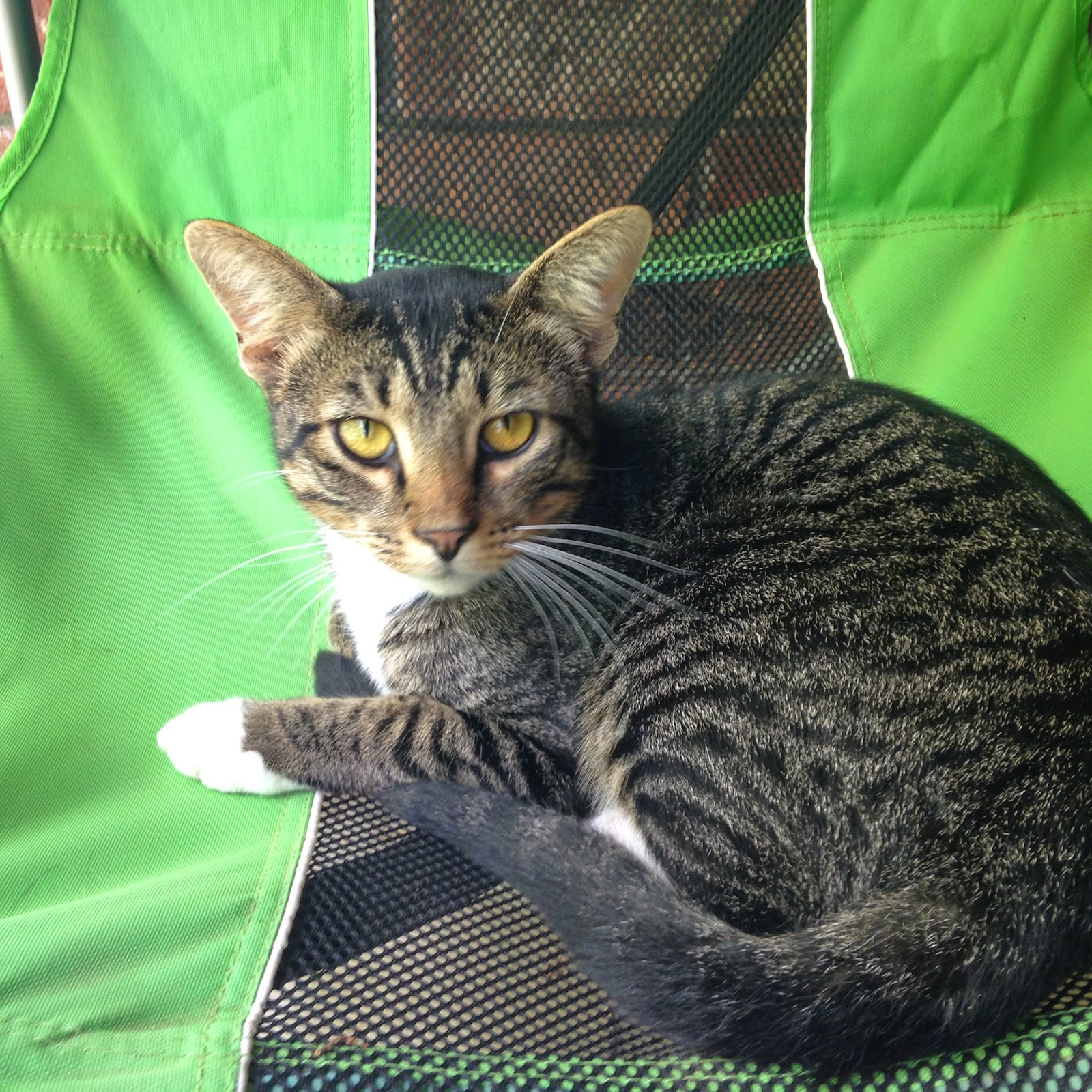
The cat has been making itself at home on our front porch

And then another member of the family says: "It's not the cat's fault. You should take responsibility for your own actions." And Bow has no answer for that.

What Bow says is one thing, and whether it is true is another. Even when a gorilla expresses sadness over the passing of a celebrity she knew, I suppose we can question her sincerity. But they say that gorillas are far more honest than chimps, so chances are, she really was sad.


Brownie and Leo are confined to the back yard in the day and come in at night. But they know that the cat is out there, and it bothers them.


Bow has grown philosophical about it of late. He knows that whatever happens with that cat, his life will proceed as usual. So he has stopped blaming that outside cat for everything that goes wrong in the pens. This, of course, does not mean that he is ready to take full responsibility for his own behavior. However, I know a lot of humans who have the same problem. And life goes on...


Saturday, August 9, 2014

One Out of Many

A violet by a mossy stone,
    Half hidden from the eye,
Fair as a star, when only one 
   Is shining in the sky. 
                                                                     Wordsworth

The lines are from one of Wordsworth's Lucy poems, the only poems that he wrote which were any good, in my opinion. He wrote a lot of other poems with many, many big words in them -- hence the appropriateness of his name -- but the simple heartfelt poems with few words are the ones that I can remember.


Is less sometimes worth more? Do we value what we have better when its very scarcity is what makes it precious? Does a single star in the sky seem to shine brighter? Are people valued more highly when there are fewer of them? Does a large body of work necessarily make for a greater legacy than a single well-crafted poem? If you've only ever taken care of one chimpanzee, does that make your knowledge of chimpanzees less than that of someone who has met fifty of them?


We contacted the person who said they lost a cat to see if the one on our property was theirs, but they said they had had so many cats, they could not say for sure if this was one of them. We then concluded that this was not their cat.


Can you imagine having so many cats that you don't know which are yours and which aren't? To me, that is unfathomable.

focusing on a single flower  from the many in the field

But... it got me to thinking about  other situations when having a lot of something is not necessarily better than having just a little. For instance, some people consider themselves childcare specialists, and they have had hundreds and maybe thousands of children go through their hands, but does this make them any more competent to care for a specific child than its own mother, who may not even have any other children and who may never have more? Some chimpanzee experts are the same way, having gotten to know maybe thirty to fifty chimpanzees during the course of a career. But how well could they know them? How much alone time could they have spent with each?

The moon above the pasture last night

Some people have read thousands of books, and others keep reading the same book over and over again. Which people do you figure have whole passages memorized? Which are more likely to have understood what they read?

The Sword of Solomon, one of my father's favorite childhood books, from which he quoted from memory  as an adult

Variety may be the spice of life, but you cannot go deep if you have too much ground to cover. In a single lifetime, a chimpanzee is not likely to meet more than fifty other chimpanzees, and that's if he's in a large group. The smaller the group, the more intimate the relationships.


Can you really know anyone if you know too many people? Isn't the percentage of time you spend with anyone the true measure of their importance in your life?


Don't get me wrong. I want chimpanzees to multiply and prosper. It's just that they don't all need to be in the same place at the same time. And it's not the number of chimpanzees you have known. It's how much time you have spent with each. I've only known Bow for about twelve and a half years, but I know him really well.


Friday, August 8, 2014

The Cat Returns

Yesterday morning, when I went to prepare breakfast, there was no sign of the cat that had been meowing at my window. There were plenty of rabbits in sight on the lawn, so I figured the feline had gone, for they would not be out cavorting in plain sight with a predator around.

It was cloudy most of the morning. In the afternoon, I went for my usual walk. I saw a rabbit by the fence.


I noticed hickory nuts maturing.


In the pasture, I admired the smooth sumac.


Then I saw a deer in the distance.


I wanted to get closer for a better view, but as soon as it spotted me, the deer ran away.


 In the late afternoon it rained, and Bow reacted with his usual display, answering every thunderclap with a vocalization.


I have long since given up asking Bow why he does this. Other chimpanzees do it, too. It's instinctive. There may be variations in their display, but they will display at the rain, and they don't know why. It's the same thing with humans. If you ask a human why he does something that is hard-wired, he won't be able to give you an articulate, intelligent answer, either. It used to drive me crazy when people could not explain themselves, and one of the things I hoped talking to a chimpanzee would help me with is clearing up some of those misunderstandings. But it turned out that Bow is not more capable of introspection than most of the humans I know.  Living with him has made me more tolerant of my own kind.

All of us have things we do that we can't help doing, and just because we come with those pre-wired behaviors, it does not mean that we don't have other actions that we perform consciously and by choice, things that we are capable of explaining to others. The difficulty, sometimes, is in determining what it is that someone else can't help doing, so that we don't waste time trying to change the unchangeable.  We have to learn not to say: "You're so smart. Why can't you just stop doing X." If X is hard-wired, there is no point even trying.

Everyone would benefit greatly from living with a chimpanzee twenty-four hours a day. There is so much to learn about our own nature from having to put up with theirs. And their generosity of spirit, when we don't judge them, more than makes up for a little inconvenience.

After the rain display was over, when it was time for dinner, Bow was perfectly capable of telling me what he wanted to eat by spelling out the words. The food calls when he saw the food coming were not for me, or for himself. They were pre-wired to give away the fact that there is food to any chimp within earshot, whether Bow wants to share or not.  But there were no chimps within earshot, only deer and rabbits and stray cats.

When dealing with humans, too, it is helpful to mute out the language they use if you want to rely on their tells. The articulated, spelled-out language performs one function, and the body language and unintentional vocalizations quite another.


In the evening, long after I had put Bow to bed, as I was tidying things up for the last time in the kitchen before turning out the lights, the cat returned. It appeared at the kitchen window. My daughter went out and got this picture of it.


Is the cat here to stay? Or is it just passing through? Only time will tell.


Thursday, August 7, 2014

Enjoying the Present and Planning for the Future

Last night, after I went to bed, there was a cat meowing at my window. It sounded so forlorn, almost like a baby crying. But Brownie didn't bark or pay it any mind, and neither did I. In the night, it rained, and there may have been distant thunder, for Bow woke up and vocalized and displayed in the dark. He was safe and sound indoors, whereas goodness knows what may have happened to that cat.

I am allergic to cats, so that cat has no chance whatever of being adopted by me. But I will tell you what I am also not going to do: I am not going to call the authorities on this cat or turn it over to an animal shelter. If it wants to be a feral cat and feed on the rodents on my land, that is all right by me. I am not going to hunt it down, to have it spayed or neutered, nor am I going to insist that it has only two options: to be adopted and neutralized. or to be put to death.

I consider my outlook on cats to be humane. But it is certainly not Humane Society policy. Many people mistakenly believe that the Humane Society (HSUS) is there to help other animals. It's not. Nor is the current "welfare" attitude toward all living things in the best interest of most animals. A lot of very good people are duped by the propaganda, only to find out later that they have been betrayed. A friend of mine who volunteered regularly at an animal shelter to help socialize cats who were unaccustomed to having a home or who had problems relating to dogs, recently wanted to adopt one of the cats she had been working with. The shelter did a home study, and put her through all sorts of rigmarole, to see if she was "good enough" to adopt that cat, even though she had been volunteering there at that shelter for years. Finally, they turned her down. She now says she is not going to a shelter to adopt ever again. If she needs a new animal, she will go to a breeder.

Breeders are not bad people. But there is so much propaganda in the air to make you think that they are, and it is not being done for the sake of other animals. It is done to empower certain people to become social workers "advocating" for animals.

Today it is dark and cloudy and Bow is sleepy. But in the past couple days it was sunny and hot, the way Bow likes it. He spent a lot of time outdoors, sunning himself and vocalizing.


I love his changing expressions as he goes through his routine.


This is self expression. Bow is very uninhibited, and his cries resonate a long distance away.


That kind of vocal power is something many a human singer or orator might envy.  But there are also many quiet moments.

Lawrence is still away, but yesterday Bow met with a few delivery people. He was cordial to each. And in the middle of the day he got a nice surprise: the gift of a peach from a neighbor's tree.


Bow knows how to enjoy and savor every bite.


It's the simple things in life that he appreciates the most.


In the end, when there is nothing left but the pit, he reluctantly relinquishes it to me.


It doesn't make him happy to give up that pit, but he once ate the inside of one, and it made him sick for a day.


So very reluctantly, he gives me the pit and looks away. I am kind of bossy about certain things, but I think I give Bow more freedom, all in all, than he would have anywhere else around here. In the long run, I want someone else to continue in my footsteps. I want to leave a legacy. I am not looking for a way out.

On my walks, I see lots of animals from the tiniest insects to the rabbits and deer. I do not tell them what to do at all. And if they eat something that disagrees with them, it is their own problem.


There are many ways for humans to interact with other animals. Some are hands on, and some are hands off. I do both kinds of interactions. I support other people's right to do the same, choosing the degree of control and responsibility that they take for the animals on their own property.

I would also like to help educate the public to the issues involved. So many people can't see past the labels -- puppy mills, breeders, abuse -- to think about what those words actually mean. They use these labels against other people, and then they are totally surprised and shocked when the tables are turned on them. "Live and let live" is harder to teach, apparently, than some other slogan, like "death to the infidels" or "down with puppy mills." But in the long run, we all benefit from being less judgmental of others and more free to do what seems best in our own eyes.

Tuesday, August 5, 2014

TURTLE TALES

by Pam Keyes, Guest Blogger


Is there such a thing as a “domesticated” box turtle, as compared to a wild one? I don’t think so, even with the ones which are “captive bred” and have been in captivity since hatching from their eggs.


I’ve had pet box turtles since I was a child, and as an adult, I have had them for many years in a backyard pen that takes up one-third of the yard and is situated under a huge mulberry tree. A few of the three-toed box turtles which have lived there have been wild, rescued from the highway or other streets, but most have been indigenous to my neighborhood. Turtles naturally walk into my backyard each spring and summer, up my long driveway into the fenced backyard, after mulberries and other food. Since I did not want to accidentally crush a turtle under the car when I backed up, I decided to protect them by providing a large pen to contain them. Currently I have two adult female box turtles in this pen, plus a male adult box turtle in his own, newer pen to the west of the large one. These three adults are semi-wild, but all three are tame. They do not close their shells and “clam up” when I approach them, probably because they know that I always bring some sort of food for them, whether it’s moist cat food, raw corn niblets, scrambled eggs, or their favorite, blackberries. Usually all I have to do to get their attention is to hit the can of corn on a rock, and they come out of their hiding places as fast as possible to eat.


One might think my turtles’ dependency on me for food and treats makes them domesticated, but that is not so. They still hunt and forage for worms, pillbugs and other insects in the pen, just like they would have done in the wild.


Years ago, I had a friend on a farm who fed wild turtles who lived in the fields near her. She had noticed when she put out cat food for her barn cats, that turtles would occasionally come up and eat alongside the cats, so she began feeding a couple of the turtles twice a day. Somehow this developed into lots of turtles coming up to her back step looking for food, and some were so bold they would eat from the end of a spoon. This was quite remarkable to see, considering these were all wild turtles. They came up twice a day from the fields, in the morning and the evening, like cattle. One time I counted 20 around her mowed yard. None of these turtles were what I would call tame, they were simply being box turtles who were opportunistic feeders. That they had developed a pattern for their opportunism is interesting, particularly since more and more turtles kept showing up for food, like a Pied Piper event.


In addition to the adult turtles, I have young captive bred box turtles who hatched in my pen. I immediately took them indoors to live in tubs with lights, as unprotected hatchlings are preyed upon by many things in the wild, including adult turtles. So are these young turtles domesticated? No. When they get bigger, they can be placed out in the backyard free of any constraint, and can fend for themselves, and forage like any other box turtle. That is because their foraging methods, etc., are instinctual and not learned behaviors. The young turtles are indeed very tame and trusting of humans, but it is not a true domesticated behavior.


Monday, August 4, 2014

The Mowers and the Forecast

Yesterday started out as a very sunny, hot day. In the morning, Bow was pretty happy and content, overseeing his domain from the outer pen.


However, around mid-morning the mowers arrived, and their presence and their noisy machines made Bow feel less comfortable. He went and sat in the corner and rocked at first.


Things were not as they should be, he felt. Something ought to be done about it.


The solution was obvious. It was time to put on a display.


When Bow displays he gets very active, the adrenaline rushes to his brain, and he feels much better.


One display is usually not enough to neutralize the mowers.


Eventually, the mowers finished their work. Bow watched them leave.


Then we went inside. and I let Bow play with my iPhone.


This video was shot on my LG, which was my previous cell phone. The resolution is much lower than on the iPhone, but the up side is that it takes very little time to upload. Even though the LG no longer receives service, it still functions as a camera, an organizer and an alarm clock. 

Bow is fascinated by the iPhone and seems to know what one does with it, but his touch on the screen does not often elicit a response from the phone. If it did work, it could serve as a much better communication device than the old touch screen, because it is portable, and since Bow sees me use it all the time, he wants to use it, whereas he never really wanted to use the computer. Now all we need is a text to speech Hebrew app for the iPhone.

Anyway, this time around, all Bow managed to do was to bring up the forecast, which was sunny. As soon as he heard this, Bow asked to go outside again, presumably to take advantage of the sunny weather. But when we went outside, it was not sunny anymore. The wind was blowing. The skies were cloudy and overcast, and tiny drops of rain were starting to fall. 


"It's not sunny like they said," I told Bow.


 He smiled philosophically about it. He never believed the forecast.


Soon after that we went in, just before the rain started to fall in torrents. 

Rain falls on the newly mown grass in the front yard
They say that our region is going through a drought, but it does not seem that way on my property. The grass is green, the wildlife is thriving, and we have more bunnies than any other neighbor. Maybe the rabbits have done something to keep the rain coming. 


Sunday, August 3, 2014

Observing the Rabbits


With Lawrence away, Bow and I are pretty much on our own, and we are left without too much external company. But people do still come by. On Friday the lady from the store brought over some bananas and some apples for Bow. She also stopped to chat. "I had to be careful not to run over all those bunnies you have on your property," she said. I knew what she meant. The rabbits on my property tend to run in zigzags on the road every time a car drives by. It seems to make it more likely that they will get run over than if they simply moved out of the way, but they have their own reasons for acting that way.


I asked her if she had that many rabbits on her property, and she said that she had a cat, so there were fewer rabbits. But on my land the rabbits are proliferating, and they act in strange and mysterious ways. They don't simply run away when you chase them. They lead you on a merry dance.


The above is a four minute video that I took maybe a week ago, but it took me all day yesterday to upload. There were three rabbits out and visible at the start, but the littlest rabbit ran north, and the other two took turns leading me on a merry chase. Why didn't they just run straight for the woods in order to lose me? What were they actually thinking?

My daughter asked me the other day why I keep chasing the rabbits. Did I want to catch and tame them? No, of course not. I have my hands full with Bow. I want to learn to understand the rabbits, not to possess or to change them.

But, unlike the Animal Rights Activists I know, I don't want to tell other people what they should do with their rabbits. Some people keep rabbits for pets. Some people raise rabbits for meat. Some hunt rabbits, and some wear rabbit fur coats. And I think all of that is okay, if they are doing it with their own rabbits on their own land. What I would dearly object to would be someone entering on my land and doing it to my rabbits.

I think it is great that there are ethologists who study chimpanzees in the wild. What is not so great is when those ethologists declare that chimpanzees should exist only in the wild or in sanctuaries. It is not good at all that these ethologists start dictating exactly what should be done to or with chimpanzees, as if there were only one way to live.

I feel the same way about humans, by the way. There are wild humans who have not yet learned to count. Should we round them all up and force them into a modern school? I think that would be sad. But by the same token, this does not mean that I want to tell all parents not to send their children to school.


There is more than one way to be. You can be a wild rabbit. You can be a wild chimp. You can be a wild human. Or you can be domesticated. Who should choose? Those born wild, should be left alone, unless they choose civilization.

Those of us born domesticated, like Bow and me, need to be left alone to live our domestic life. Unless, of course, we find a way to become wild again.

 Most of us recognize that missionaries and social workers are not always the best influence on indigenous populations. But it is hard to interact with others without interfering. And lots of bad things can happen when cultures clash. When someone from the outside comes and says "Let me help you" one has to be wary. We have to ask, is this help going to make us happier? Or is it going to make us more like him?