Search This Blog

Saturday, May 23, 2015

The Damselfly and Phylogenetic Relationships

Yesterday I came across a beautiful insect in the grass. At first, I thought it was a dragonfly. But on closer inspection I was not really sure. Something about it was like no other dragonfly I had seen.


I got in as close as I could, and I tried to film it, but it was hard to focus on something so small  for too long.


Later, I posted the photo below and asked my friends on Facebook to tell me what this insect was called. Some thought it was a dragonfly just as I had initially believed. But my friend Arle identified it as a damselfly, a close relative of the dragonfly.


Somebody else asked: "Are damselflies like  mayflies?" I answered that they were quite different, as mayflies are in the order Ephemeropteroida, because they are short-lived, but damselflies, like dragonflies,  are in the Odonata order. Arle agreed, He also noted: "They are about as closely related as I am to a rhinoceros." This was a startlingly vivid way to consider phylogenetic relationships, and I think it's a mental exercise well worth the effort.


Every once in a while, someone I know will exclaim that we cannot be more closely related to Bow than Bow is to a monkey, because Bow "looks like a monkey", and we don't. In fact, Bow does not look any more like a monkey than we do, but there is a psychological effect in place that makes us always view ourselves as unique, and anyone who is different from us as more similar to all the others who are different from us. I don't know what this effect is called, but it should have a name.


 All living things on earth are related. Somewhere in the tree of life, you will find our kinship with the ox-eye daisy.

Source: https://upload.wikimedia.org/wikipedia/commons/thumb/1/12/CollapsedtreeLabels-simplified.svg/800px-CollapsedtreeLabels-simplified.svg.png


 But the relationship to the daisy is so very distant, that we might as well not be related at all. On the other hand, the damselfly, the mayfly, the rhinoceros, the chimpanzee and man are all more closely related to each other than each of us is to a daisy. This kinship is formalized by biologists by saying that we all belong to the Kingdom animalia. whereas the daisy belongs to a different Kingdom, Plantae. We're all animals, and the daisy is a plant. So far, so good. Most people can recognize the difference between a plant and an animal, without ever having studied biology.

Can you tell which is the plant and which the animal in this picture?

Most people will also  agree that insects, (Kingdom: Animalia, Phylum: Anthropoda, Class: Insecta) are more closely related to each other than to any vertebrate (Kingdom: Animalia, Phylum Chordata. Clade: Craniata, Subphylum: Vertebrata). We have an almost instinctive sense of how those differences break down, which is why when I saw the damselfly I knew at once it was an insect. I had no need to look that up. Where it gets trickier is assessing relatedness between and among beings very different from ourselves, and maintaining objectivity regarding beings very similar to ourselves.

So the rhinoceros is classified phylogenetically like this:

DomainEukaryota • RegnumAnimalia • PhylumChordata • SubphylumVertebrata • InfraphylumGnathostomata • SuperclassisTetrapoda • ClassisMammalia • SubclassisTheria • InfraclassisEutheria • OrdoPerissodactyla • SuperfamiliaRhinocerotoidea • FamiliaRhinocerotidae • Genus: Rhinoceros
And my friend Arle is phylogenetically classified like this:

DomainEukaryota • RegnumAnimalia • PhylumChordata • SubphylumVertebrata • InfraphylumGnathostomata • SuperclassisTetrapoda • ClassisMammalia • SubclassisTheria • InfraclassisEutheria • OrdoPrimates • SubordoHaplorrhini • InfraordoSimiiformes • ParvordoCatarrhini • SuperfamiliaHominoidea • FamiliaHominidae • GenusHomo • Species: Homo sapiens 
It's all exactly the same until you get to the order! And the mayfly and the damselfly also share everything until you get down to the order, which is where they diverge. They are both insects and so very different from us, but when you look at it from their perspective, they are about as different as a rhinoceros is from a man.

So much for differences. Now let's compare similarities. The dragonfly and the damselfly share an order, Odonata, but they diverge at the suborder. The dragonfly is from suborder Anisoptera, whereas the damselfly is suborder Zygotoptera.

Family Tree of the Order Primates from Wikipedia


But humans and chimpanzees are much more closely related to each other than the damselfly is to the dragonfly, because we do not simply share an order, Primates, but we also share a family, Hominidae  (Great Apes) and a subfamily, Homininae, and a tribe, Hominini. The only thing we do not share is a genus. So yes, we are different species. But much more closely related than a dragonfly to a damselfly.

Family Tree of Odonaraptera from Wikipedia

Most phylogenetic classification presupposes binary bifurcations as you can see in the trees above. But real life can actually get much more messy. The other day I met a man who told me a long story about how his family tree crossed-over several times, along the lines of the popular song, "I am my own grandpa."  This involved marriage and in-laws, but it can also happen with plain genetic relationships. In reality, after humans and chimpanzees split into two groups, it is also known that they continued to interbreed for a period of time, so they may be even more closely related than a simple phylogenetic bifurcating tree can show.

 If dragonflies and damselflies are less closely related than chimpanzees are to humans, why is it so hard for us to tell the difference between the two, whereas we see the physical difference between humans and chimps so clearly?


I think it's the same reason that we tend to think we look very different from all our family members, but an outsider can spot the family relationship very clearly just by looking at us.  I have had complete strangers tell me I look just like my mother, and my daughter has had the same experience when people compared her to me, but we do not think we look anything alike. The differences are what we notice, not the similarities. To see how closely we resemble chimpanzees, we should ask an outsider, someone very different from us, like the damselfly,  how hard it is to tell us apart.

To a damselfly, humans and chimps probably look the same

Friday, May 22, 2015

Transitions

I am bad with transitions. If everything stayed the same in some kind of miraculous steady state called the here and now, I would be fine. But no matter how many changes I have experienced in my life, any time something visibly changes right before my eyes, it throws me.


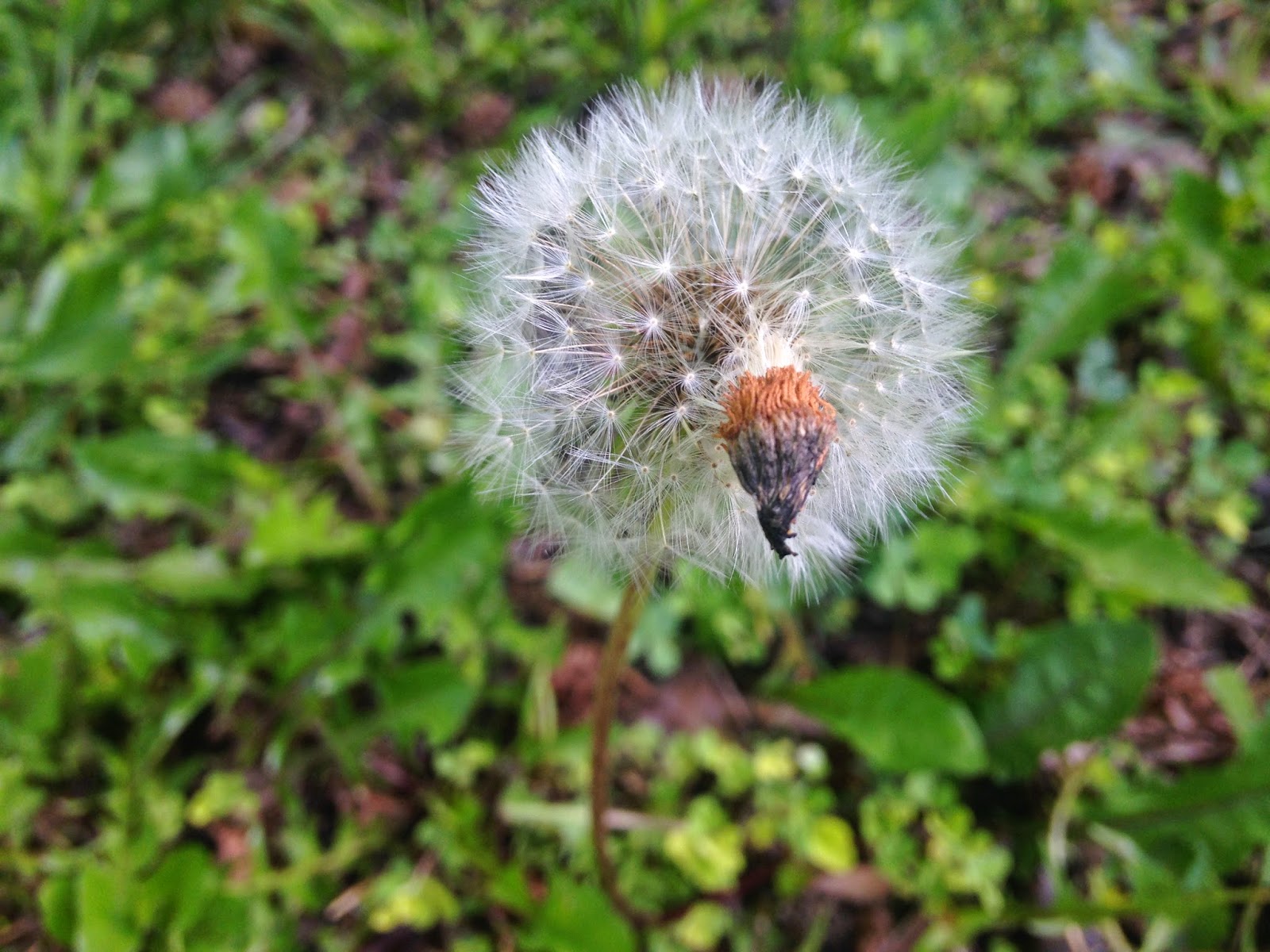
Things change gradually. Most of the changes are so small, that we do not notice them. Is Bow bigger today than yesterday? Is he more mature? I cannot tell. When does the youthful yellow dandelion transition to being a fuzzy white elder? Most of the time you cannot tell, because the moment of transition goes by unnoticed.


But if we do notice a transition in the making and stop to wonder about it, it looks a little awkward.


Yesterday evening, I went to feed the kitten in the barn, but long before I got there, in the distance, I spotted the kitten sitting patiently outside in front of the barn, waiting for me to show up. That threw me so badly that I turned around and went right back in the house.

I took the picture this morning, when the kitten showed me it can go out

Well, to be more precise, I went back to get my camera, so I could take a picture of the kitten sitting in front of the barn. But by the time I returned, the kitten was not in front of the barn anymore. It was meowing at me helplessly from inside the barn, just as it had every day before, as if it did not know how to leave. Was this assumed helplessness an act it had been putting on for me for weeks now, just to get me to feed it?


Mind you, the barn is not even fully enclosed, so there was nothing keeping the kitten from leaving it all along. But just as it seemed unable to leave the stroller at first, later it seemed to be totally unaware that there was an easy way out of the barn.


The barn is where I used to paint along with Sword, while Bow watched us from the playpen. That was when Sword was four and Bow was a year and a half. It's in the barn that I painted most of the illustrations for In Case There's a Fox.


When I have not been looking, the kitten seems to have been rearranging some of the things in the barn and playing with used up paint canisters.


This morning, the kitten waited for me in the barn, but it did not hesitate to show me that it could in fact step over the threshold and into the grass.


At what point should I stop feeding it and expect the kitten to start earning its own keep? I am confused. It looks so tiny and helpless, and if it wandered outside in the field, it would make some hawk a very nice meal. So I feel a little protective seeing it wander outside alone. But on the other hand... how else is this supposed to work? And am I assuming too much about the kitten's age based on its size? How long had it been in the barn before I discovered it? Could it be much older than I think, but small because underfed?


I spotted two daisies in the woods today. One was very tall, and the other was very short, but they both were blooming.


Looking at the daisies, one is tempted to say, "There is an adult daisy, and that's a baby daisy." But I don't think that's how it works with daisies. If they have flowered, then it means that they are both sexually mature. The big daisy must have somehow had access to more nutrients and more sunlight, so it grew big and tall. Or, alternatively, it could have a genetic difference that makes it stay small. Or it could be a combination of the two factors.

They say we should live in the moment and not worry too much about the past or the future. But the true significance of each moment would be lost on us, unless we saw them in the greater context of the moments that came before and the moments to come.


The honeysuckle is just starting to bloom, and its blossoms are white. Bumblebees are attracted to its flowers.


Butterflies flit from flower to flower.


But when I spot a yellow blossom on the same vine as a white one, what does that mean?


Are they different colored flowers? Or are they simply more mature? A snapshot of anything frozen in time -- a person, a country, a language, a culture -- tells us very little. It is the historical context that helps to recognize transitions and interpret trends.

By all means, live in the moment. But no moment is isolated, and the real meaning of it all comes from the historical context. I have yet to understand the history of this  kitten. How did it come to be here? Where is the mother? Were there others in the litter? How old is it and how much does it need my help? When should I start letting go? I will keep piecing the facts together until I figure it out.

Thursday, May 21, 2015

Bow and Fast Food

Yesterday was my day off. I actually only took half a day, starting at 1:00pm, but Sword and I managed to cram a lot into the time we had. Meanwhile, Bow enjoyed his day with Lawrence. He also got to socialize a little with the delivery lady and her daughter. So he had more than his share of excitement, too.

When I returned, I brought Bow a strawberry milkshake from Hardee's. That made him very happy!


Bow knows exactly what to do with a milkshake. For as long as he can, he will slurp it up from the straw.


Then, when that no longer works so well, he will start to use the straw as a spoon, to get out some hard to reach solid bits.


After that, he will try to tip it so that even the last drop of liquid can reach his mouth.


And when all else fails, he even knows how to remove the bubble guard for an unobstructed path into the very heart of the cup.


While we don't have fast food often, Bow is familiar with all the chains, and he even has experience dining out. He has not been locked up all his life. He knows quite a bit about the world outside.

When Bow was little, I used to travel to a linguistics conference every other year, and I took him and Sword with me when I went. Naturally, we could not fly, so we drove, and on the way we stopped by at many fast food chains and  individually owned restaurants. To this day, I still remember the little mom and pop diners as the most hospitable.

When Bow was an infant, I could take him in to any eatery, lying in his car seat and with a blanket covering his person. People were nice. Some even would approach us and ask: "How old is your little girl? How old is the baby?" If the blanket slipped a little and they caught sight of something dark underneath, they probably thought I had a mixed race baby and said nothing about it.

But by the time Bow was a year old, it was already not so easy. And it was not on account of Bow. He was perfectly well behaved, clinging to me when we were out among strangers, and not bothering anyone else. It was just that it was no longer possible to hide the fact that he was not a human. And that's where laws and company policy suddenly kicked into place.

A private person can make case by case decisions. A government entity or a corporation cannot. They have policies in place, and their employees are not free to deviate from those policies. The day came when we were told we could not enter a McDonald's.  We were on the road, we were hungry, we needed to use the restroom, and I could not leave Bow alone in the car. But we were told in no uncertain terms that we were not allowed in, as long as Bow was with us.

I remember some other fast food chain on that same trip where my daughter started crying when we were told we could not come in and eat, and then when we stood outside eating our food, the employees came out and gaped at us and one of them asked me if Bow was mean. Bow was clinging to me, afraid of them. "No, he's not mean," I told the girl. "You're mean!"

We learned to avoid these situations, by going through the drive through and then eating the food at a rest stop,  but at the time, when it first happened to us,   it was a jarring realization. I felt as if we had suddenly gone back in time and were living under Jim Crow.

Mind you, I support the right of private people to discriminate. I think it's stupid, and it does not pay off, but it's their right. It should be their right, if it is their business. If you own a restaurant and you hate redheads and refuse to serve them, then go ahead. See how fast your business goes down in smoke because of your prejudice. But in my experience, it's not private people who discriminate the most. It's government entities and corporations, because their rigid policies can't distinguish between a rabid dog and a family pet, a feral cat and a domesticated one, a dangerous out-of-control chimpanzee and one that is too small and helpless to do anyone any harm. A dog is a dog and they are not allowed. A chimp is a chimp, no matter how small.

So it was a real joy, when on that same trip, we came upon a mom and pop restaurant where everyone was thrilled to have Bow as a diner. We checked first. We asked. And they said: "You have a chimp? Oh, please do bring him in!" And they catered to our every need, and treated Bow as a guest of honor, and when I asked for orange juice that he could drink through a straw, they stood at a respectful distance, delighted to see what a well mannered diner they had at their restaurant.

Private enterprise is a wonderful thing! It's not just for making money. It's also for civility and courtesy and  good will to all. I just wish we had more private businesses like that, and fewer entities protected by government rules. And to the extent that a whole county is against non-human primates, like Greene County, MO or a even a whole state, like Ohio, it's good that there are other counties and other states that can compete with them for residents and tax dollars. The best way to weed out bad laws and bad policies is to keep those laws from being uniform across an entire country. Rather than solving the problems centrally, we should allow local competition to do its work.

Tuesday, May 19, 2015

The Tortoise and the Hare

This is the time of year when all the wildlife seems to come out from wherever they were hiding. The day before yesterday, Bow told me there was something going on in the front yard and encouraged me to go outside and look.


From the yard I could see a deer in the pasture. Then it was joined by another, before they both bounded off.


It has been raining a lot. I missed several walks in the past few days after lunch, because it started to rain just when I wanted to go for a walk. Everything is soaked, even the peony.


Yesterday, to make up for the missed walk after lunch, I went out in the late afternoon when the sun was high in the sky, just before dinner time. It was hot and muggy. The air was full of moisture. On the way to the barn, I saw a turtle moving in the distance, so I went to investigate.


Though the turtle had been moving along at a good pace, for a turtle, it stopped dead in its tracks when it saw me approach.


Evasive maneuvers for a turtle seem to be to stay very still. I was lucky that it did not withdraw completely into its shell.


There were tiny little flies and other insects buzzing right in front of the turtle's head, and I wondered whether it wanted to eat them.


My turtle expert friend, Pam Keyes, identified this as a female three-toed box turtle who is rather old -- at least fifty years old, she said, if not older.


The turtle has had some sort of traumatic encounter with a predator in the past, as there are bite marks on her shell.


I wanted to get to know her better, but really what can you say to a turtle to elicit its life story?


I also wanted her to start walking again, so I could get some footage of that, but it was clear that as long as I kept staring at her, the turtle was not going anywhere. So I decided to walk away for a while to give the turtle a chance to get going. My plan was to come back and film her from behind as she walked away, because that seems to be less disruptive for turtles.


As I walked away, in the direction of the lagoon and the peony, a rabbit caught my eye.


The evasive maneuver of the rabbit is to sit still until you approach a little closer, then to lead you on a merry chase.


The rabbit loves to run in zigzags to try to confuse its pursuer. After it had led me all around a pine tree and zig-zagged across the lawn, it went straight to the fence-line. I decided not to pursue any further, and just go back to check on the turtle's progress. But when I returned to the spot, the turtle was long gone. That fifty year old female box turtle  had taken a lot less time than the rabbit to move on. This reminded me of the fable of the Tortoise and the Hare.


Sunday, May 17, 2015

Interdependence, Independence and Temporary Mutualism

The peony has finally bloomed. Yesterday, by the end of the day, it looked like this:


The black garden ants are no longer attracted to the flower and have moved on. I wrote a retrospective about the whole process, and you can read it here:

http://www.pubwages.com/45/how-the-peony-blooms-with-help-from-black-garden-ants

When I first noticed the black garden ants patrolling the peony flower head, I had not idea what they were doing there. My friend Susan had to point out to me that they were helping the flower to open and were enjoying its juices all the while. This is an example of mutualism. It is also an example of how temporary mutual benefit should work. I find this highly instructive, in view of other insect models we have been cited as something to pattern our lives on.

People take all sorts of examples from nature, and depending on their preferences, try to apply them to mankind. For instance, in another blog I am following, on Mother's Day there was a piece on self-sacrifice using a spider as an example:

http://aliendjinnromances.blogspot.com/2015/05/mother-eating-spiders.html

Yes, there are spiders who offer up their own bodies as nourishment for the young. Some people see this as a heartwarming example of altruism, but personally, I find it a little grotesque. Altruism of this kind is not attractive to me. On the other hand, I  like the temporary mutualism of the black garden ants and the peony. I especially appreciate how there are no hard feelings once the mutual benefit is over. The ants just move on. There are no recriminations: "You used us when you needed us, but now that you don't need us, you're sending us away empty-handed! We feel exploited!"

Instead, perceiving that there is no longer a benefit here for them, the ants move on. The ants have other sources of food. The peony is just one of them. They do not actually need the peony, nor does the peony in truth need them, but both sides benefited immensely from the relationship while it lasted, and all is good.

I think that  ideally employment should be like that. People sometimes want extra money and benefit immensely from having a job. Other people sometimes need help getting a task accomplished, and they benefit from having people work for them. So long as both sides are happy, they should stay in the relationship. But employees should not regard the employer as their only source of sustenance, and employers should not think that they get to have people work for them forever. As soon as there is no longer mutual benefit in the relationship, each party should be able to move on.

The problem is not just that sometimes people think they should have a job, because they "need a job", which is a euphemism for saying that they want money and does not take into account the rights of employers to discontinue a position. The problem is also that employers sometimes think they "need" employees and try to make sure that employees do not have other ways of life available to them.

I think the whole business of penalizing people for living off-grid is an attempt to make sure everybody will always need to be employed in order to pay the bills. That is just as bad as employees thinking they are entitled to a job. "Slavery is a leash with a noose at both ends." Recognize the quote?

Forced dependence of anyone on anyone else is a nasty thing. The essence of the concentration camp is actually such a forced dependence. It goes beyond slavery, to something even worse: uselessness.

http://theodosiaandthepirates.blogspot.com/2015/05/lord-kitchener-inventor-of.html

The maternal relationship is sometimes seen as the model for all other relationships, but people forget how temporary that relationship actually is. Dependence by young on a mother is designed to last only long enough to bootstrap the new entity while it acquires the skills it needs to make its way in life.


Which brings me to the kitten. I am a little worried about the kitten, because I have noticed that when I put the food dish down on the floor, the kitten does not immediately know where it is. It goes all around the dish in circles, until it finally finds where the food is and sets about eating hungrily.  I hope this just means the kitten is inattentive, not blind. It will need to be much more efficient at locating food if it is to become an independent hunter.

If the kitten is not able to learn how to hunt, then it cannot live on its own. In that case, it will have to become owned or die. The case of individuals who can't provide for themselves and will always need help is a special one. To the extent that they are dependent, then they also cannot be free. Sometimes that cannot be helped, But we should not foster universal dependence of all people on all other people.


So what about Bow? There is no question that Bow is not independent right now. He is still an adolescent, so it's not that big a problem, but there is no reason to think that he will ever be independent, The important thing for Bow is to be with someone who finds him useful, so that paying for his keep will not get discontinued.  Unlike other researchers, I do not consider the project over and done with, and I will not stop supporting Bow, no matter what.  But for all the exotics who are currently being confiscated from owners who love them and therefore have a use for them, and are being shut up in government run facilities, the situation is much worse. Even in the so-called private sanctuaries, you have to wonder what will happen when their public funding runs out.

Not every concentration camp is intended to be an extermination camp. Sometimes people really do intend to treat others humanely, only it does not work out this way. I am currently researching what happened in an internment camp run by the Japanese in China during World War II. The Japanese did not intend to starve their prisoners, but as they started losing the war, they could not afford to give them much food. It's not the intentions that count. It's the results.

Here's what I'm really getting at: animal rights activists say that ownership of animals is evil because they liken it to slavery. While I will admit that slavery can be a very ugly thing, it is not the worst thing that can happen to someone. The worst thing is to be thrown into a sanctuary or a camp or a centralized facility where no one can find out what is really happening to you. That is my worst fear, not just for me and other humans I care about, but also for Bow.

Friday, May 15, 2015

Happy News Story and Ordinary Life

There have been no major developments here recently, but sometimes no news is good news. That's because so much of the news is full of sensationalism, and "we had a nice day" is not news.


I did hear an encouraging news story recently, and I will share it with you:

http://fox4kc.com/2015/05/12/runaway-pet-monkey-follows-chillicothe-officers-orders-and-hops-in-patrol-car-to-go-home/

A domesticated monkey by the name of Harley in Chillicothe, Missouri gave its owner the slip and went for a little walk around the neighborhood. A sheriff's deputy, alerted to fact that monkey was missing and had been spotted, found Harley a few houses away from home. Knowing the monkey well from previous meetings, he had a quiet conversation with Harley, and then he asked the six year old Capuchin to get in his truck so he could take him home. Harley complied and hopped into the truck. The officer took him home, and that is the end of the story.

This is exactly how law enforcement and domesticated primates should interact. I love this story, because nobody was hurt, the officer treated the monkey decently and the monkey reciprocated by doing as told, and nobody blamed the owner, and no confiscation or arrest took place. It is such a non-incident that arguably it does not qualify as news. But I'm glad it made the news, because we are constantly bombarded with bad stories to the point where people don't realize this is the normal course of events, and the others are unfortunate flukes.

For instance, every day around here, nothing much happens, even though Bow is a post-pubescent male chimpanzee and all sorts of  self-appointed experts will suggest that there is no way a human can co-exist peacefully with a chimpanzee who is not an infant or a toddler.


Now I cannot report that something spectacular happens here every day, though as a researcher I would like to have more breakthroughs. Like most people,  our family has very routine lives, day by day. There are lots of quiet little moments that do not mean anything in particular to anyone else, but there is contentment, and certainly there is peace.


Of course, we might like to have more in our lives -- an island for Bow and a mate -- and better proof of what he can do. But this does not mean that our ordinary lives are without interest.


The peony is unfurling itself, slowly and surely with the help of the ever watchful black ants.


There has been a resurgence of wildlife sightings on my property. I sat on my porch a couple of days ago and saw both a rabbit and some deer.


Certainly they were cautious and stayed far away, but I am wondering if  Mother Cat is still around watching the kitten in the barn, I continue to drop in on the kitten and offer it food, and it seems to be doing well.


I hope the mother is still around, though, so it can teach the kitten how to hunt. I am not adopting it, so it needs to learn the skills of a free cat. I hope, however, that most of its kills are mice, not rabbits.


There is one rabbit that I keep seeing around, but I don't know how many others remain completely invisible to me.


Sometimes the rabbit seems to wait for me to draw closer before it bounds away.


After the wild roses blossomed, I got to witness a wide variety of bees and bee-like insects enjoying them.


Even the bumblebees have moved on from the tulip tree flowers to the wild roses.


The roses vary in color depending on where they are growing.


The roses deep in the woods seem most pink. But already, some of the roses are starting to fade, and the newest wildflower to bloom is the daisy.


They stand crowded together in the field and sway in the breeze.


I report on all of these developments to Bow, and he sometimes actually sends me off to explore outside, to make sure no one is trespassing on our property. He has a concern about unwanted invaders that he also sometimes shares with Lawrence. Lawrence has told me that many times Bow has sent him out to check that no one was out there. But if the visitor is someone Bow knows, like the delivery lady, he is always happy to see them and spend some time socializing with them.

Bow is very cooperative when it comes to filming. He was relaxing this morning when I wanted to shoot some video of him, and I asked him to look at me. He did, but when he saw I was filming, he decided on his own it would be a good idea to make faces at the camera.


I think the key to peaceful living is getting to know people and developing a relationship. Just like the monkey in Chillicothe, Bow understands language and responds well to people he knows and trusts. A big city would not be a good place to raise a non-human primate, because it contains so many strangers, and you can't possibly get to know them all. That's why so much bad news seems to come out of big cities, especially when strangers confront strangers.

It's not that strangers are necessarily bad, but it's not possible to develop instantaneous relationships with people you have only just met. I think there is a lot more room for misunderstanding in a big city not just for non-humans but for humans as well. Once you know someone, you know what to expect. If they are autistic, or hard of hearing or have some other disability that makes them not respond in the same way as others, you can make allowances for the differences, and things will go smoothly. Even humans do not belong to a cookie cutter array of pre-set behaviors that everyone can predict. Knowing what to expect from each individual cuts down on unnecessary discord. We can learn to make allowances for people we know, and strangers can become friends. But until we get to know someone well, just like Bow, we all tend to be on our guard.

Tuesday, May 12, 2015

Self-Aware and Self-Conscious

There are many pairs of words that ostensibly mean the same thing, with only subtle distinctions of connotation and emphasis. A friend of mine pointed out one such pair yesterday: compliant and complicit. If we comply with a law that we know to be wrong, does that not make us complicit? If we work with enemy does that not make us collaborators?

Another such pair of words is self-aware and self-conscious. The one is seen as a big cognitive achievement, and the other as a psychological problem. Knowing about yourself as apart from others is good. Thinking about yourself and how you look to others, rather than being in the moment, can be a problem. But how can you be self-conscious unless you are self-aware? And if you are self-aware, how do you avoid being self-conscious?.

Bow getting ready to display at the mowers

Bow is definitely self-aware. This makes him self-conscious sometimes. Yesterday, the mowers came to finish the job they had started the day before. They had gotten rained out in the middle of mowing. Bow was anxious to go outside to display at them. But at the same time, he seemed to be  very concerned that I watch him, looking over his shoulder to make sure.


Bow looking back at me to make sure I am watching
                                                         
I had gone back inside, when Bow summoned with the sound he makes when he wants to come back in, but he did not want to come in. Instead he began his display again, at the mowers, but could not help but stop in the middle to look back at me to see if I was filming.


"Yes, I am filming you," I told him. And he turned back to continue his display, but a lot of the oomph  had gone out of it! If you are too self-conscious then sometimes things that just come naturally don't come out as they should. It's like a sneeze interrupted.


This is a problem that flowers don't seem to have. They just go about the business of blooming regardless of who is looking on.


Because they are not self-aware, the flowers cannot possibly be self-conscious.