Search This Blog

Showing posts with label chimpanzee conservation. Show all posts

Friday, August 29, 2014

Ten Generations into the Future

There is a saying attributed to native Americans that any agreement by elders should take into consideration its consequences for ten generations into the future. This means that when I think about what would be best for Bow, I should consider not only Bow, but his children, his grandchildren, his great grandchildren -- all the way down to the tenth generation.

It makes a lot of sense to me, and I think it would be a good rule of thumb to implement for any being for which you have stewardship, whether it is your own minor child or a member of a different species, especially if that species is threatened or endangered.
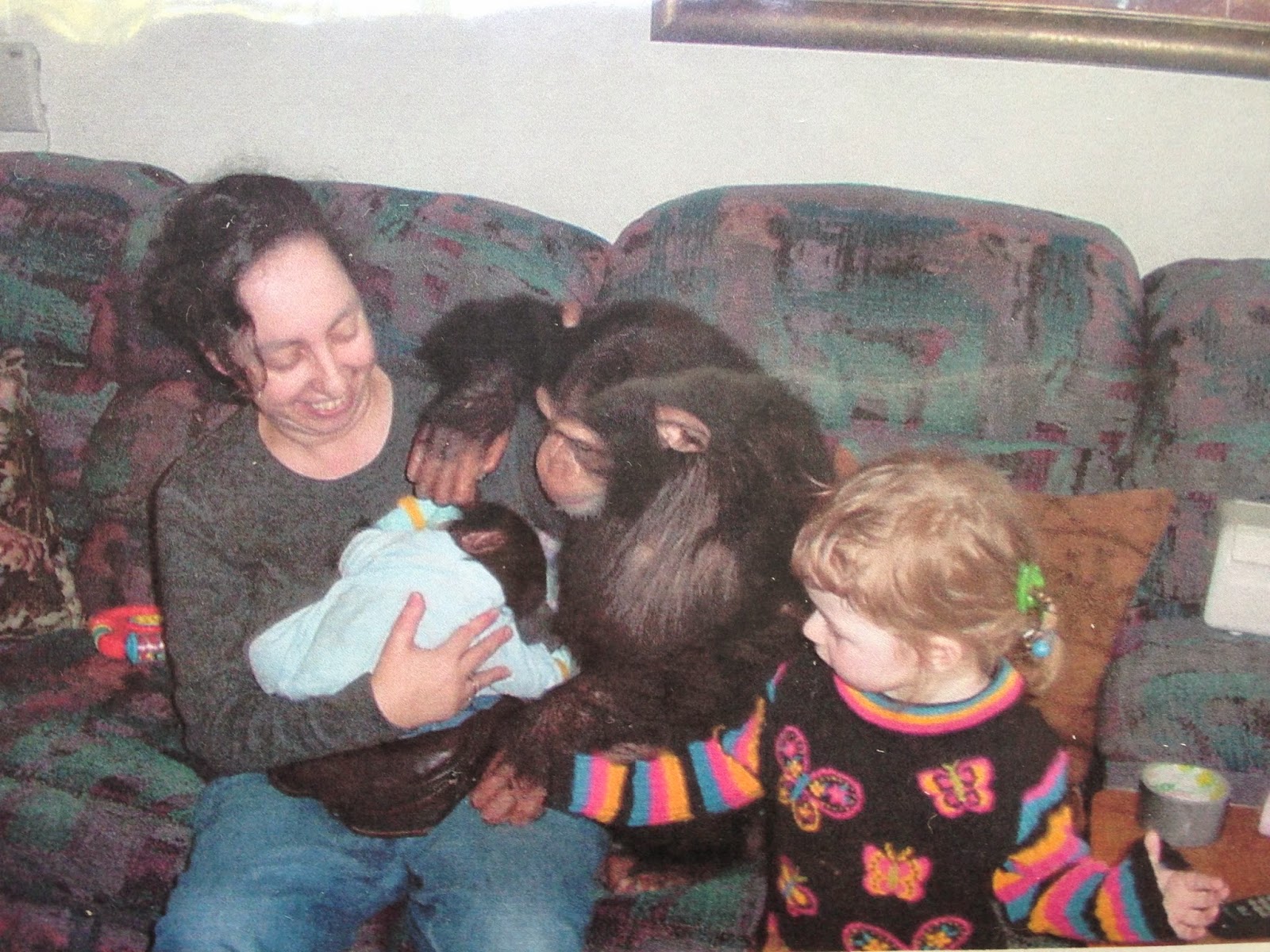
When we came to adopt Bow, Connor was there to show us how to interact with an older chimp
Everybody -- well, almost everybody -- enjoys holding a baby, meeting its needs and forming that deep bond of intimacy that happens only when someone is entirely dependent on you for everything. But the real test of parenthood comes when the child starts showing signs of independence, starts thinking for himself and doing things that don't always seem so sweet or cute.

The breeders know this. That's why they don't allow you to adopt a chimpanzee just based on your ability to bond with a helpless little baby. They want to know that you won't bail out when the going gets tougher. Before I adopted Bow, I was introduced through the glass to some adult male chimpanzees, who hurled themselves at me and made a big point of trying to scare me. When I was first allowed to hold Bow, unbeknownst to me, an eight year old male by the name of Connor was allowed to come into the room to check me and my daughter out. My eyes were fixed on Bow, so that I did not even notice when Connor first came on the scene. But clearly he was there to test us.

Connor was very interested in Sword. He liked her shoes and the decorations in her hair. He offered to hold her hand and walked with her all around the room, and he took off her shoes, and played with her hair. He was very gentle, though, and she did not mind. When asked to give back the shoes, Connor reluctantly did so.


Later Connor was given some baby food to eat with a spoon. Sword even got to feed him some.


We thought we were going there to see the baby we were going to adopt. But there was no question that we would like Bow and that he would like us. The real question was, would we be a good family for Bow when he was no longer so small and helpless. Would we be able to cope with a bigger chimpanzee, like Connor. Or an even bigger one, like the adult males behind the glass.

A Closeup of Bow taken yesterday
Today, Bow is much older than Connor was on that day in 2002. We are still getting along just fine. And I think we will continue to get along when he is an adult. But the question for me is how to prepare for the day when Bow no longer has me to rely on. And any solution I choose, I believe needs to be a solution that is not just good for Bow, but for ten generations into the future.


It's true that now Bow's mobility and options are more restricted than they were when he was little and able to play outside the pens and travel with us to distant states, like New Hampshire.


One criticism that is leveled at people who raise chimpanzees is that after a certain age the freedom that the chimps enjoy as youngsters is curtailed. Knowing that this will happen, people ask, would it not be better not to have adopted the chimp in the first place? Would it not be better to keep them with their own kind?

No, it would not be better. If Bow had been kept with his own kind his entire life, he would have been caged his entire life. He wasn't born free. He was born right here in Missouri.  Isn't it better that he had his freedom for as long as he possibly could, under our current social restrictions?  And if Bow has children of his own, which I hope that he will someday, would it not be better that they have freedom to roam for as long as they possibly can?

They say we should think about solutions which are sustainable. The breeder model is sustainable, because the funding for it comes from people who really want chimpanzees. The sanctuary model is not sustainable, because the funding for it comes from people who have no real interest in chimpanzees and who are largely committed to ending the existence of chimpanzees outside the continent of Africa.


I don't see my role in Bow's life ending with his maturation, though I recognize that as a child matures, the relationship has to change. With our human children, as well, we have to learn to let go and give them more space, though we never stop caring. The big reward for allowing your children to grow up, I am told by people who have been through this, is that eventually there are grandchildren!

There is no shame in liking babies of every kind. It is only wrong to try to keep your children babies forever!  We don't love our children less because we have that special place in our heart for the next generation that comes after. One of the reasons it is important not to infantilize your child or your non-human companion is that an eternal infancy is a biological dead end.

There is a place for grandmothers in the scheme of things.  Grandmothers see past the needs of a single generation. They think about ten generations into the future. I consider myself a grandmother in training.

Monday, May 20, 2013

My Hopes for Bow

Day by day, Bow is a pretty happy fellow. He's safe in his family relationships. He has people who are consistently there for him, and he enjoys good food. Here is Bow eating an avocado at lunch yesterday.


However, I am not unaware that some things still have to be taken care of in order for Bow's life to be fully, completely whole: he needs a place in a social group and he needs a mate or mates. He no longer asks specifically for a girlfriend, and he seems pretty happy with his lot, but I am not oblivious to the issue.

Every once in a while, someone from a sanctuary contacts me, ostensibly because they are concerned about Bow's well-being. At first, when this used to happen, I was hopeful that maybe they would be willing to send  someone of his own kind to keep company with Bow, whether temporarily or permanently. But with time I learned to understand the social reality: they are not calling to give me a chimp. They want to take one away from me.

American sanctuaries for chimpanzees do not allow them to breed. Their purpose is to warehouse what they consider to be a "surplus' chimpanzee population until such time as the last of them dies out, of old age. That they do this in the name of humane treatment is disturbing. That they think of themselves as conservationists is absurd.


My attitude to this question is very different from that of my predecessors in ape language research. Typically, the researchers were people who looked at their research subjects as disposable after the experiment was over. Herbert Terrace had little compunction about returning Nim to the Lemmon Farm, and neither did the Gardners with Washoe. These were ape language researchers who relied heavily on others to raise the chimpanzee in their experiment and did not take on a parental role to their charge.

Typically, the people who really cared about the chimpanzee in question, Roger Fouts with Washoe or Robert Ingersoll with Nim, were not as into the language research. They simply enjoyed the company of chimpanzees, had good rapport with them, and were chosen to work with the chimpanzee for that reason. Later, when they saw how much damage was done to Nim and Washoe by their abandonment, these people were converted from researchers to conservationists. They began to argue that nobody should work with chimpanzees on language again, because it is inhumane.

What was done to Washoe and Nim was inhumane, but not because of the language part. It was wrong to take a child -- any child -- and to adopt and then discard, as if they were only so much equipment once the experiment was over.

My relationship to Bow and to the research is different. Of course, I want my research published. It is a very big breakthrough. But I also care personally about Bow. I am not abandoning him just because he is not a source of funding for me. At the same time, I do see that he needs more than what he currently has. And what I want for him is not only right for him as an individual -- but also is what is the best possible hope for all chimpanzee kind.

When we read about Nim and Washoe, in the books written from the perspective of the Jane Goodall Foundation -- and let's face it, all the recent books have that bias -- we are taught to look down on the researcher, to root for his conservationist lowly assistant, and to despise and loathe as if he were a demon the breeder who made the experiment possible in the first place. We read about the horrors of the Lemmon Farm, and we conveniently forget that if not for the Lemmon Farm,  Nim would never have even existed and Washoe would not have had a place to go. Nim was not stolen from Africa. He was made in America. Washoe, though African born, was given an opportunity to become a mother on the Lemmon Farm. That the Lemmon Farm was a less than ideal place is unfortunate. But this should not cause us to vilify all breeders.

By all means, let us support true conservationist efforts in Africa, to the extent that they allow chimpanzees to live free. But this does not require us to forget American chimpanzees and their right to full lives and to a future in this country, living among humans.