I am a primatologist who spends twelve hours most days in the company of a thirteen year old chimpanzee named Bow. I am also an editor with Inverted-A Press.
When Bow was little, we arranged his words on menus. So Bow was used to picking out food items from the menu. And for those things that were not on the menu, he used "Something Else". Now Bow can spell any word he knows, but occasionally, when faced with an unidentified food, he says that he wants "Something Else". That's what happened yesterday when I offered him leftover takeout. He called it "Something Else" when requesting it.
Bow gets very excited about the possibility of eating restaurant food. He remembers when he used to go out to eat with us, and he knows where those styrofoam containers originate. The entire dining out experience is evoked by the appearance of those little takeout boxes.
But then at other times, Bow can be very coy about what he wants. When he knows that it's not quite time for dinner and no food is being displayed to him, he will ask me over and over again for other things which are readily available, like his blanket, before he ever admits that what he actually wants is food.
Yesterday, frustrated by his asking for things he clearly did not want, I asked him pointedly: "Bow, what do you want?!"
He paused for a moment as if to think about it, and then answered back with a typical question:
"?נו מה יש" -- "Well, what is there?" -- Meaning -- What is available? What's on the menu?
Unless something is being offered, sometimes Bow does not even bother to ask. Forced choice is sadly a part of all our lives. When we ask people what they want, they will rarely tell us. Instead, they ask what is on the menu. That's why it's so important to list Libertarian candidates by name in the polls.
I am beginning to wonder whether the difficulty in finding a simple answer to the identity of the beautiful new flowers in my pasture is not in part due to issues in speciation. At this point, it is clear to me that the new flower, Something Else, is more closely related to the Prairie Rose than to the Missouri Primrose, due to the number of petals, the thorns and the leaf shape. But that does not mean that it is identical to the Prairie Rose.
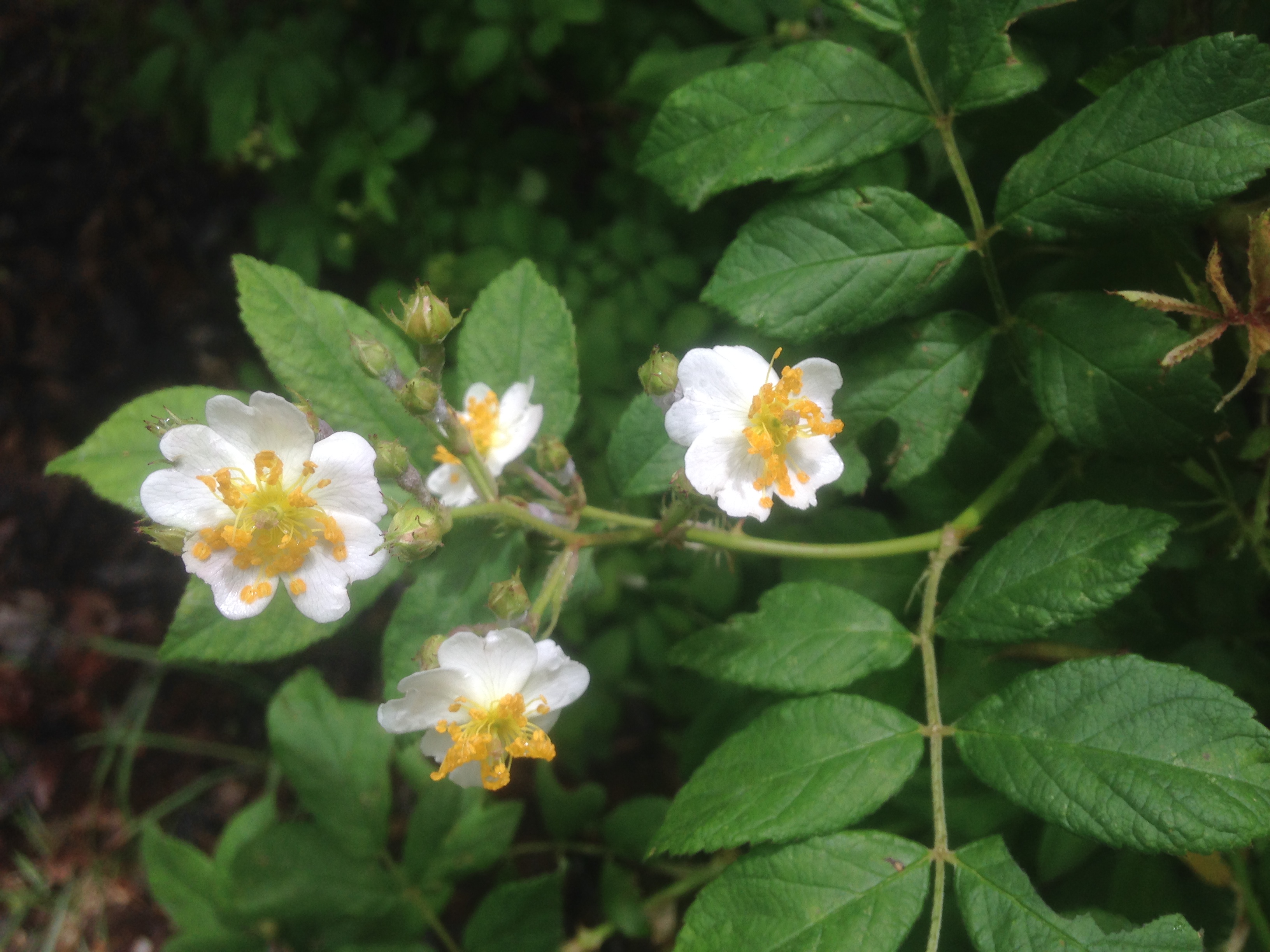
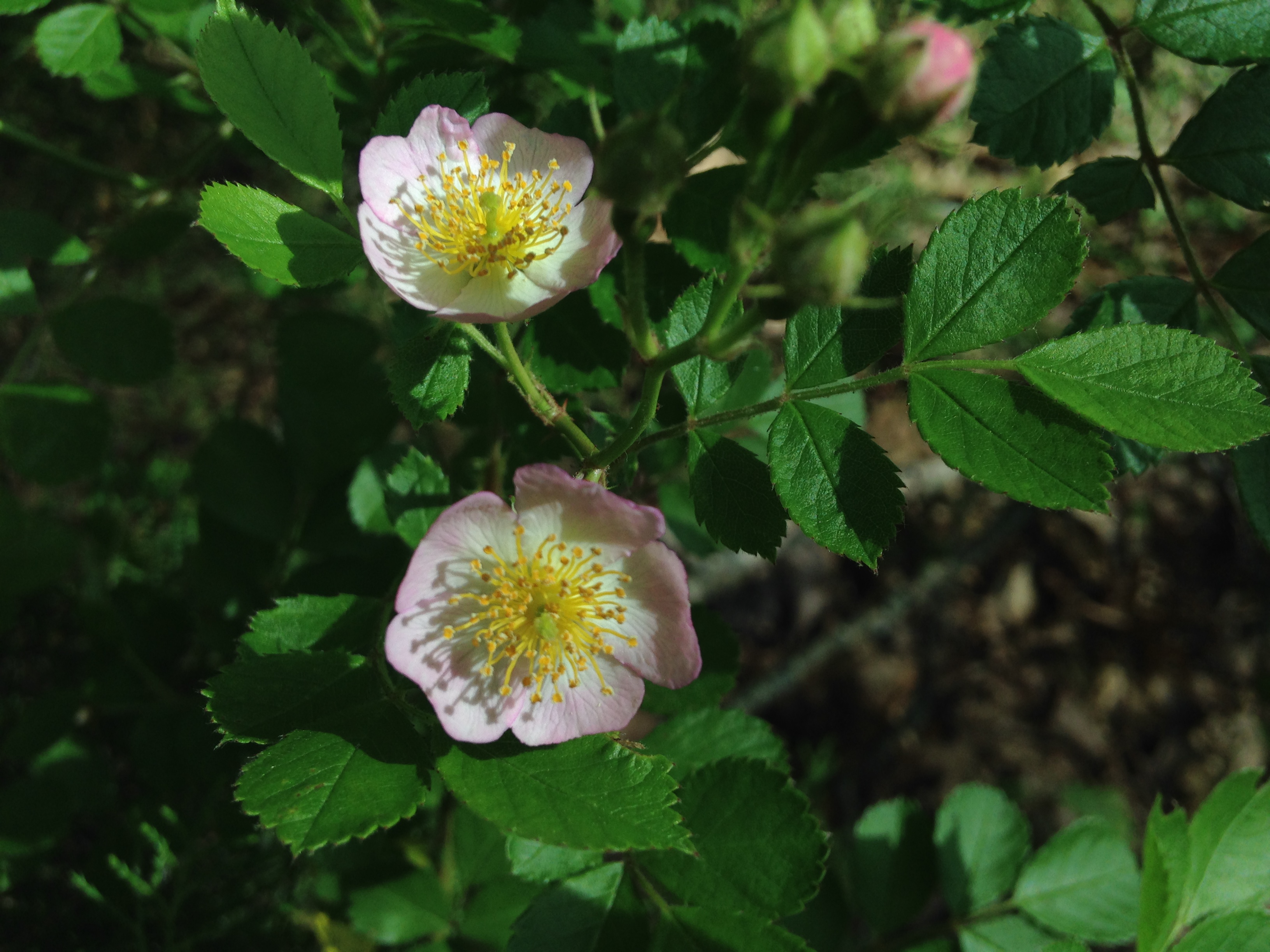
When the new flower first blossoms, it looks like the picture above. But when the Prairie Rose first blossomed on my property, it looked like the picture below.
After the Something Else flower has had a chance to spread out its center, it looks like the picture below.
The appearance of the center of the Something Else flower changes after the first day
The color seems to deepen with time for the wild roses as their center becomes more defined, too.
Wild roses in the woods with the bloom at its brightest
The most important differences are not the color. My wild roses do come in a pink variety that looks remarkably like the new flower. But notice the following more formal differences: the flowers are smaller than the leaves on the wild rose, but not so with the new flower, and they are smaller than the new flower, and they bloom in clusters, and they are on bigger bushes and they have a different blooming season. The wild roses are almost all withered away, and the new flower is just now at its most beautiful.
The New Flower When it is More Mature
Compare our new flower, aka Something Else, above, when it has its deepest color, to the wild roses at their peak.
The Wild Roses in the Woods When in Full Bloom
You can see a definite resemblance between the wild roses, aka Prairie Rose, and the new flower, aka Something Else. They are clearly related. But they are not at all the same. Yet so far I have not been able to see any clear listing for this species on the official sites identifying flowers. Sometimes we see Prairie Rose identified with a picture of what looks like my wild roses. Sometimes it is a picture that looks a little more like Something Else. Could they be some kind of natural hybrid -- an example of imperfect speciation? Take this turtle that I saw just before sunset yesterday.
Looking at this turtle in the harsh light of the setting sun, I was sure it was a box turtle, but a little less certain as to whether it is a three-toed box turtle or an ornate box turtle.
So I consulted my turtle expert, Pam Keyes, for an identification. Here is what she had to say:
This may be a cross between three-toed and ornate. It is a female, middle age range, around 20-25, with some shell damage from predators.
The three-toed box turtle (terrapene carolina triunguis) and the ornate box turtles (terrapene ornata ornata) are two different species. But nobody told them that! So they happily interbreed whenever they meet, species boundaries or no species boundaries. This is the sort of boundary crossing that makes the lines that biologists draw a little less than the absolute truth.
A Common Chimpanzee (pan troglodytes) that I happen to know
We all know the story we have been told about hybrids. A horse is horse. A donkey is a donkey. A mule is a cross between a horse and a donkey, but it cannot reproduce, so it's a dead end, and that's the story of hybrids. But the real story is a lot messier than that. Species break off from one another for many reasons, not the least of which is simply separation by distance. They start to look different when different individual members of particular lines can reproduce only with each other. But if they happen to meet, though there are visible differences, the different groups still can often interbreed. This is what happened when humans and chimpanzees first broke off from each other. They still continued to interbreed whenever they happened to meet. And it is probably also the case for bonobos (pan paniscus) and chimpanzees (pan troglodytes) if they get the opportunity.
Which brings me to the identification of our problem rose, Something Else. Could it be so closely related to the Prairie Rose that cross pollination can occur? Is it a hybrid? And if so, a hybrid between what and what?
When Bow was a very little fellow, and we were still using lexigrams, he had menus for food that would go something like this: "BANANA, GRAPES, APPLE, JUICE, MORE, ENOUGH, LATER, SOMETHING ELSE". We had to include the label "SOMETHING ELSE" because while we were doing language research, we were also just a family, eating whatever foods happened to be available that day. and I could not always print out a new menu every time a new food was introduced. We would verbally tell Bow what the food was called, but if he wanted it at that meal, he would point to "SOMETHING ELSE."
In the stand up menu on the table the top right corner says "SOMETHING ELSE"
משהו אחר
To this very day, if Bow is too lazy to spell out "What is that called?" he will just ask for "something else." It means "that thing that I don't have a name for". Bow remembers the good old days when he used to eat in the kitchen and point at lexigrams. In fact, that's what he misses the most about his childhood outside the pens. It's not our long walks in the woods or the trips in the car that he longs for. He wants to eat in the kitchen. The one time he was out of the pens briefly after his confinement, he headed straight for the kitchen and swiped a muffin. And when he complained to me early on about being locked up, what he said was: "Let me eat in the kitchen."
Bow looking over the fence on a wet day
These days, Bow is quite resigned to our living arrangement, and when I go on my long walks, he also surveys the property from his perch atop the bench on the outer pens.
Lately, I have been seeing these flowers all over the pasture, and some friends assure me that they are Missouri Primroses. But when I look up Missouri Primroses, they don't look the same. They don't even have the same number of petals. So until I know what they really are, I am going to just call them Something Else.
Now the blossom itself resembles a wild rose or a prairie rose, having pink petals and a yellow center, but it is bigger than the wild rose blossoms that we have all over my property. It can't be a Missouri Primrose because those flowers have four petals and a different center. But it is also not a Prairie Rose, even though the blossom is very similar, the body of the plant is not.
These flowers grow in ones and twos and can be seen all over, and the only time they do not have five petals is when they have been damaged, because something has eaten some of their petals.
There are many insects that like these flowers, and not all of them are pollinators.
The flowers are so pretty now. They seemed to have increased their color saturation in the past twenty-four hours, because they started out pale pink, but now they are bright pink almost to the point of lavender.
Until I know what they are, I am going to stubbornly insist that they are Something Else!
So far, I do not have this problem when I see a rabbit. I do not ask myself what kind of rabbit it is. But I would feel kind of gauche reporting that I saw a flower today, as there are so many obviously different kinds of flowers that I see every day.
I need a good way to distinguish a daisy from ... well, from something else!






 Posts
Posts


