I am a primatologist who spends twelve hours most days in the company of a thirteen year old chimpanzee named Bow. I am also an editor with Inverted-A Press.
After the last rain storm, the Great Spangled Fritillary butterfly returned to the purple milkweed with frayed wings. There was no one there willing to mend them, so the butterfly just proceeded with its work, regardless of the injury.
How much money is any person's life worth? More than he himself can earn in a lifetime? More than the people who love him can earn? More than the entire Gross National Product?
A meme I have seen making the rounds: "Nobody should die just because he does not have enough money to pay for medical services." But what if the price of medical services is skyrocketing precisely because of this attitude? What if the price of anything is dependent on supply and demand? And what if an unlimited demand creates a very expensive supply?
Right now the demand is artificially unlimited. Unlimited by the financial means of the individual patient, unlimited by the means of the employer, unlimited by any factor in economic reality, the price of medical services has got no natural check on it.
Have you ever considered that the deeper the pocket the medical establishment has to dig into, the more medical services are going to cost? It's all a matter of supply and demand. If doctors and hospitals know that nobody is ever going to say "No. That's more than this life is even worth" -- then they will keep charging astronomical sums that no individual could possibly pay.
The other night, an old friend called me with this dilemma: He and his wife had taken their sick dog to the vet for treatment. The vet charged them ten thousand dollars. They paid it. Then it turned out that their dog was dying, and my friend wanted to take her home, so she could die peacefully among family. But the vet said they still owed four thousand dollars and would not let them have the dog back.
"How much money do you think your dog is worth?" I asked my friend, trying to get him to see that these vet bills just did not make any sense, from an economic standpoint.
"But we love her!" my friend replied.
Right now, people are being told that before they acquire a dog, they need to get medical insurance for their new pet. But isn't it the existence of medical insurance for pets that creates such inflated bills in the first place? Then we hear of people abandoning their dogs in old age, and they are accused of being heartless, but nobody taught them how to deal with a dying dog or a dying human. You make them as comfortable as possible, you stand by them, and you offer a way out if it gets too painful. But you don't go bankrupt in the process. Because after death, life still has to go on.
In nature, a life is worth only as much as it can bring in. Take the Great Spangled Fritillary after a storm. Who will repair its damaged wings?
There was another storm after I shot the footage of the frayed butterfly. When the sun came out again, only the bumblebee returned to the purple milkweed flowers.
It's raining this morning, and it is dark and murky outside. But yesterday was a sunny, warm day, and I went for many walks on my property.
I was going to invite my readers to go hiking down the trail with me, but then I remembered that I can't seem to upload longer clips any more, so I settled for a full turn that allows a view in every direction. This is the five acre plot of land that could become Bow's island someday. It is full of rich vegetation and is well on its way to becoming wooded, but it is still just a savanna at the moment. Perfect for chimpanzees.
Bow on the blooming dogwood tree in 2005
One of the things I used to ask myself, and still do sometimes, is how would the trees and shrubs and flowers in my pasture survive the onslaught of the destructive forces that Bow would unleash. I used to limit Bow's time in the backyard, because I worried that if I left him to play unchecked, he would destroy the dogwood tree. He used to break off branches as if... well, as if they grew on trees! And I kept thinking: "We only have one dogwood tree. Who knows how long it took to grow to this size! I can't let Bow destroy it. We're not rich."
My Maternal Grandparents, Sarah & Isaac Minkowitz
I had grown up with the idea that trees are rare and expensive and took a very long time to grow and needed massive cultivation. My maternal grandparents were farmers in Israel. They made the desert blossom by the sweat of their brow. With that example in mind, I tended to think of trees as a very expensive commodity. But have you ever asked yourself how that land of milk and honey had come to be a desert in the first place? Could it be because that was the cradle of civilization and the spot where agriculture first flourished in place of the nomadic herding life?
Sword (right) and a friend in walking down the path in the pasture in 2005
I also believed that European settlers were guilty of cutting down forests in North America, and that what we needed to do was plant more forests. How naive I was! The Europeans prevented forest fires and caused the savanna to be replaced by forest. But the fact is that it was four years into my ape language experiment, and I had been keeping my pasture unmown, and yet no trees were growing in it. See the picture of Sword and her friend walking down the path? I was still thinking at the time that maybe I needed to plant a few trees in the pasture!
Bow and I 2005
Bow played outdoors every day, but he spent most of the time riding on my back indoors, where he could do the least amount of mischief. In the picture above, you can see that Sword and a friend were playing hopscotch out in the back yard, in the area where the outer pen now stands, while Bow and I are in the sun room, which is now the inner pens. I was protecting the environment from the destructive force that Bow is! I was afraid no tree would remain standing if I let him play out there all day. And trees cost money, right?
Mulberries growing on a tree in our pasture yesterday (June 2015)
Fast forward ten years. Trees planted themselves. Right now in the pasture, there are mulberries ripening on branches of fruiting trees that I never planted and never watered, never sprayed against insects and never shooed the birds away from. And yesterday, in that pasture, I picked a few berries for myself.
What would happen to all the new trees in the pasture if Bow lived there? Would he denude the land and leave it sandy and bare, the way the fertile Middle East became a desert once agriculture was practiced there for a while? Would he create a new Dust Bowl where he lived, the way the American farmers did in the Great Depression because they were growing too much wheat to sell to Europe? Just maybe, by cutting down some of the trees, Bow would actually be making a valuable contribution to his ecosystem. He would be ensuring that the savanna would not turn into a forest. Because it's not supposed to be a forest, it turns out. It's supposed to be only moderately wooded. There should be tall grasses growing and waving in the breeze. Who knows, maybe even poison ivy!
Milkweed growing freely in a field of poison ivy
What if everything the conservationists have been telling us is wrong? What if they are actually infected with the protestant work ethic, which suggests that it is by the sweat of our brow that we make a paradise out of a desert, when in fact the sweat of our brow makes deserts out of paradise?
A Great Spangeled Fritillary Butterfly enjoying the milkweed
I have been obsessed with the milkweed flowers and the butterflies lately. What especially confuses me is how people tell me we should plant milkweed to help the Monarch butterfly, because that is all the Monarch caterpillar can eat, and the Monarch butterfly will go extinct if we don't help it. But what exactly is the Monarch butterfly doing to help itself? How come I never see it sitting on the milkweed flowers and pollinating them? How come it leaves all that work to the Great Spangled Fritillary Butterflies, the bumblebees, the honey bees, the beetles and the nameless bugs that I have observed there? Every insect I know enjoys the milkweed bloom. But not once a Monarch!
The one time I spotted a Monarch, it flew in circles, mocking me, and did nothing to pollinate the milkweed. Freeloader! I wanted to shout at it. After all, if all it does is eat the flesh of the milkweed and expect other people to grow it, what is the Monarch's contribution to the ecosystem? Why is everyone so concerned that it might go extinct? Who cares? It's not like the honey bee (and all the other kinds of bees) that we need to pollinate our fruit.
A honey bee on a milkweed flower
And then it struck me: maybe the Monarch butterfly is just like Bow! Maybe it's supposed to keep the milkweed population in check. Maybe destroying milkweed plants is the Monarch's job. Ask not what your ecosystem can do for you, ask what you can do for your ecosystem! What if we are each designed to do whatever it is we do best? And what if destruction is just as important as creation in the cycle of life?
Bow lounging around this morning while it rains outside
When Bow was little, I used to have these arguments with my interns about whether Bow was creative or destructive. We would give him a toy, and he would tear it apart, and the interns, always politically correct, would say: "Maybe he's not destroying. Maybe he's creating something new." But he didn't build something new out of the ashes of the old thing. He pounded it till it was pulverized! He smashed it to smithereens!
A Painting I created to Taunt Vegetarians
And maybe that's not always such a bad thing. Maybe we are not all supposed to be creative. Maybe we are not all supposed to conserve every little thing in our environment, like packrats. Maybe forest fires and locusts and plagues and chimpanzees serve a purpose, too! Maybe if we just let things sort themselves out, it will all work out for the best.
We are surrounded by conservationists who are vegetarian. But if they really want to conserve nature, why don't they acknowledge the part that one creature preying on another plays in the natural cycle of life? Why do they sound like farmers when they tell us we should plant trees to save the animals and milkweed to conserve butterflies -- and why won't they ever just leave well enough alone? They make taking care of trees and butterflies and wildlife sound like welfare work. Like we are supposed to feel sorry for the wildlife and plant trees to assuage our guilt. But in paradise there is no guilt. There is only pleasure and internal compulsion to make everything work. And with no central planner.
Late yesterday afternoon, I came across an odd looking turtle. At first I thought it must be very young, because it seemed somehow unformed.
I could not understand what was so odd about it. It seemed as if someone had forgotten to fashion part of its face. All I could think of was some lines of Omar Khayyam as translated by Fitzgerald:
And strange to tell, among that Earthen Lot
Some could articulate, while others not
And suddenly one more impatient cried:
"Who is the Potter, pray, and who the Pot?"
On one side of its face it seemed perfectly normal.
But if you looked at the other side closely, you could see there was nothing where the eye should be.
How did this happen? How could the turtle survive when it could not see anything from one side?
My friend Pam says this is a male who is about thirty years old. From the domed, pyramid-like rear of the shell, she deduced the turtle may have been kept in an aquarium as a pet for some portion of its life. I felt a little sorry for it, so I went to get it some food, but by the time I returned it was gone. Even with its disability, the turtle was not looking for a handout.
Creatures in nature are as tenacious and stubborn as a Great Spangled Fritillary butterfly clinging to a milkweed flower in the wind. They know what they are supposed to do, even though they never consider how it fits into the great scheme of things. I was told as a child that I should not pick the flowers, because what if everybody did that? But maybe we're not supposed to consider what would happen if everybody did what we do -- because not everybody does! Not everybody is a turtle. Not everybody is a flower. Some creatures are born to build, and others are made to destroy. And it all comes out all right in the end, if you let it.
Conservationists are so busy worrying about species losing their habitats, that they sometimes forget to ask what the species contribute to the ecosystem they depend on. If we really believed in natural balance, though, we would not be too quick to intervene.
I had been so preoccupied with the milkweed plants in the field all day yesterday, that I almost forgot to check whether the yucca had bloomed. So it was past sundown when I finally went to see. Sure, enough, it had, and already there were bugs crawling all over the flower. Should I do something about that? No, I don't think so. I think I will let it sort itself out.
When I was a young girl, I wondered about many things. One of them was apes and language. Another was artificial intelligence. What I had trouble understanding, in both cases, was the psychological hurdles to success.
I mean, you can teach an ape language. In fact, you don't really need to teach it at all. They pick it up. But then proving it to your fellow man is very, very hard. Why? Because the ape does not care to prove it. He doesn't cooperate. He won't help. He does not really care if anybody thinks he is smart. He's pretty happy with himself, either way.
The psychology of learning, and especially of proving what you have learned, is something that humans are still working out. For instance, among humans, there is a gender gap, according to a recent article in the Atlantic. Girls are hard workers with great organizational skills who like to be graded on their effort, not their ability. Boys hate to be forced into work, but they will gladly rise to the challenge of a test, in which they try to prove how smart they are, not how hard they worked preparing for it.
But is this really about girls versus boys? Or is it about different types of people, some of whom are compliant, but unthinking and others of whom cannot be motivated to comply for a bribe, because they would rather think for themselves? Isn't it just that there are more girls in the one camp and more boys in the other, so that the unusual girls are discarded as outliers?
At this point, you're probably saying, yeah, that's what it means that boys are different from girls, that most boys do this, not all boys. That most girls are like this, not all girls. But what about a class full of girls? Would they all work equally hard? Would they all rather memorize than think? And does it matter what culture they belong to?
In my novel Our Lady of Kaifeng the American teacher, Marah Fallowfield, is shocked by the degree of teamwork, compliance, hard work and memorization that her students are capable of, and at how they refuse to think for themselves. It is an all girls' school, so it is not a matter of gender norms. Instead, all the girls in her class are Chinese, and they come from a culture that places a premium on obedience, self-abnegation and collective achievement. rather than on individualism and self-motivated action.
The United States is heading in the same cultural direction at the moment as China went years ago, which is why the more compliant and submissive students are getting better grades. We are rewarding thoughtless submission in the form of grades, and so more compliant people are going on to college. As it happens, more of those people are women.
But you don't have to be some kind of genius or rebel to see which classes in high school have actual content and which involve mostly memory work. Even students who don't excel academically can tell that some subjects require more understanding and less studying, while others you cannot get by with anything less than memorizing the study guide word for word in order to pass the test. For my daughter at the moment, music and math are subjects where the answers can be found in her own head. Other classes have to be studied for. And studying mostly consists of rote memorization.
This is not necessarily because she's good at these more objective subjects. It's because they have content that has a logic all its own. In grade school, she used to ace the spelling tests without looking at the list of words, because she is hyperlexic, and spelling has an internal sense to it, despite the arbitrary elements. But in high school, there are no more spelling tests. People who excel in the humanities have no chance to show it, because the tests are designed for social purposes, not objective content. There are no more translations from Latin or Greek to show your academic merit in the humanities.
So I don't really think it is boys against girls: it's that we have shaped the content in the schools to reward hard work and cooperation and to discourage independent thinking. As a result, even those people who might have loved the humanities in a former era find they are more fairly dealt with in math, where there is still some advantage to thinking for themselves.
When I wanted to adopt a chimpanzee, I wasn't sure whether I wanted a boy or a girl. I thought, as many people think, that a girl might be easier to handle. I had heard that boy chimps were more powerful, and hence more dangerous. And I wanted someone teachable. But the breeders told me this: female and male chimpanzees are both equally smart, but the girls are more temperamental. If you tell a boy he did something wrong, he will accept it much sooner and move on. But tell a girl chimp that she made a mistake, and she is going to fume and fuss, and you can't get her to try again for a whole day, because you have insulted her! So when Bow became available, and he was a boy, I accepted him into my life. And it's true, he is pretty easy going. He just isn't very eager to prove anything about what he knows.
So much for natural intelligence. But what about AI?
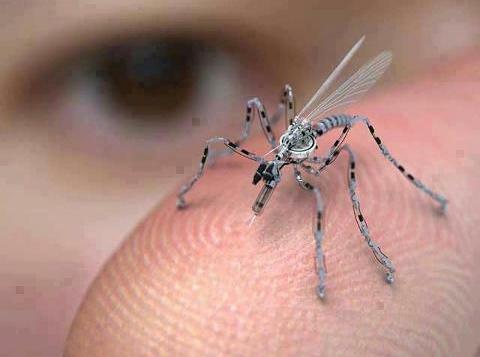
The day before I captured and released the last snake, I came across a very damaged Great Spangled Fritillary butterfly. And there it was, going about its usual business gathering nectar from a thistle flower, even though it was fall, and its wings were frayed and surely its days were numbered. Does the butterfly know it is going to die? Is it following a preset algorithm for behavior? What is the difference between that little creature and a similar artificial drone of about the same size that might be used by the government to gather information or DNA?
A mock-up of an artificial intelligence mosquito that gathers DNA
There is no such capability currently according to Snopes
There are no AI mosquitoes or butterflies as of yet. It is just an urban legend according to Snopes. Most people discuss the technical challenges of miniaturization as being what has prevented this from coming about. But I think there is a bigger problem: the open question of consciousness. I think butterflies are conscious, and drones, of whatever size, are not.
I came across the damaged butterfly again yesterday, and it was feeding next to a counterpart who was still intact.
I don't think there is a simple algorithm that accounts for the butterfly's behavior. I suppose you could build one that is remote control, but for there to be artificial intelligence, the drone must think for itself. It has to decide where to go, when to hide, when to feed, and when to take off for better pastures. Have we solved that problem yet? I don't think so.
Will intelligent robots wipe out the human race? That is a sensational headline that has been hitting the news. But before we can program intelligent robots, we first have to stop trying to turn our children into drones.
An algorithm, no matter how complex, cannot tell you what to do. Even Google can't tell whether a piece of writing is genuinely good, without resorting to tinkering with their own algorithm constantly, because it is based on second-guessing other readers and not reading the piece for themselves. When they decide a site like Squidoo needs to be downgraded in the rankings, they still do it by hand.
Google can't grade an essay to save its life. Yes, they are working on natural language processing. But did you know that they are still paying humans for the menial task of marking the noun phrases? A computer still can't tell by itself the difference between a noun and a verb.
Yesterday, I watched a skipper and a bumblebee share the same flower. The bumblebee buzzed off pretty soon, but that skipper stayed and stayed, and I could really tell it was enjoying every drop of nectar.
Where does intelligence come from? It is not from the desire to comply. It is not from harmony and peace. Intelligence is born out of conflict of interest between and among different beings who are vying with each other for survival. If we ever do discover the secret, it will be by pitting drones against each other and letting them duke it out, not by centrally planning a perfect, compliant drone.
But for the time being, we are turning our children into drones and discarding the best among them, because they won't do as they are told.




 Posts
Posts


