I am a primatologist who spends twelve hours most days in the company of a thirteen year old chimpanzee named Bow. I am also an editor with Inverted-A Press.
Bow is fit and trim, even though he eats a wide variety of foods. He has plenty of access to fruit, including apples, bananas, strawberries and grapes regularly, and occasionally pears, persimmons, pomegranates, avocado, kiwi, guava, locquat and any other exotic fruit we can get our hands on. But he is not exclusively a frugivore. He eats salad with ranch dressing, eggplant fried in oil or bacon fat, raw tomatoes, fried onions, boiled cauliflower and boiled brussels sprouts, and asparagus, baked potatoes and yams, plus other vegetables that occasionally appear on the menu. But Bow is not a vegetarian. He also likes baked chicken, roast beef, pork chops, Big Macs, chicken nuggets and any other meat dish that he can get his hands on. And Bow has milk with his cereal and in his oatmeal and black sesame porridge, as well as whipped cream with his strawberries and sour cream with his baked potatoes. No, he's not lactose intolerant, and he is not a vegan, and he is not kosher; he has a nice appreciation for many different kinds of food, including oriental dishes like hummus and tahini and Chinese pot stickers and rice. Like me, Bow is an omnivore. He enjoys food, and he has routines and rituals, but he is not stuck in a gastronomic rut. He feels free to explore new foods.
And like me and my daughter, Bow is not overweight. He has a well-defined waistline and is built like the cartoon character, Li'l Abner.
Notice Bow's well-defined waistline
What I have noticed is that when they cross-foster, most people end up with great apes whose weight issues are a little like their own. It is usually because we tend to feed our nonhuman apes the same sorts of things that we eat, and also our attitude toward food is similar. It's a cultural issue.
Cross-fostered chimpanzees get a lot of their attitude and approach to life from the family they grow up in or the persons who raise them. For instance, a chimpanzee raised Catholic will take on Catholic ritual, crossing himself and praying before meals. A chimpanzee raised by a Buddhist will often display Buddhist attitudes and behaviors, even to the the point of looking like the Buddha.
Is it bad to look so happy and content that you no longer have a visible waistline? It depends very much on the culture you come from, how this is regarded. People are too quick to judge.
What if I told you that a certain great ape, deprived of the company of the humans that he loved, has lost a prodigious amount of weight and is now looking healthy and fit? Let's say he had before been so round about the middle that he was beginning to resemble a statue of the Buddha, but now he is fit and trim and his coat is glossy, and he runs around with his fellow apes outdoors, a perfect specimen of natural health and fitness. Is this good or bad? An improvement or an infringement?
When the Red Cross sent the Swiss Consul to visit the internees at the Weihsien Internment Camp for Enemy Aliens run by the Japanese in Shandong Province, China, he had similar improvements in the health of the inmates to report.
When people are placed in an internment camp or a sanctuary, good animal husbandry demands that they be given at least the minimal number of calories per day to live on, but not much more. If these people, when they were free, were accustomed to eating a great deal more than was good for them, then the resultant weight loss can lead to improvement in their overall health. In the same way, lack of access to alcohol and drugs can cause an improvement in the health of those of the internees who were addicts before they entered the camp. The camp has the same effect on the overall health of the inmates that a drug rehab center or a spa can have. But that does not mean that the lack of choice imposed on the inmates is brought about by humanitarian means or that it is in any way humane.
It's that time of year again. October is almost over. After Halloween, there is always Thanksgiving. And after Thanksgiving there is Christmas. And after Christmas, taxes come due. First there are the property taxes. and later there is that whole business of the income tax.
Sword and Bow in 2002
People who make their living in sales find this season to be the busiest one of all. Sometimes they put everything else on hold until it is over, because during this season they can make enough money to finance the whole rest of their year.
At Project Bow, we also hope for that kind of income. And no, we are not a "nonprofit". Why not? Because we want to maintain our first amendment rights to speak out against those who would do us harm. If we were a nonprofit, then there would be many things I would not be allowed to talk about.
Campaigning for a presidential candidate, which is something I have done this year, would not be allowed. But there are many other things that I would not be able to say and do, including lobbying my local and state and Federal representatives not to pass anti-primate legislation. I would not be allowed to speak out against US Fish & Wildlife and their funding of the Jane Goodall Foundation with our tax money. I would be silenced. And for what, a few measly tax dollars? Why should I sell my soul for that? Why should anyone?
Other Books published by Inverted-A Press
So when you buy books from Inverted-A, books that I wrote and that will help fund Project Bow, or books that I edited and published but did not write, you are not going to get a tax write off for the purchase. I, in turn, will not be able to take in that income, tax exempt. I will have to pay the IRS for my right of free speech. It isn't right that they should tax free speech, but I would rather pay the tax than give up my first amendment rights.
Because I am willing to pay those taxes now, I can campaign for a presidential candidate whose platform includes doing away with the IRS, so that not only non-profit organizations but every single citizen can have tax free income. To me, that makes the whole thing worthwhile. If you agree, and you would like to make a contribution to Project Bow, please buy books that I have written and/or published as Christmas presents for friends and family on your list. It isn't tax exempt, but it's worth every penny, because what you are buying is freedom.
Spring is definitely here. Yesterday afternoon it was eighty degrees out. In the grocery store, grapes are suddenly affordable again. Bow and I are taking advantage of the opportunity,
He was grunting with pleasure when he had his bunch of grapes for breakfast yesterday.
Bow also spent many hours outdoors on his bench, while I roamed the grounds spying all the sudden transformations that the warm weather has wrought.
The hyacinth by the front door is blooming.
The peach trees in the orchard have opened their blossoms. And no sooner had they bloomed, than they began to attract busy little bees.
Bees began to swarm by the fruit trees.
They seem to know exactly what flowers are available.
Some flowers, however, are more popular than others. For instance, though the new trees that were planted only last fall are also blooming, they do not attract any bees.
And although we might suppose that all the flowers growing on the same tree or bush are equal. no such equality is to be found in nature. Even on the forsythia bush, which is now in full bloom, some flowers just seem to stand out.
What is it about this particular bloom that makes it dance in front of me, as if shouting: "Look at me! Look at me! I am different from all the others!"
No two mountains have the same height and no two stalks of grain are equal, as the great Russian writer, Alexei Tolstoy, once wrote. (No, not the author of War and Peace. That was somebody else) There is no such thing as absolute, factual equality. Which brings me to my new book, Our Lady of Kaifeng: Courtyard of the Happy Way. It has been published, and people all over the world are receiving copies even as I write.
When I was a young girl, I wondered about many things. One of them was apes and language. Another was artificial intelligence. What I had trouble understanding, in both cases, was the psychological hurdles to success.
I mean, you can teach an ape language. In fact, you don't really need to teach it at all. They pick it up. But then proving it to your fellow man is very, very hard. Why? Because the ape does not care to prove it. He doesn't cooperate. He won't help. He does not really care if anybody thinks he is smart. He's pretty happy with himself, either way.
The psychology of learning, and especially of proving what you have learned, is something that humans are still working out. For instance, among humans, there is a gender gap, according to a recent article in the Atlantic. Girls are hard workers with great organizational skills who like to be graded on their effort, not their ability. Boys hate to be forced into work, but they will gladly rise to the challenge of a test, in which they try to prove how smart they are, not how hard they worked preparing for it.
But is this really about girls versus boys? Or is it about different types of people, some of whom are compliant, but unthinking and others of whom cannot be motivated to comply for a bribe, because they would rather think for themselves? Isn't it just that there are more girls in the one camp and more boys in the other, so that the unusual girls are discarded as outliers?
At this point, you're probably saying, yeah, that's what it means that boys are different from girls, that most boys do this, not all boys. That most girls are like this, not all girls. But what about a class full of girls? Would they all work equally hard? Would they all rather memorize than think? And does it matter what culture they belong to?
In my novel Our Lady of Kaifeng the American teacher, Marah Fallowfield, is shocked by the degree of teamwork, compliance, hard work and memorization that her students are capable of, and at how they refuse to think for themselves. It is an all girls' school, so it is not a matter of gender norms. Instead, all the girls in her class are Chinese, and they come from a culture that places a premium on obedience, self-abnegation and collective achievement. rather than on individualism and self-motivated action.
The United States is heading in the same cultural direction at the moment as China went years ago, which is why the more compliant and submissive students are getting better grades. We are rewarding thoughtless submission in the form of grades, and so more compliant people are going on to college. As it happens, more of those people are women.
But you don't have to be some kind of genius or rebel to see which classes in high school have actual content and which involve mostly memory work. Even students who don't excel academically can tell that some subjects require more understanding and less studying, while others you cannot get by with anything less than memorizing the study guide word for word in order to pass the test. For my daughter at the moment, music and math are subjects where the answers can be found in her own head. Other classes have to be studied for. And studying mostly consists of rote memorization.
This is not necessarily because she's good at these more objective subjects. It's because they have content that has a logic all its own. In grade school, she used to ace the spelling tests without looking at the list of words, because she is hyperlexic, and spelling has an internal sense to it, despite the arbitrary elements. But in high school, there are no more spelling tests. People who excel in the humanities have no chance to show it, because the tests are designed for social purposes, not objective content. There are no more translations from Latin or Greek to show your academic merit in the humanities.
So I don't really think it is boys against girls: it's that we have shaped the content in the schools to reward hard work and cooperation and to discourage independent thinking. As a result, even those people who might have loved the humanities in a former era find they are more fairly dealt with in math, where there is still some advantage to thinking for themselves.
When I wanted to adopt a chimpanzee, I wasn't sure whether I wanted a boy or a girl. I thought, as many people think, that a girl might be easier to handle. I had heard that boy chimps were more powerful, and hence more dangerous. And I wanted someone teachable. But the breeders told me this: female and male chimpanzees are both equally smart, but the girls are more temperamental. If you tell a boy he did something wrong, he will accept it much sooner and move on. But tell a girl chimp that she made a mistake, and she is going to fume and fuss, and you can't get her to try again for a whole day, because you have insulted her! So when Bow became available, and he was a boy, I accepted him into my life. And it's true, he is pretty easy going. He just isn't very eager to prove anything about what he knows.
So much for natural intelligence. But what about AI?
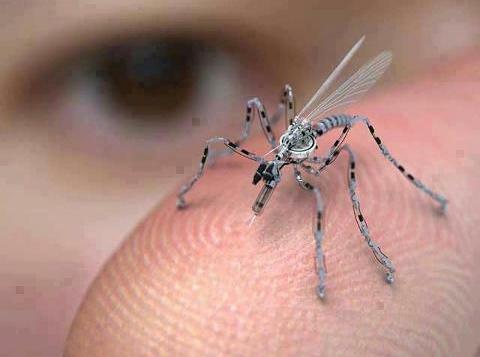
The day before I captured and released the last snake, I came across a very damaged Great Spangled Fritillary butterfly. And there it was, going about its usual business gathering nectar from a thistle flower, even though it was fall, and its wings were frayed and surely its days were numbered. Does the butterfly know it is going to die? Is it following a preset algorithm for behavior? What is the difference between that little creature and a similar artificial drone of about the same size that might be used by the government to gather information or DNA?
A mock-up of an artificial intelligence mosquito that gathers DNA
There is no such capability currently according to Snopes
There are no AI mosquitoes or butterflies as of yet. It is just an urban legend according to Snopes. Most people discuss the technical challenges of miniaturization as being what has prevented this from coming about. But I think there is a bigger problem: the open question of consciousness. I think butterflies are conscious, and drones, of whatever size, are not.
I came across the damaged butterfly again yesterday, and it was feeding next to a counterpart who was still intact.
I don't think there is a simple algorithm that accounts for the butterfly's behavior. I suppose you could build one that is remote control, but for there to be artificial intelligence, the drone must think for itself. It has to decide where to go, when to hide, when to feed, and when to take off for better pastures. Have we solved that problem yet? I don't think so.
Will intelligent robots wipe out the human race? That is a sensational headline that has been hitting the news. But before we can program intelligent robots, we first have to stop trying to turn our children into drones.
An algorithm, no matter how complex, cannot tell you what to do. Even Google can't tell whether a piece of writing is genuinely good, without resorting to tinkering with their own algorithm constantly, because it is based on second-guessing other readers and not reading the piece for themselves. When they decide a site like Squidoo needs to be downgraded in the rankings, they still do it by hand.
Google can't grade an essay to save its life. Yes, they are working on natural language processing. But did you know that they are still paying humans for the menial task of marking the noun phrases? A computer still can't tell by itself the difference between a noun and a verb.
Yesterday, I watched a skipper and a bumblebee share the same flower. The bumblebee buzzed off pretty soon, but that skipper stayed and stayed, and I could really tell it was enjoying every drop of nectar.
Where does intelligence come from? It is not from the desire to comply. It is not from harmony and peace. Intelligence is born out of conflict of interest between and among different beings who are vying with each other for survival. If we ever do discover the secret, it will be by pitting drones against each other and letting them duke it out, not by centrally planning a perfect, compliant drone.
But for the time being, we are turning our children into drones and discarding the best among them, because they won't do as they are told.




 Posts
Posts


