Search This Blog

Monday, September 8, 2014

Identity Politics and Chimpanzees

Bow is a chimpanzee, and many of his behaviors are natural and inborn and not given to change through enculturation or indoctrination or education or whatever you want to call it when we stamp another person with our culture.  The way he walks, his displays, the simple pleasures that he yearns for are not given to change, regardless of where he has been brought up.


But sometimes -- actually quite often -- Bow will do something that seems so characteristic of humans, that it takes one's breath away.


I dropped a Kleenex on the floor by accident yesterday, and as I was cleaning up the potty, my back turned to Bow, I heard him blow his nose -- loudly! I turned around, and there he was, blowing his nose and then looking at the tissue.


Did I teach him how to do this? No. But I did use a tissue in his presence many times, and when he was little, and he had a cold, I used to wipe his nose. Is this "natural" behavior for a chimpanzee? Well, they certainly don't have facial tissue in the wild, but I would not say that it is unnatural. In fact, it is no more natural for a human than for a chimpanzee. Do you think I have had disposable facial tissues all my life? My mother sent me to kindergarten with a cloth handkerchief! Facial tissue is a new invention.

So what is natural? It's natural for all of us to learn to use the cultural artifacts that we have in our environment. Bow picks up Kleenex and the alphabet with the same facility as a human. I didn't invent facial tissues and neither did Bow. I didn't invent the alphabet and neither did Bow. In fact, the alphabet was only invented once in all the history of mankind. Everybody else borrowed it. Having a writing system is not a uniquely human thing. Using the writing system that everybody else drops in our laps is natural for humans -- and no less natural for chimpanzees. The veneer of civilization is something we all pick up, like a dropped Kleenex.

What doesn't make sense to me  is to call it one thing when a human does it and something else when a chimpanzee does it. But there are lots of  experts who do just that. There is the fellow who made a career out of suggesting that chimpanzees may react to seeing just the same as humans, but they don't understand seeing in the same way. So when they hide behind a tree, they do it for a different reason from the reason a human might have to hide behind the tree. The human knows that you can't see him, because the tree blocks your vision. But the chimpanzee only hides out of instinct!

There has been a long tradition for researchers not to attribute mental states and emotions to chimpanzees, even when the reaction is pretty much the same as ours to the stimulus. A human is sad, but a chimpanzee can't be, because he is just a chimpanzee. A human is amused, but a chimpanzee displaying amusement must never be described that way. Different words for the same behaviors have to be employed. A researcher who breaks these rules is considered to have lost his scientific objectivity.

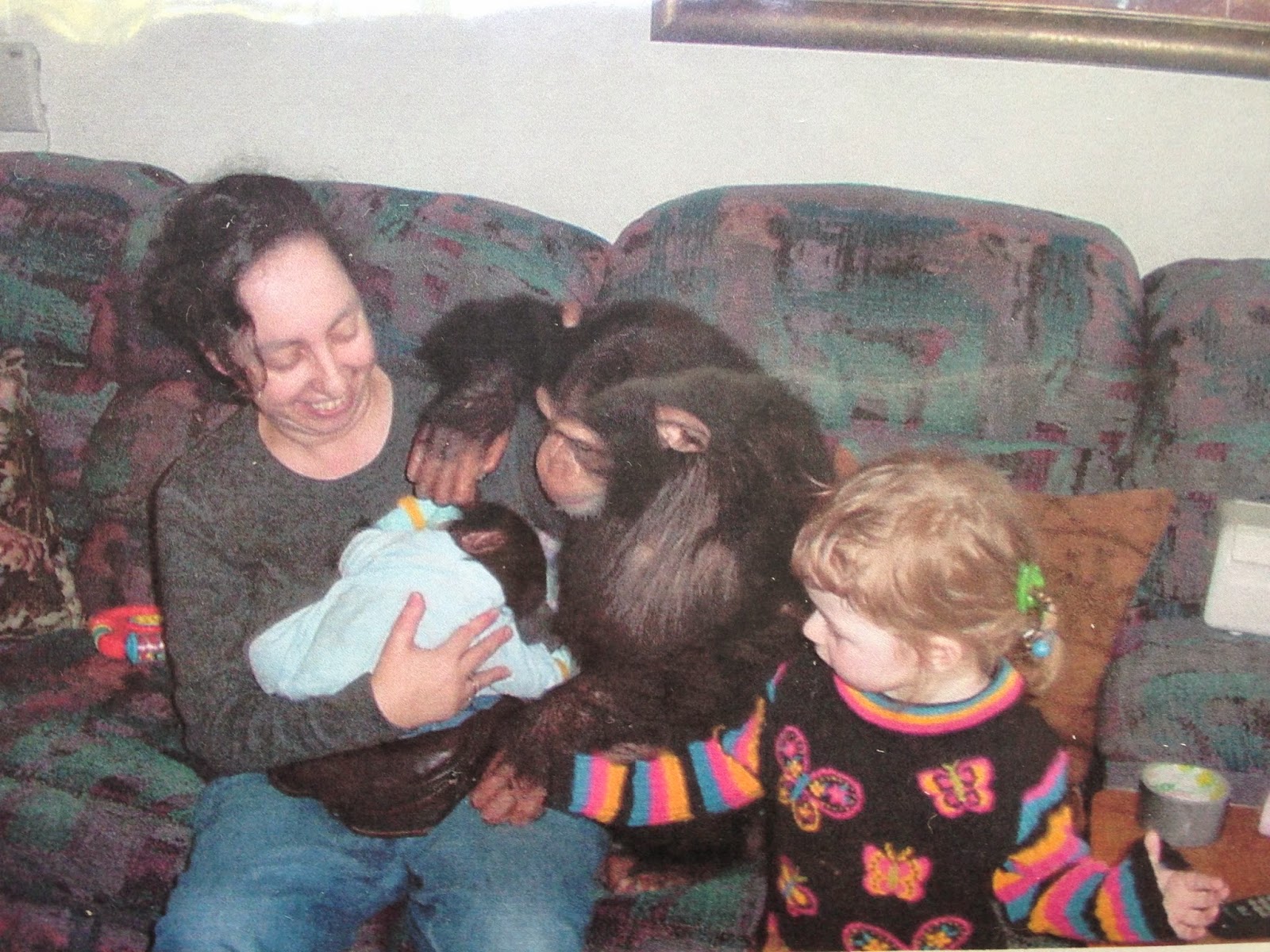
Under our cross-fostering experiment, I call myself Bow's adoptive mother. All I mean by this is that while I am not his biological mother, I have served him in the capacity of a mother all his life. One "expert" told me that because Bow is a chimpanzee and I am a human, I can't be his adoptive mother. At most I am his surrogate mother. The last time I checked, in ordinary parlance, a surrogate mother is a woman who carries another woman's child in her womb. I never did that for Bow, so I am not his surrogate mother. I am just his adoptive mother. But this person was working so hard to make the point that chimpanzees and humans are different species, that he was willing to break the language to come up with a different word for the same relationship.

Don't get me wrong, Bow is a chimpanzee. He does belong to a different species from me. I am not in denial about that. When the mowers came yesterday to cut the grass, Bow went into a characteristically chimpanzee display.


When he does this, Bow is showing us the parts of being a chimpanzee that are hard-wired and not open to cultural mediation.


But then there are the other behaviors, which are very much like our own. I am not suggesting that Bow has become more human by living among humans. I think, instead, that humans and chimpanzees have more in common than many people are comfortable admitting, including many researchers and self-appointed chimpanzee spokesmen.

An experiment in cross-fostering has at its base the desire to learn which behaviors are due to enculturation, and which are hard-wired. A very large percentage of human behavior is learned rather than inborn. The same is true for chimpanzees, although it may not be exactly the same percentage or exactly the same behavior.

In German, they have two different words for eating, "essen" when a human does it, and "fressen" when a non-human does it. It is part of the identity politics of differentiating us from them. In Hebrew when a woman gives birth, she "יולדת". When a dog gives birth,  she "ממליטה". It's an understandable human move, to want to mark how special we think we are by creating a whole different vocabulary for those in the out-group. But it's not scientific or objective.

When Bow blows his nose using a Kleenex, it's the same as when I do it. It's not "natural", because it is culturally mediated, but the action is the same.

In order to be objective in our attempts to understand chimpanzees, it is important to use the same words for the same behaviors. It is important not to engage in identity politics and suggest that every action has a different meaning when performed by a non-human.

Saturday, September 6, 2014

Staying Snug Where We Belong

Today it is dark and cloudy out, and Bow is staying safe and snug indoors.


It may not be all that exciting, but he is not in any distress. He is at home, where he grew up and with the family he knows. In the wilds of Africa, his life would be in danger. In my news feed today, I read about five gorillas who grew up near Canterbury who met their deaths when they went back to live in Africa.

Death of Five Canterbury Gorillas

I also know of what happened to Lucy Temerlin when she went to live in Africa after being raised as an American for sixteen years.

Sometimes apes can prosper under circumstances that are not the canonical environment in which they evolved and can be doomed under what seems the most "natural" way of life. We may think that there is a right place for everything, but sometimes the things that survive are precisely those that do not spring up in the "right"place.


There's a crack in the concrete behind my garage. Nothing is supposed to be growing there. And yet today, when I looked more closely, I saw that under the falling leaves of the tulip tree, some stunning flowers were flourishing.


The flowers don't "belong" here, and yet here they are!


Who is to say where anyone else belongs? Bow and I are staying snug and safe indoors this morning. When the weather changes, we will venture forth.

Thursday, September 4, 2014

Cross-Fostering and the March of Time

This morning, Bow asked to go outside early and started his display on the swing.


For people who are not accustomed to chimpanzee displays, it can seem frightening or be interpreted as a sign of aggression. Bow makes it very clear that what he  means is: "I am big and strong" and that his display implies no menace towards anyone who is willing to concede that, yes, he is big and strong.


In the clip above, you can see Bow displaying, then gesturing to invite me over to the bench, once the display is done. He is happy and friendly, and one of the reasons we get along so well is that I don't try to hinder him in his natural behaviors. If Bow needs to tell the world that he is big and strong, that is fine with me. I do not have any desire to stop him or to edit his message to make it more politically correct.


One of the reasons I feel no desire to engage in a shouting match with Bow over our relative strengths is that I am perfectly at peace with who I am. I am a five foot two human female, and I don't need to be stronger than a post-pubescent male chimpanzee to feel good about myself. However, I do know other people who feel threatened by another's attributes, abilities and activities, even when they have nothing to do with them.

Lately, I have seen all sorts of displays by humans about their right to edit the free speech of others. One person, who I really felt should know better, suggested burning every copy of a book, because the book contained "false" information.Who decides what is false? By what authority?  If it is false, don't you trust other people to eventually figure it out?

The argument goes something like this: Are you a government certified expert on this subject? If not, how dare you write about it? What if somebody believes you, and they get hurt? How dare you publish this recipe for poppy seed cake? What if someone uses it and gets food poisoning? What if someone reads this false interpretation of ancient Egyptian hieroglyphs and relies on it to his detriment? Don't people need to be protected from false information?

I have no actual claim to being an expert in the culinary arts, but this does not keep me from occasionally publishing a recipe. Other people may dabble in linguistics, who are not linguists. Even though I am one, it does not bother me. That's what's great about living in a free country. One can try anything and learn from mistakes and get better at it and later publish one's findings.

What makes it okay to call something a lexigram when it looks like a word? I've written about that here:

http://hubpages.com/hub/Project-Bows-FAQ-Why-is-it-called-a-lexigram-when-it-looks-like-a-word

While I do have a Ph.D in linguistics, any real claim to fame that I have as a linguist is not based on authority or certification, but on the things I have found out for myself and the information I have shared by writing about it and publishing.

We have some new readers for this blog, some of whom are unfamiliar with Project Bow and with the meaning of the term "cross-fostering", and who don't know our long history. Some of them seem to still think that Bow is a baby, and they warn me about what may happen when he turns three or five or six or seven. They don't realize that in February, he will turn thirteen. For those people, I am sharing these links, so that they may learn about our experiences at the ages they mentioned and beyond.

A Young Chimpanzee's Growth and Development

Chimpanzee Development Age Three through Five

Bow and Literacy

When I  published "When Sword Met Bow" as a book for children, the intent was not to scientifically explore the phenomenon of cross-fostering. Instead, the book was meant for anyone bringing home a new baby to help their older child with the transition. It was a lyrical picture book, intended for a young audience.

When Sword Met Bow
However, now there are people who are worried that it will encourage others to adopt chimpanzees, and one such person has seen fit to write a "review" of the book without having read it, warning about all the stages of chimpanzee development.

And here I am, wondering whether I should put on my expert hat or my libertarian hat. Should I explain that I do in fact know a great deal more about it than these people assume? Or should I simply remind them that this country was founded on the principle of live and let live?

I am a linguist and a primatologist, and I do have scholarly publications on this topic. 


But more important than any claim I might offer to expertise is this: we live in a country that was founded on the principle that all men are created equal and have the right to pursue happiness at their own expense. No expertise is required to pursue science or art, and no license is required for the publication of our results. 

Other people do not adopt chimpanzees primarily because they do not wish to do so. Chimpanzee owning citizens are a minority, but one that needs protecting.

I once sat at a restaurant with a group of scientists, among them a noted primatologist, and all of them were complaining about how hard it was to get funding. Then in the same breath, one of them said something about money being the root of all evil. 

Money is not evil. Trying to get it by force is. Respectable ape language researchers have been pushed under the bus. Their funding has run dry. They have been forced to try to escape to the private sector, but Federal regulations still leave them very much under the government oversight committees. The only hope is going totally private, and this means giving up the protections afforded by "expert" status. 

Bow is not a "pet". But it's only because private ownership is still allowed that Project Bow is possible. That  -- and the first amendment to the United States constitution -- is something I am very grateful for.


Project Bow 2015 Calendar


Tuesday, September 2, 2014

Hark to Your Bees

There is going to be a Project Bow Calendar for sale very soon. It may even look a little like this:


When it's available, I will post a link here, so you can get one for yourself and for any of your friends who may like chimpanzees. I am told they make great gifts for those hard-to-please people who already have everything else.

I feel a little foolish saying this, as it sounds quite a bit like a commercial. However, we must eat, and it would help.


 As Rudyard Kipling once wrote:

Bees, bees, hark to your bees, 
          Hide from your neighbors as much as you please,

          But all that has happened to us you must tell

          Or else we will give you no honey to sell.

Well, I am not a bee keeper, and Bow does not produce honey, or anything that most people would consider to be of value, so this is the best I can do.

 I did see a lot of bees buzzing about this afternoon on my walk. I do not, however, know whether these were eusocial or solitary bees.


Bees are popularly known as little collectivists, and the work ethic is said to be ingrained in their genes, but even they can end up being solitary and hiding from their neighbors, if their system becomes overloaded with non-contributors. I  wrote about all this a while back, here:

http://aya-katz.hubpages.com/hub/The-Evolution-of-Selfishness

For those who think of the bee social hierarchy as static, it seems as if bees are a good role model for social cooperation. But the fact is that if you take into consideration the cyclical dynamics of evolving bee societies, it looks more like this:


It's not just about bees or humans. Towards the middle of my article, there is something about chimpanzees. Chimpanzees tend to work for themselves. They are social, and they do submit to more dominant individuals, but only just enough to get by. They never internalize anybody else's dominance, so on the inside they stay individuals. That's why chimpanzee hierarchies never turn into eusocial caste systems.

I admire Bow's individuality and would not want him to be any other way. But it's a lucky thing for me that he rather enjoys posing for pictures. That gives us something to sell.


Saturday, August 30, 2014

Vacationing at Home

This is Labor Day weekend, but we are not going anywhere. Our traveling days are over. But it's okay, because with the right attitude, you can enjoy a relaxing vacation at home.

Bow sunning himself in the outer pen yesterday
They say that one of the factors in premature aging is stress. There is even research on the topic that suggests that people who meditate are prolonging their lives by cutting down on the effects of stress. I am a bit skeptical, however, as how would the researchers independently verify that the people who were meditating were doing it right? And, in fact, wouldn't trying to adhere to a specific practice of meditating as taught by particular practitioners cause stress in itself?


Bow and I don't meditate, but we cut down on stress simply by giving in to our interest of the moment.


When Bow feels like doing something, he does. That freedom in and of itself is a stress reducer.


Bow  gives himself over to whatever activity has him engrossed at the moment, so there is very little internal conflict.


It's all about focus. For me, concentrating momentarily on a flower can have a calming effect.


Everything else in that moment fades away, and all I can see is the thing I am concentrating on.


 When we give ourselves over to the study of a tiny, damaged butterfly, the rest of the world recedes into the distance. Just focus. Even when we look away from the butterfly momentarily, it is hard to see anything else.


This does not mean that we should never get angry or never argue, in order to reduce stress. On the contrary, you should give yourself over completely to your anger, and then the anger can pass. You should argue with all your might, as if nothing but the argument matters. I can imagine taking my argument all the way to the Supreme Court, perfectly at peace with myself. Someday, I'd still like to do that!

"Drink deeply, but never too deep." --Kipling
When Bow takes a sip of water, he savors it as if he has never had water before. Then when he's done, he forgets all about it. We should all be like that!


Every sunset and every sunrise is an opportunity to get lost in the moment. We live in a beautiful, quiet spot. We don't need to go away to have a vacation. Sometimes all you have to do is just close your eyes and relax.


Friday, August 29, 2014

Ten Generations into the Future

There is a saying attributed to native Americans that any agreement by elders should take into consideration its consequences for ten generations into the future. This means that when I think about what would be best for Bow, I should consider not only Bow, but his children, his grandchildren, his great grandchildren -- all the way down to the tenth generation.

It makes a lot of sense to me, and I think it would be a good rule of thumb to implement for any being for which you have stewardship, whether it is your own minor child or a member of a different species, especially if that species is threatened or endangered.

When we came to adopt Bow, Connor was there to show us how to interact with an older chimp
Everybody -- well, almost everybody -- enjoys holding a baby, meeting its needs and forming that deep bond of intimacy that happens only when someone is entirely dependent on you for everything. But the real test of parenthood comes when the child starts showing signs of independence, starts thinking for himself and doing things that don't always seem so sweet or cute.

The breeders know this. That's why they don't allow you to adopt a chimpanzee just based on your ability to bond with a helpless little baby. They want to know that you won't bail out when the going gets tougher. Before I adopted Bow, I was introduced through the glass to some adult male chimpanzees, who hurled themselves at me and made a big point of trying to scare me. When I was first allowed to hold Bow, unbeknownst to me, an eight year old male by the name of Connor was allowed to come into the room to check me and my daughter out. My eyes were fixed on Bow, so that I did not even notice when Connor first came on the scene. But clearly he was there to test us.

Connor was very interested in Sword. He liked her shoes and the decorations in her hair. He offered to hold her hand and walked with her all around the room, and he took off her shoes, and played with her hair. He was very gentle, though, and she did not mind. When asked to give back the shoes, Connor reluctantly did so.


Later Connor was given some baby food to eat with a spoon. Sword even got to feed him some.


We thought we were going there to see the baby we were going to adopt. But there was no question that we would like Bow and that he would like us. The real question was, would we be a good family for Bow when he was no longer so small and helpless. Would we be able to cope with a bigger chimpanzee, like Connor. Or an even bigger one, like the adult males behind the glass.

A Closeup of Bow taken yesterday
Today, Bow is much older than Connor was on that day in 2002. We are still getting along just fine. And I think we will continue to get along when he is an adult. But the question for me is how to prepare for the day when Bow no longer has me to rely on. And any solution I choose, I believe needs to be a solution that is not just good for Bow, but for ten generations into the future.


It's true that now Bow's mobility and options are more restricted than they were when he was little and able to play outside the pens and travel with us to distant states, like New Hampshire.


One criticism that is leveled at people who raise chimpanzees is that after a certain age the freedom that the chimps enjoy as youngsters is curtailed. Knowing that this will happen, people ask, would it not be better not to have adopted the chimp in the first place? Would it not be better to keep them with their own kind?

No, it would not be better. If Bow had been kept with his own kind his entire life, he would have been caged his entire life. He wasn't born free. He was born right here in Missouri.  Isn't it better that he had his freedom for as long as he possibly could, under our current social restrictions?  And if Bow has children of his own, which I hope that he will someday, would it not be better that they have freedom to roam for as long as they possibly can?

They say we should think about solutions which are sustainable. The breeder model is sustainable, because the funding for it comes from people who really want chimpanzees. The sanctuary model is not sustainable, because the funding for it comes from people who have no real interest in chimpanzees and who are largely committed to ending the existence of chimpanzees outside the continent of Africa.


I don't see my role in Bow's life ending with his maturation, though I recognize that as a child matures, the relationship has to change. With our human children, as well, we have to learn to let go and give them more space, though we never stop caring. The big reward for allowing your children to grow up, I am told by people who have been through this, is that eventually there are grandchildren!

There is no shame in liking babies of every kind. It is only wrong to try to keep your children babies forever!  We don't love our children less because we have that special place in our heart for the next generation that comes after. One of the reasons it is important not to infantilize your child or your non-human companion is that an eternal infancy is a biological dead end.

There is a place for grandmothers in the scheme of things.  Grandmothers see past the needs of a single generation. They think about ten generations into the future. I consider myself a grandmother in training.

Wednesday, August 27, 2014

Bow's Potential Success in Business

Bow's ring finger is much longer than his index finger

The other day I read an article that purported to be able to predict success in business based on the relative length of the ring versus index finger. Those with ring fingers longer than index finger were supposed to be much better at business than those for whom the opposite condition held true. This was supposed to be the case regardless of gender. The idea behind it was that a longer ring finger tends to be an indicator of greater exposure to testosterone in the womb, and higher testosterone masculinizes the brain, regardless of genetic or anatomical gender. Thus official sex has less bearing on business success than the relative length of one's ring finger as compared to one's index finger.

As might well have been predicted, I immediately started studying my ring and my index finger and came to the conclusion that they are nearly equal. It is actually hard to tell which one is longer, though if you look at the joints, my index finger's joints occur higher, so I think my index finger is a little longer.


But then I looked at Bow's! His ring finger is so obviously longer than his index fnger that there is no room for doubt!


Bow, according to that article, has great potential for success in business! Maybe I should just turn the reins of Inverted-A Press over to him! There's just one problem. Bow has no work ethic. None whatever. When I ask him to proof a book, he just scribbles over everything. It's not that he can't read. It's not that he is unintelligent. He just does not seem to be able to curb his desire of the moment in order to accomplish a distant goal. He has problems with impulse control. 

And this made me question the results in that article even more. As explained in the article, the longer ring finger is a result of greater exposure to testosterone in the womb. If that is the case, then there is certainly no question in my mind that Bow was exposed to a great deal more testosterone in the womb than I was. Number one, he's male and I am female. Number two, he's a chimpanzee and I am a human. I think male chimps are probably exposed to more testosterone in the womb than the average male human. That's why a male chimpanzee is super masculine, compared to a male human. Exposure to testosterone makes male chimps much more aggressive than male humans. They feel the need to constantly display their greater dominance.


However, in order to succeed in business, you also have to exercise a great deal of self-control, planning for the future and making sure that you do not crash and fail, due to too much risk-taking. If today's business climate requires the aggressive nature  of a chimpanzee male without self-control, it can be for only one reason: that going into debt and incurring bankruptcy is not punished with dire consequences, anymore.

At this point, some of my readers wll probably protest that I am forgetting there's a difference between humans and chimpanzees that transcends the issue of the ratio of ring to index finger length. No, I'm not forgetting that. I know that humans and chimpanzees are different in many ways, I just don't happen to think it's a matter of intelligence. It is, in my opinion, much more an issue of self-control.

Do I think that if chimpanzees show they are capable of language they should be granted the rights of humans, including universal suffrage? No, I do not. I think that someone who is not capable of managing money -- no matter how intelligent he is -- should not get to vote. I think that it's not about sex or race or species: it's about personal responsibility. Bow has not demonstrated that he is capable of  personal responsibility, and that's why he should not have the same rights as the rest of us.

On my other blog today, I write about the universal suffrage that was granted in New Jersey  between 1776 and 1807 to all free people of any color or gender over the age of twenty-one who were not in debt and owned property valued at fifty pounds. 


This is what the animal rights activists do not seem to grasp: you cannot be free unless you are responsible for yourself. Those who are supported by others need to be under the control of the people who take care of them and pay for their food and clothing and shelter. It is not right for anyone else to have any say in the matter. It is not right for some people to be taxed so that other people can raise chimpanzees or children or run a business. 

If the people who are most successful in business today have ring fingers that more nearly resemble Bow's rather than mine, this may have been the result of a simple selective process: allowing debtors to vote away the rights of creditors.  It may not seem like a subject for scientific inquiry, but natural selection works in mysterious ways!