Search This Blog

Showing posts with label bees. Show all posts

Thursday, September 22, 2016

A Fall Bouquet for Bow


Fall comes every year. This year, the first day of fall is today, September 22. It's still pretty warm out, but somehow the animals and plants outside sense that it is time to get ready for winter.


In fact, they have been getting ready for the past week now.


The wasps on the goldenrods are stocking up for the winter. 


The honey bees on the white wildflowers are doing the same.


The pipevine swallowtail is in such a hurry to meet all its deadlines, that it flits right past me in the field.


It won't stay in one spot long, but it will pause long enough for a clear view.


An American Lady butterfly, a little worn in the wings, enjoys the goldenrod flowers.


Them a Common Buckeye and the American Lady Butterfly socialize together on the swaying goldenrods.


A fuzzy little caterpillar makes its way on the ground among the fallen leaves.


And then there is the dogwood all decked out with faux berries, an unmistakable sign of fall. 


The dogwood tries to dupe us into thinking its bright red drupes are luscious fruit, while the dogs frolic under its branches.


The tiniest butterflies, the eastern tailed-blue and the pearl crescents, hold social balls on the gravel road.

There are still so many flowers blooming out today, that I decided to gather a bouquet and present it to Bow in a vase. Bow was interested.


He began taking out the flowers.


I thought he was getting all excited about the flowers, but actually it was the vase that he wanted.


"Hey, what's in that vase?" Bow seemed to be wondering. "Nothing, after you took all the flowers out!" I wanted to say. "It's just an empty vase now." But we didn't actually say any of that. We just acted it out. 


Once he had made sure that the vase was really empty, Bow handed it back to me.


I think that's sort of how it is when we expect something special to happen on the first day of fall. It's just a date. It's a day of the year. It's an empty possibility, until you fill it with something. It's like any other empty vessel.

Sunday, July 10, 2016

What is Enough?

Everything is so green and lush on my property. Going outside, I see so many flowers and insects.


I can walk down the path and spy skippers and bees feeding on Virginia Mountain Mint.


Though there have not been as many milkweed flowers, the Great Spangled Fritillary has not been a stranger.


On the Virginia Mountain Mint by the fence line, the silver-spotted skipper and the yellow antenna black spider wasp do battle over territory.


The tall phlox is blooming as if it were wild, without my watering or weeding any of it.


My pear trees are full of pears.


There are what look to be honey bees everywhere. But I don't know whether they are solitary bees or part of a colony. I am not sure whether you can tell by looking at them whether they are libertarian or socialist bees, It may not be a matter of breed so much as temperament. All I know is that they let me film them and leave me alone.


I walked down the path yesterday and found some ripe blackberries and brought them home for Bow to eat.

He enjoyed the blackberries, and since I served them in a glass, he practically drank them in.


It rained again last night long and hard. This morning when I went out to mow, I saw how lush and alive the back yard was.


It rains a lot here, even though we reportedly are suffering from a drought.The grass in the backyard would grow uncontrollably high if I did not mow it -- using the reel mower -- about every other day. A stronger person could put it off longer, but with my upper body strength, I can't afford to. Last year, I let it grow too long, and it was back breaking work to get it down to size with only clippers and a reel mower. So this year I have been more consistently diligent.

The backyard supports lots of life. There is the big green stinkbug on the window looking into the dining area. There is the bumblebee on the day flowers by the generator. There are the dogs and me and Bow.

What does it mean that there is a drought? I have been told that the farmers need more rain in order to grow crops and raise food animals. So in essence, a drought is when you don't have enough water to do what you want to do. A drought is a drought only in terms of the goals that we humans or other animals have set ourselves. There is no drought in purely objective terms.

It's kind of like poverty. Poverty is not having enough money. Drought is not having enough rain. But the question is: enough for what? It's a purely subjective issue. There is no right answer. If you want to use a motor-operated mower, you might need more money than you'd need to operate a reel mower. If you want to eat food grown by other people, then you might need more money than if you grow the food yourself. If you want to grow food for many other people, you might need more rain water than just for yourself.  If you want to feed a colony of bees and then harvest their honey, you might need more flowers  and more pollen than you would for solitary bees whose honey surplus is not taxed.

Do we have enough of everything? Depends. Enough for what?

Friday, August 14, 2015

Interacting with Distant Relations

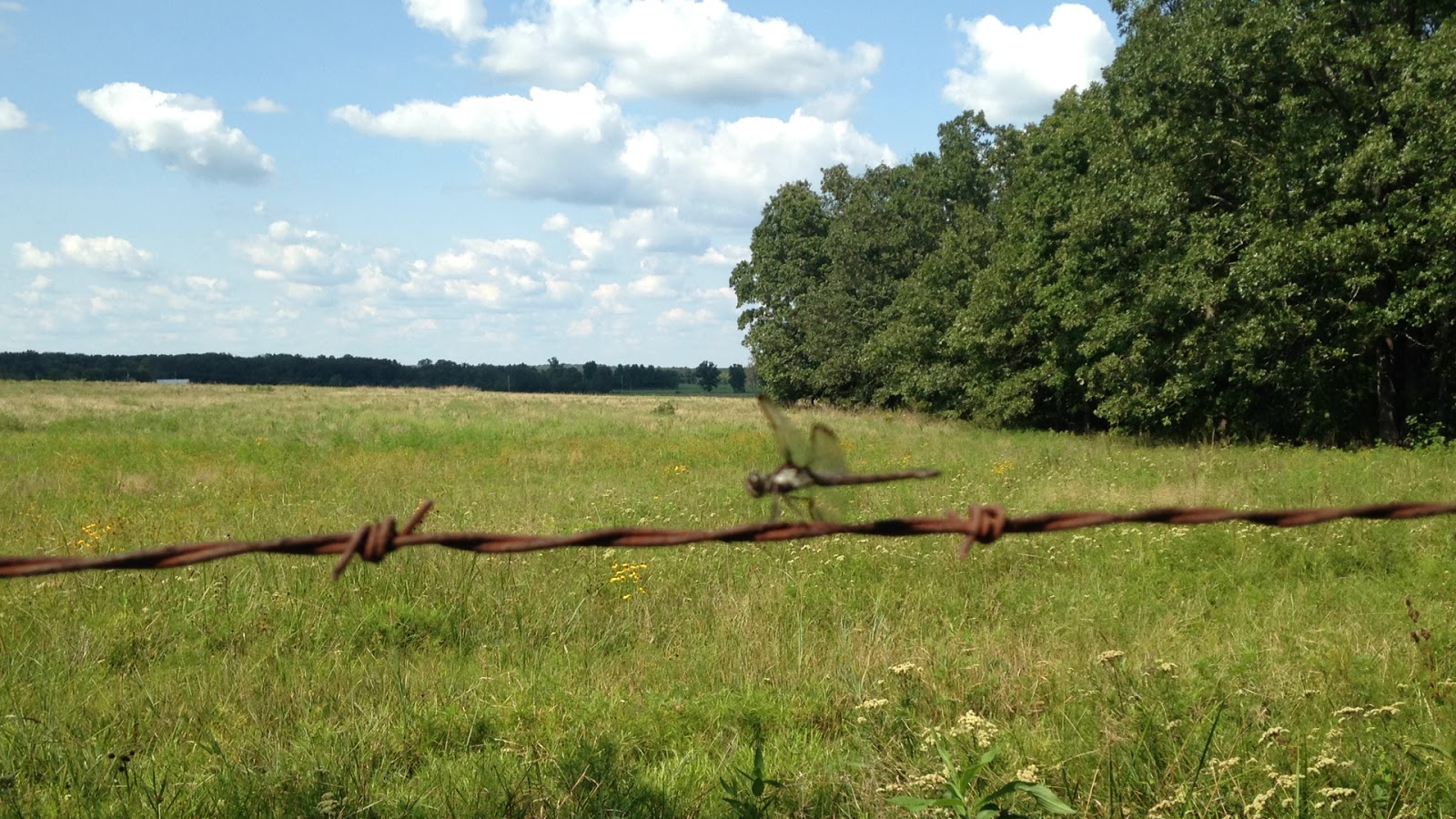
Yesterday, I spotted both a dragonfly and a damselfly in  about the same place. The dragonfly was delicately balanced on the barbed wire that separates my land from the neighbors. The beautiful backdrop to the dragonfly was a landscape I do not own, but am lucky enough to enjoy anyway, from a distance.


The damselfly was less than a foot away, on a poison ivy leaf.


Now I have written about the difference between dragonflies and damselflies before. In that post, we established that the damselfly is as distantly related to a dragonfly as a human is to a rhinoceros,

http://notesfromthepens.blogspot.com/2015/05/the-damselfy-and-phylogentic.html

But at the time, I only spotted a damselfly, and had no dragonfly to compare it with. Yesterday, I was given an opportunity to observe them both closely in a very similar environment.


At first, I noticed only the dragonfly, which was bigger and more active than the damselfly. It kept taking off from the barbed wire, only to return over and over again to the same spot.

Dragonfly in flight

It would get so small in the distance, then grow back in size as it came in for a landing, making its final approach.

Dragonfly coming in for a landing
This happened over and over again, and meanwhile, the damselfly was so quiet and demure and still, that I hardly noticed it.


But it was in almost the same place.


Nobody thinks that because dragonflies and damselflies are so distantly related, they should be kept apart for the purity of their races or cultures. They can hang out side by side, and there is no problem.


You might argue that it is because the two species occupy a different ecological niche -- one preferring barbed wire to perch on and the other poison ivy -- they pose no threat to each other.


But I have seen animals as distantly related as the great spangled fritillary butterfly and the common honey bee feeding side by side on the same flower.

A bumblebee, a honey bee and a great spangled fritilalry 

And I have also seen animals as closely related as bumblebees and honeybees share the same flowers with the great spangled fritillary butterfly, and there was peace and harmony, and all went well.

And yet if someone suggests that bonobos and chimpanzees might be able to live together if they knew each other well and agreed to the arrangement, some experts frown. And for humans to live in the same environment as either species is verboten. It would be unnatural, they say. Why? Don't you think we evolved in pretty much the same environment? Don't you think we occupy the same niche? Don't you think there are also humans in Africa in a more or less natural setting? You might as well segregate the honey bees from the bumblebees and the damselflies from the dragonflies.

Of course, there are conflicts between similar animals occupying the same niche. But most of the differences between chimpanzees and bonobos are cultural. And if we are raised in a similar culture, we can get along with others who are not exactly the same as we are. At least we can, if we choose to.

Saturday, August 8, 2015

Beekeepers and Bee Breeders.

Who is your master, little bee?

The truth is that there is still a lot that I don't know about bees, even though there seems to be no shortage of them on my property. Some of the bees are honey bees, while many belong to other varieties. But even in the case of the honey bees, I don't know where they live or whether they are free or "owned". And I certainly don't know how they reproduce or manage to survive our harsh winters.

The idea of owning bees may seem kind of silly. They are insects. They fly around freely. There are no collars on them or identification tags. How could you possibly complain that a bee is trespassing on your property and ask for restitution from the owner? By the same token, how would you go about filing a claim if you thought a bee belonging to you was stolen? Do the bees know who owns them? Oxen and asses do know who owns them, according to Biblical scripture (Isaiah 1:3). But bees?

However, not only are there beekeepers and bee owners, there are also bee breeders and bee sellers. If for instance, 30% of a beekeeper's colony dies of the dreaded "colony collapse disorder", that does not mean that next season that beekeeper will have 30% fewer bees to begin with. Not at all. He can simply order new bees -- in a kit -- from his friendly local bee breeder, and next year he will have exactly the number of bees that he wants to have. No more, no fewer.

I did not think of this myself. I read it here:

http://www.washingtonpost.com/news/wonkblog/wp/2015/07/23/call-off-the-bee-pocalypse-u-s-honeybee-colonies-hit-a-20-year-high/

I actually did know about the bee kits, because a friend of mine orders them most years. Although recently she skipped a year, and that must have greatly reduced the bee population in her neighborhood.

If you read the most popular news items about bees, they never mention this. They don't talk about bee breeders, and how all of us are counting on them to supply beekeepers with extra bees, to make up for the bees they lose to the vagaries of nature.

They do talk about how we need bees as pollinators, so that even if we don't like honey and could not care less if there were no honey left to eat, we should care if we like peaches and nectarines and apples and pears. No bees, no fruit, they tell us. The earth will be a desolate place, and the only thing left to eat will be hamburgers and bean burritos.

Here's what they don't tell us: if we keep importing honey from abroad, our local beekeepers will stop ordering pre-packaged bees from the bee breeders, and then the local fruit growers will have to find some other way to pollinate. This will not result in no fruit. It may, however, result in much more expensive fruit. Because all the bees will be overseas, working for the local beekeepers who are making a living from selling honey to us.

Everything in life is interconnected, including ecology and economy. An animal has no chance of survival in this overpopulated world unless humans cultivate it, breed it and keep its kind going. That's why if you want bees, you go to bee breeders. No breeders, no bees.


The same thing is true for chimpanzees. If you want there to be chimpanzees on earth in the future, then you have to be nice to chimp owners and chimp breeders. Chimp breeders make a living from chimp owners. Do away with ownership of chimpanzees, and there will be no breeders. No breeders means no chimps. There is no other way for them to have any chance at all to survive as a species. So if you are a real conservationist, you have to fight for the right to own chimpanzees.

Saturday, June 6, 2015

Part Versus Whole

When Bow eats an apple, he eats the whole apple.


There is no differentiating core from outer layer.


There is no concern over seeds or less tasty fibers.


Bow likes to examine every part of the apple, to see what is there, but when it gets small enough to slip it into his mouth, he does so, and the apple disappears.


There is only one part of the apple that Bow does not eat: the stem.


When he is done with the apple, Bow hands me the stem.


To many, the apple can be divided into slices and eaten in parts, or even shared among friends. But a little apple is too small for Bow to subdivide. Portion size will vary.


To most of us, the milkweed flower is an indivisible whole, a poof of color in an otherwise drab field.


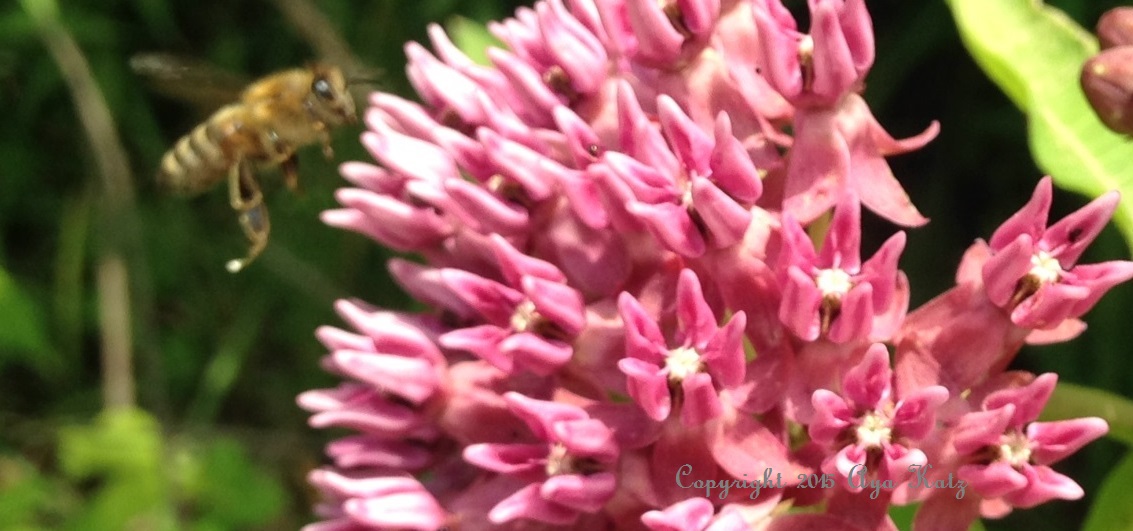
But to the bee, the contents of each individual floret of which the  complex flower consists is the meal being attacked.


The bee can visit more than one floret per feeding, but it can't possibly finish harvesting the contents the whole flower. And this is true even though the bee is bringing food home to the hive, and not consuming it all on the spot.


I have stood there and watched a bee flit from one floret to the next.


But as many times as it comes in for that landing, it still cannot cover the entire flower.


There is enough food in a single milkweed flower for a whole hive full of bees.


One size does not fit all, and the portions you purchase or consume are an individual matter. But there is a movement afoot among government officials to suggest that portion size is something that is immutable and dictated from above.

A couple of recent items made me think of that. One was a picture of a school assignment, in which a math problem was posed: "Luis ate 2/3 of his pizza and Marty ate 1/2 of his, but Marty ate more pizza that Luis. How is that possible?" In a childish handwriting, the student replied: "Marty's pizza was bigger." Then in a green marker, an adult -- presumably the teacher -- wrote: "That is incorrect. Marty could not have eaten more pizza, because 2/3 is always more than 1/2."

Now I don't know if this was a real example of a teacher/student interaction or a hoax, but it would not surprise me if there are teachers who don't realize that pizzas can vary in size. We are fast approaching a world where everything is standardized,  and portions are set by the government.

Then there are officials who want to ban super-sized sodas on the ground that they are "not healthy", but if you want to drink that much, you should have to buy two regular sodas. Or the federal regulator who forbade a manufacturer from labeling a low carb snack bar as "healthy" because it had "too many calories."

Portion size varies. How much of anything you eat also varies. How much you need to eat varies. How do the regulators know if the soda or the snack bar are going to be shared with a friend or not? How do they know you won't save some for later? Do they know how big you are or high your metabolism? They don't! It varies.

My daughter and I regularly ask for doggy bags every time we eat out. Yes, restaurant portions seem to be designed for people at least twice our size. But this does not upset us or cause us to waste the food or eat until we burst. We just have the other half the next day, and it makes the meal more economical.


Even a bee knows when it has had enough, and their food is loaded with sugar! Why on earth do they assume portion control is something individual humans cannot manage?


Friday, April 17, 2015

Caught in Midair

What is the most typical pose for a bee on the Weigela?


Is it dead center in the middle of the flower with its wings spread out?


Is it more typical for them to be up in the air and about to land on a blossom?


Or is it with its rear end toward the camera and its head inside the flower?


Or is this a more typical view?


Whichever way we look at the bee, it presents a different side to us.


Or do they hang around like this?


Or is it more often found in midair, in a holding pattern, waiting for a landing?


The days of the Weigela blossoms are numbered, but while they yet bloom, the bees  hovering around them abound. And not just bees. A wasp or two has been sighted.


They look much like bees, but their silhouette is not as plump.


Meanwhile, by the lagoon, the black ants are not even waiting for the peony blossoms to bloom.


And the backyard the tiny flower heads in the center of the dogwood blossom look about ready to open.


At the end of the day, bumble bees still buzz around the overripe redbud blossoms.


The smaller bees have all moved on the Weigela blossoms, but there are bumble bees that persist by the redbud, even as the sun is about to go down and the sky turns a rich blue.


Only after the sun finally set did the bumble bees disappear from the redbud.


Before I put Bow to bed tonight, I had washed his blanket, and it came out of the dryer very warm.  "Look Bow, your blanket is clean and warm, and it smells good." He sniffed the blanket appreciatively, laid it down on the floor carefully, lay over it, spread his other blanket over his lap, and gestured to me that he was happy, so he wanted to groom my hand.

There's a lot that happens every day, but most of it is not important, except in a momentary sort of significance,  like a bee hovering over a blossom before it can land,

Tuesday, April 14, 2015

After the Rain

It is raining again now, but after the last rain, there was a short respite, and I went back out and looked at the flowers.

Service berries by the fence line

After the rain, in that strange light that lingers in the air, everything looks greener, even the service berries by the pasture fence.

apple blossoms against a cloudy sky
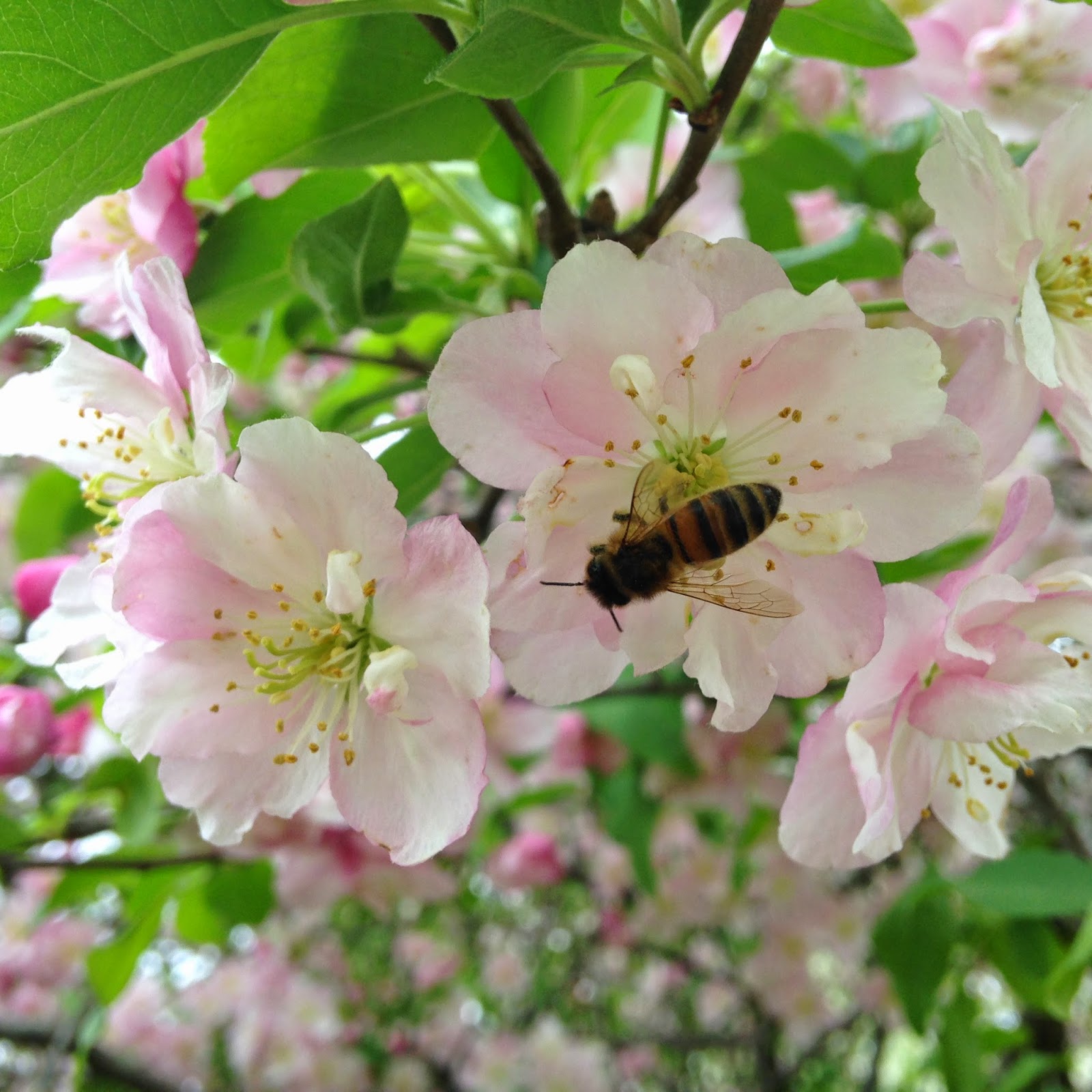
 The blossoms on the new apple tree all seemed to be opening at once.

apple blossoms close up

It was hard to capture a clear picture of each blossom, because they would not stand still. The branches of the new apple tree were towering up into the sky and swaying in the breeze.

apple branches swaying in the breeze
But where were the bees? Didn't they want to take advantage of the opening apple blossoms? No. They had all gone to call on the Weigela blooms by the woods.


The Weigela blossoms, more numerous that the apple blooms, and just as pretty, drew my entire bee population into their midst.

a bee comes to call on a Weigela bloom
The bees were so confused by the embarrassment of riches before them that they flitted too quickly from flower to flower to flower.


Which Weigela blossom is best? Which is the prettiest? Which offers the sweetest nectar? It is very hard for me to tell, and gauging by the bees' reactions, they don't know, either. Every one is beautiful in its own way -- and they are very hard to tell apart!