I am a primatologist who spends twelve hours most days in the company of a thirteen year old chimpanzee named Bow. I am also an editor with Inverted-A Press.
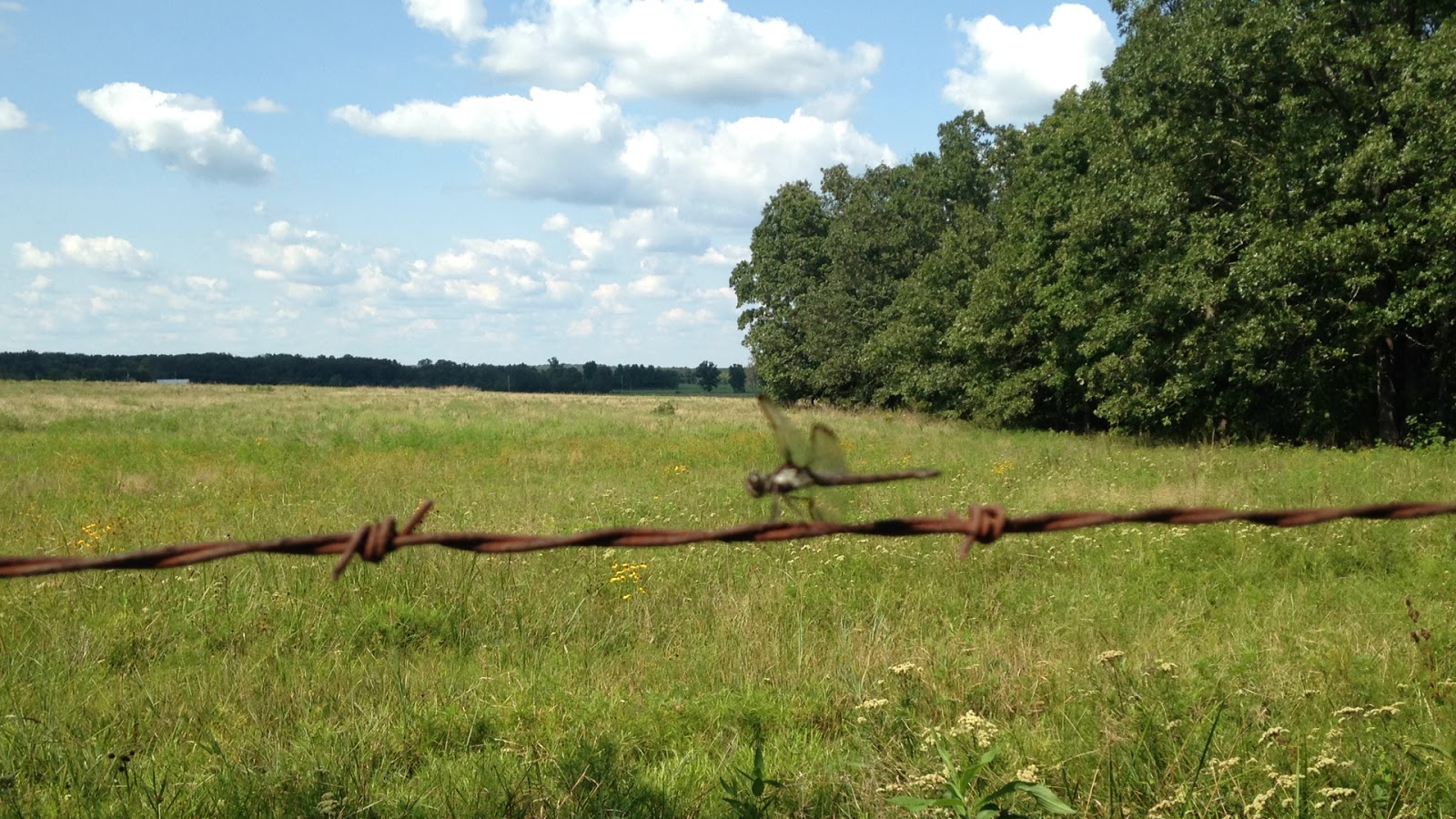
Yesterday, I spotted both a dragonfly and a damselfly in about the same place. The dragonfly was delicately balanced on the barbed wire that separates my land from the neighbors. The beautiful backdrop to the dragonfly was a landscape I do not own, but am lucky enough to enjoy anyway, from a distance.
The damselfly was less than a foot away, on a poison ivy leaf.
Now I have written about the difference between dragonflies and damselflies before. In that post, we established that the damselfly is as distantly related to a dragonfly as a human is to a rhinoceros,
But at the time, I only spotted a damselfly, and had no dragonfly to compare it with. Yesterday, I was given an opportunity to observe them both closely in a very similar environment.
At first, I noticed only the dragonfly, which was bigger and more active than the damselfly. It kept taking off from the barbed wire, only to return over and over again to the same spot.
Dragonfly in flight
It would get so small in the distance, then grow back in size as it came in for a landing, making its final approach.
Dragonfly coming in for a landing
This happened over and over again, and meanwhile, the damselfly was so quiet and demure and still, that I hardly noticed it.
But it was in almost the same place.
Nobody thinks that because dragonflies and damselflies are so distantly related, they should be kept apart for the purity of their races or cultures. They can hang out side by side, and there is no problem.
You might argue that it is because the two species occupy a different ecological niche -- one preferring barbed wire to perch on and the other poison ivy -- they pose no threat to each other.
But I have seen animals as distantly related as the great spangled fritillary butterfly and the common honey bee feeding side by side on the same flower.
A bumblebee, a honey bee and a great spangled fritilalry
And I have also seen animals as closely related as bumblebees and honeybees share the same flowers with the great spangled fritillary butterfly, and there was peace and harmony, and all went well.
And yet if someone suggests that bonobos and chimpanzees might be able to live together if they knew each other well and agreed to the arrangement, some experts frown. And for humans to live in the same environment as either species is verboten. It would be unnatural, they say. Why? Don't you think we evolved in pretty much the same environment? Don't you think we occupy the same niche? Don't you think there are also humans in Africa in a more or less natural setting? You might as well segregate the honey bees from the bumblebees and the damselflies from the dragonflies.
Of course, there are conflicts between similar animals occupying the same niche. But most of the differences between chimpanzees and bonobos are cultural. And if we are raised in a similar culture, we can get along with others who are not exactly the same as we are. At least we can, if we choose to.
Bow and I had a very quiet weekend. We had a task to accomplish, and we have accomplished it. We needed to go over the proof of the book Transatlantic Lives. The proof came back to us from the author, marked through in many, many places. We looked it over, and eventually I corrected it. It took three days of intensive work.
Today, after correcting the entire interior, I made a book trailer for Transatlantic Lives. And then when I was done, Bow asked me to spend some time with him. Sometimes he just likes to sit next to me, both of us quiet and still and nothing much happening. Sometimes, he asks to go out, and again nothing much happens. Our lives are marked by a conspicuous lack of drama.
In a novel or a short story, a lack of drama is a serious flaw. Drama is not just something that we look for in plays. Any story requires drama to hold our attention. Epic poems, ballads, and novels all require drama.
Drama does not merely consist of a list of events that happen in a given sequence. There has to be tension. There needs to be suspense. There are plot points and cliff-hangers and climaxes and denouements. If we don't have those things, then it's not dramatic.
One of the peculiar qualities of Transatlantic Lives is that even though the book tells about extremely dramatic historical events and how they impacted the lives of two individuals, the telling of it minimizes the drama, to the point where you almost feel that you are experiencing moments frozen in time, crystallized and preserved in all their stunning detail, but with the drama sucked out.
In this day and age, drama may not be what everyone is looking for, both in their reading material and in the lives that they lead. Many avoid drama, thinking that the word refers to people behaving badly or drawing undue attention to themselves. In common parlance, drama has come to mean melodrama or false hysterics.
I don't mind, at this point in my life, that not every day involves a dramatic turning point. But I sometimes wonder whether Bow might not be missing out on the usual dramas that take place in a chimpanzee social group: males fighting over dominance, coalitions forming, couples forming and going off to mate. These are all good things to have happen in your social group, and I'll readily admit that nothing even resembling that is going on around here.
Some people think that Bow belongs with his own kind and that keeping him from these kinds of interactions is a form of abuse or neglect, because every chimpanzee longs for the drama of natural social group, so that he can practice his social skills and feel that every day is a meaningful, significant plot point in his short, but highly dramatic life.
Yes, in the wild life is much shorter, and much more exciting. And I do feel guilty sometimes that Bow has been deprived of that. If I could, I would provide him with a mate. If I could, I would give him other males to play -- and fight -- with.
But recent criticism of Sue Savage-Rumbaugh has made me realize that the people who want Bow to be sent off to a sanctuary are not actually planning on letting Bow enjoy mating and striving for dominance in a social group.
Sue has been accused of "abusing" the bonobos under her charge because:
1) She allowed them to be together, and in some cases this involved two or more of the males getting injured in a fight over dominance.
2) She allowed them to be together, and this has led to copulation and pregnancy.
And now these people are saying that the bonobos should be taken away from Sue and sent to a sanctuary where nothing like that can ever happen.
If depriving a chimpanzee or bonobo of the companionship of his own kind is abusive, and if allowing them to have that companionship is also abusive, then I can't imagine what would not be abusive.
At the moment, Bow and I are pretty content with our undramatic lives. He's not yet eleven, and though he longs for a mate, he would probably not be allowed to mate by other males in his group, if he lived in a social group. In fact, he would probably get beat up a lot, to keep him from mating.
But if the time comes when it's possible to provide Bow with companions of his own kind, I am willing to put up with the drama, for the sake of the fulfillment that would come with it.
What the critics want, however, is very unclear. It's almost as if they are hoping for a utopia where all the fulfillment of striving for happiness comes with none of the drama. I think it's a pipe dream.




 Posts
Posts


