Search This Blog

Showing posts with label butterflies. Show all posts

Wednesday, May 30, 2018

The Merry Month of May

May has been merry. I can't point to any big achievements, but things are moving in a good direction, and we are gaining momentum slowly.


As the weather grew warmer, Bow and I spent more and more time out of doors.


More time outdoors meant more grooming and more mowing the lawn.


While mowing the lawn, I discover butterflies hidden in the grass.


Other things come to my attention, like the common milkweed that I found growing in the lawn.


There were three such plants, and on the day the mowers came, I was going to ask them to transplant them to the flower garden by the lagoon. But when the mowers came, two of the plants were gone, roots and all! At first I was a little paranoid. Had someone followed me and stolen my milkweed before I had a chance to transplant it myself? But my gardener explained to me that it was probably an inside job, performed by moles who ate the milkweed root first, starting deep in the ground and working their way up to the leaves. Only the smallest milkweed plant remained, and after it was transplanted, it wilted and fainted all the way to ground.


The prognosis did not loo good, but I kept watering it. Meanwhile, I discovered a purple milkweed patch growing by some dogbane in the pasture.


This will be a great way to compare the growth and habits of dogbane and milkweed, I thought. But it wasn't only the plants that were starting to propagate. On Mother's Day, I discovered a new nest.


These were not robins' eggs, like the one I had seen in years past. These were brown and white, marbled.


I was looking forward to watching them hatch and seeing what sorts of birds they turned out to be, but the next day, the nest was empty. Is there somebody following me around and taking whatever I find? I wondered. But probably not. Probably it is just part of the grand scheme of things, where not every living being that sprouts or is conceived gets to make it past the very earliest stages. Being culled out is part of the system. Redundancy and wasted life are part of the grand design. There are so many, because not all are expected to make it. And still, despite it all, some do survive! I am glad of that.


I was very grateful to have Sword home for Mother's Day, and Bow enjoyed the gifts she brought, too.


How they both have grown! Soon a new Audible and Kindle version of When Sword Met Bow will be coming out, read by Kelly Clear. My time for raising babies is done, but this book can help the families that are just starting out to introduce a new baby to older siblings. .

When Sword Met Bow -- Order Here

My other children's book, Ping and the Snirkelly People will also soon be out, read by Evelyn Adams. It describes the process of acquiring a second language by total immersion.

Ping and the Snirkelly People -- Order Here
However, on most days right here in and around the pens, life unfolds more like my third children's book, In Case There's a Fox. Through daily walks I encounter various animals, and they don't always tell me what they are up to. I can ask the rabbits to let me now what the turtles are doing, but until I look down and notice the turtles, the rabbits will keep mum.


On May 15, I spotted a couple of rabbits behind the garage and moved in closer to take a look.


As I drew closer, one of the rabbits ran away, but I kept my focus on the other rabbit, still oblivious of the indistinct rock-like thing in the grass by the fence.


Would you believe that, even at this distance, I was so focused on the rabbit that I had no ideas there were turtles in the picture? The rabbit stood very still. I wonder what it was thinking. I'm guessing it knew all about the turtles in plain sight.


I kept coming in closer to get a better look at the rabbit, and it kept holding its ground, until the moment when it ran off. Then I noticed there were two turtles at my feet!


I've never seen anything quite like it. But it's not going into any children's book.


My friend, Pam Keyes. who is an expert on turtles, told me that the female of the pair is at least sixty years old. Male turtles prefer older females to mate with, because their offspring have a better chance to survive. We recognize this particular female by the BB gun hole in her shell.. I have decided to call her Beebee.


Later that day, I saw Beebee just outside the fence. I thought maybe she was scouting locations to lay her eggs. But it was a bit early for that yet.

The sagas of box turtles in love and rabbits keeping their secrets are mostly for my own amusement. For the regular viewers of my channel, Bow is the only star attraction. Our most popular video for this month was the one from May 18 of Bow grooming me, but stopping short of picking my nose, when I asked.


In the Missouri Ozarks, May is part of the rainy season. It rains day after day sometimes, and the lush vegetation is richer for it. It's not such a bad way of life. But Bow prefers that it never rain, so he can go sunbathing in the outer pen. Lately, though, he has been taking the weather mostly in his stride.


For several days it rained, with brief periods of respite in between  The video above is from May 19, when Bow went out between rainstorms and displayed at the wind -- without setting foot on the wet floor of the pen! After the rain, there was a bit of flooding, and small rivulets of water crossed the internal road on my property to get to the other side.


Beebee the turtle found a conveniently wet spot to dig a nest for her eggs. And the armadillos came out to play. There were so many bugs for them to feast on!


Although I wanted to immediately sit down and to report on Beebee the box turtle, seeing all those armadillos that very same day over and over again kept me distracted.


But the armadillos disappeared, after putting in a full day of appearance on the May 21st, and by Memorial Day they were long forgotten. We did have a nice encounter with several butterflies, instead.


The best part of May is hanging out in the great outdoors. And Bow, more than anyone else, knows how to hang out. He has it mastered!


Sunday, September 24, 2017

What is Conservation? What is Wildlife?

Bow and I live in one of the most beautiful places on earth: the Missouri Ozarks. However, I am not a native of Missouri, and while Bow was born in this state, he is not a wild animal In Missouri, all the chimpanzees are domesticated, and none is subject to the Department of Conservation. But Bow still enjoys reading The Missouri Conservationist and looking at all the big, colorful pictures of Missouri wildlife that can be found within its covers.


"What is that book about?" my reader from Scotland asked when he saw Bow leafing through the Missouri Conservationist.  I answered: "It's not a book. It's a magazine about wildlife and the flora and fauna of Missouri, the state that Bow and I live in. It has pictures of the same kind of deer and the same kind of butterflies that lie just outside our front door." And that is really what it is. This issue featured Monarch butterflies and white tailed deer of the very sort that showed up in the last few entries in this blog.


Deer come almost right up to my front door. I go out to the meadow and each time I meet a different butterfly.


We don't really need to read the Missouri Conservationist to see these sights, but the Missouri Department of Conservation puts out the magazine, and Bow's friend Charla subscribes to it and brings Bow copies to read.

Another friend who saw the video of Bow flipping through the pages of the Missouri Conservationist had this to say: "Sorry Bow, no cute chimps (other than you) in the Ozarks."  But that's not quite factual, so I replied: "There are actually quite a few here in Missouri, but they are, of course, not native wildlife." I meant that because all chimpanzee in the US are domesticated, they would naturally not pose for the Missouri Conservationist, the way the deer and the butterflies do. But my friend said she thought Bow was looking for girlie pictures. Well, that's what we have Harper's Bazaar for. But it's something that I am very thankful for that the Missouri Department of Conservation has shown no interest in our locally born and bred chimpanzees.

The same cannot be said for US Fish & Wildlife, who, by declaring that American domesticated chimpanzees are an endangered species, have opened the door for PETA to harass local breeders into giving up their chimps and sending them to sanctuaries where they will not be allowed to breed, based on the claim that the species is endangered. Attempts to get a declaratory judgment to say the Endangered Species Act does not apply have proved fruitless.

Right at the moment, I am very glad there are no pictures of chimpanzees in the Missouri Conservationist. At least our local government has not yet lost its mind. They know that conservation of Missouri wildlife only applies to Missouri wildlife, not exotics and not domesticated animals.


Saturday, August 20, 2016

The Secret Shame of Butterflies

Bow and I are terrestrial beings. As such, we breathe air, drink water, and take in nutrients from dead plants and dead animals. We breathe, we eat, we sleep, we exercise and express ourselves, sometimes loudly and sometimes softly, and we get rid of waste. We are not angels. We don't walk on air or take our nourishment without harming another living soul. But we are also not hypocrites.

Bow is not fooled by the Butterfly

Our dogs are the same. They play together. They eat. They defecate, And they are so innocent and alive and natural that they feel no shame concerning any of these functions.


And yes, I do have dogs. I own them. And they own me. And that's nothing to be ashamed of, either.


We eat. We breathe. We exploit nature for nutrients. And we give back a waste product, which in turn can be someone else's food. Everybody does that, right? It's nothing to boast about, but also nothing to be ashamed of.


And then there are the butterflies. They flit in and out of our lives, beautiful, resplendent beings, and we tend to put them on a pedestal, as if they alone did nothing awkward in order to gain their livelihood.  The black swallowtail flew right past me to land on a yellow bidens flower, but when I drew closer it flitted away.


This is how we like to think of butterflies -- as beautiful and independent, incorruptible and feeding on nectar and drew drops and moonbeams. But butterflies have feet of clay, too, not unlike spiders.


 The spider has an ugly reputation, because it captures and feeds on other insects.


But did you know that butterflies are not the innocent vegans we sometimes take them to be? One day, I saw a Common Buckeye sitting on something on my private road. From a distance, I could not tell what it was.


But as I drew closer, I could clearly see that the Buckeye had been perched on a dead frog. It rains every day, sometimes almost flooding the road, but as soon as the rain retreats, then we get sunshine, and things dry up very fast. Earthworms are not the only victims in this rapid change of environment, and sometimes frogs wash out of local ponds and end up drying to death on our road. Then the butterflies come out and feast on dead flesh.


You can't really blame the Common Buckeye for what it does for a living. As it gets older, later on in the butterfly season, it loses its ability to fly long distances, and sometimes you can just see it walking along down the road, looking for carrion.


There is no shame in eating what is available when it is available, unless, of course, you have been pretending to be something you are not. The coquettish orange-spotted purple in our backyard gives itself airs, as if it were far above us, and as if we were far beneath it. But we are on to it. Yesterday, we caught it on film eating dung!

The Orange-spotted Purple Caught in the Act
There it was in all its glory, and I, not wanting to disturb it, let the dogs into the house, so that the orange-spotted purple and I would have the backyard all to ourselves. Bow, in the outer pen, was the only other witness. So absorbed was the butterfly in what it was doing that it let me creep up on it and film its every move. But Bow was not fooled! You can hear him displaying at the butterfly in the background.


The butterfly had been boastful and imperious before, suggesting that it was low and base of me to take time out of my research to try to earn a living by getting paid for my time. The butterfly had acted as if it never stooped so low as to be motivated by money or nutrients. It was above all that. It only did things for art and beauty and science and the good of all mankind.  Don't you believe it!

People who utilize nonprofits to make a living hide their profit motive, But the motive is still there. And in odd, unguarded moments, they slip up and let you see what they are really like.


At a meeting of the Global Federation of Animal Sanctuaries (GFAS), the nonprofit's executive director, Kellie Heckman,  stated:
Most of us came into the animal welfare business, you know,  for one reason: It's because we love money. 
Then she realized she had slipped up, and she put her hand to her mouth and made an inarticulate shameful noise. Believe me, that is the one moment of truth in the entire video. Later, that part was edited out for public consumption, in the same way that dung could be edited out of my beautiful portraits of the orange-spotted purple butterfly. I was almost complicit in doing that, because I felt maybe my readers do not really want to know the truth about butterflies. But I decided to be brave.

The butterfly has been preaching to me that I should not ask for payment for my time and Bow's or for money to feed my dogs or to make repairs to my research facility or to put food on the table for my family, which includes Bow and my daughter, and the dogs and the birds who depend on us. The butterfly has accused me of selling out when I do things for a living, such as write for certain papers "which as everybody know, is worse the serving in a shop or scaring of the crows."

But I do good work when I write for the Libertarian Papers. I expose, for instance, how nonprofits are being used by the powerful and the wealthy.

http://thelibertarianrepublic.com/clinton-charity-begins-home/

I do good work for all of us, when I write about what the Federal government has been doing to break up the family.

http://libertybuzz.us/story/gary-johnson-will-supports-fathers-rights/2016/08/17/808/

I do good work in covering the FDA's attempts to corner the market on pain relievers.

http://thelibertarianrepublic.com/fda-seizes-kratom-dea-says-relieves-pain/

I am not a sell out because I want to be paid for my time, and because I don't pretend that I don't like money. Money is not the root of all evil. People pretending not to want money while they line their pockets at other people's expense are the problem.

So the next time a butterfly or a nonprofit tells you that it is above earthly concerns, don't you fall for that. Even butterflies need to eat. And they will stop at nothing to get what they want.


Tuesday, September 1, 2015

My Own Butterflies

Over the weekend, I visited a different place and saw different scenery.


I saw some beautiful landscapes, but I also noticed the butterflies. Everywhere you go in Missouri right now, there are butterflies.


The butterflies that I noticed were just like the butterflies at home: pearl crescents, common buckeyes, and even a passing red-spotted purple flying high. But there was one important difference: they were not my butterflies. I knew it, and they knew it, too. And so they did not stop to say hello, but just went flitting by.

"Aya, you can't own a butterfly," someone might want to say to me at this point. "You can't own any animal at all, because they have souls of their own." And I would beg to differ. You can tell who is yours and who isn't, by the way they behave. This is true of dogs, cats, and chimpanzees. And it includes human beings, too! Can you go up to strangers and give them a hug? Unless you are mentally challenged, you know there are boundaries. The boundaries may not be marked with a fence or a property line, but they are just as real!

Back home again, I went out into the backyard and mowed it yesterday, while Bow and the dogs did their own things. Everybody was glad I was back, and I was glad to be back. And since it was my own backyard, I could even stop in my work any time I wanted to, and take pictures of butterflies.


I saw what I thought was a question mark butterfly on the trunk of a tree, and while I was trying to get closer, a great spangled fritillary landed on my leg and then flitted off and landed again on my shoulder.


This never happens to me any place but at home, on my own land. But it has been happening more and more frequently lately, as if, after fourteen years of living here, the butterflies finally know and trust me.


With Bow and Brownie looking on, the butterfly remained on my shoulder for a good long moment.

Brownie watching as the butterfly moves freely on my shoulder
Then it flew away. Nowhere else than on my own land has anything like this ever happened to me.


People talk about how property lines and state boundaries and borders are all artificial constructs and how when the world is viewed from outer space, all that disappears. But we don't live in outer space. We live right here on earth, and when you get closer, really close, you can see that the property lines make a big difference in the behavior of every living being they affect, even if they are not marked from above.


The wildflowers on either side of the fence may look exactly the same, but when the neighbors mow their pasture, my flowers don't get cut down. And on some level of visceral feeling, I think they know it, and it alters their behavior. My butterflies trust me, and the butterflies that are not mine do not.


Trust is not something you can give somebody else as a present. Trust has to be earned. I have that with Bow. Bow has that with me. And that's what ownership is all about. And if you don't believe me, then take it from Nabal the Carmelite, in my novel Vacuum County.


Monday, August 24, 2015

Bow Sends Me Out

Early in the morning after breakfast, Bow is  sleepy.


Later as he wakens, he will ask to go outside. There Bow gets to strut his stuff.


He flexes his muscles and is king of all he surveys.


Meanwhile, I looks at the dayflowers while they are still open.


I have been spending a lot more time in the backyard, lately, because that is the only part of my outdoor property where the kitten cannot go.


The backyard is guarded by ferocious dogs -- Leo and Brownie -- and no cat may enter there. But late in the afternoon, Bow expects me to go for a walk, and if I do not go of my own accord, he tells me to go in no uncertain terms. He likes his alone time.


There are many more opportunities to meet butterflies in the front yard than in the back.


There are crescent pearls on sunflowers, silver-spotted skippers on wildflowers in the pasture.


Bumblebees share the blossoms with the skippers.


But just as I am most immersed in nature, I suddenly here that familiar meowing.


 And I see that the kitten is right there at my heels.


I would probably never even venture out of the house, anymore, if it were not that Bow needs his alone time.

Friday, August 14, 2015

Interacting with Distant Relations

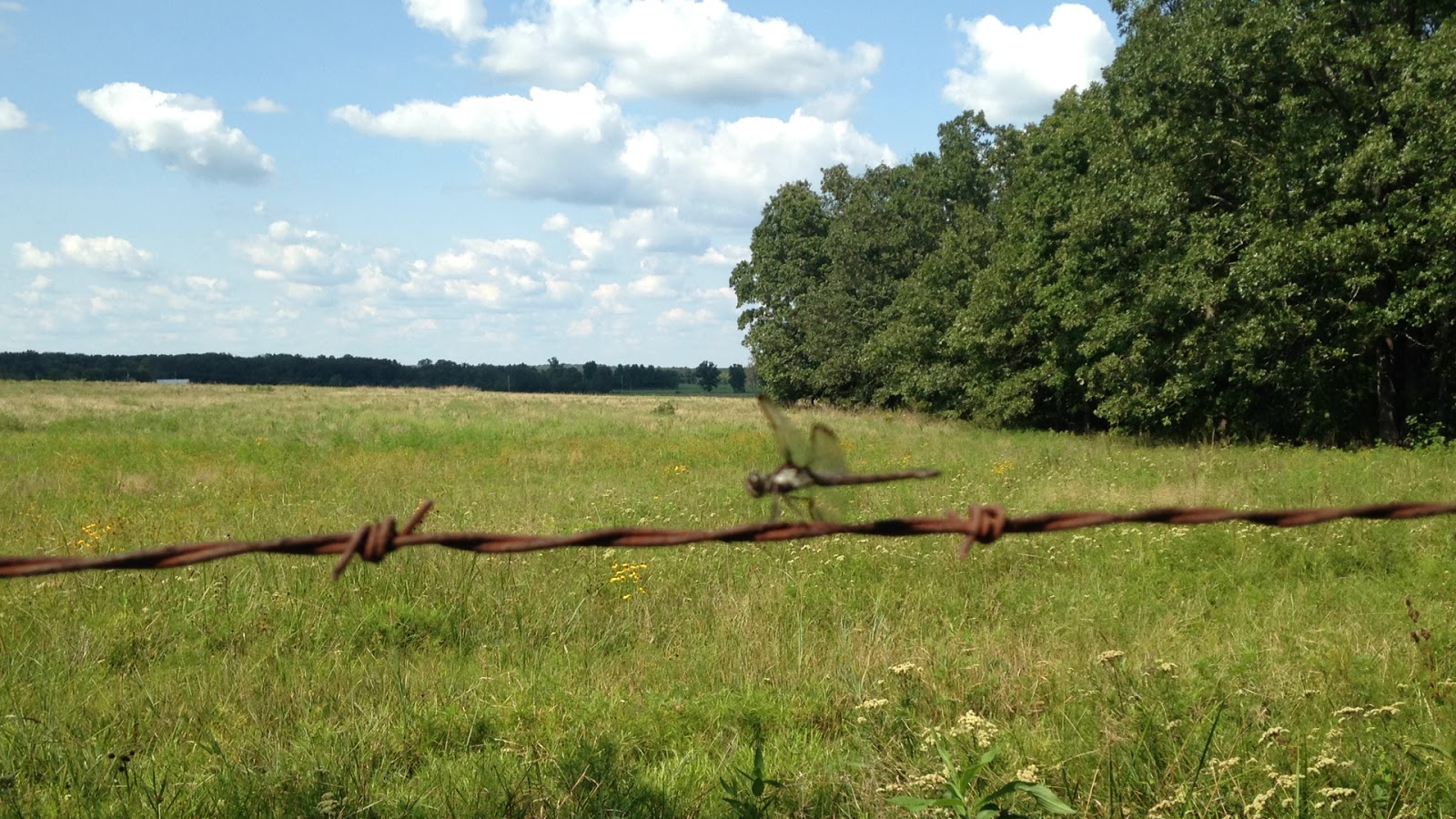
Yesterday, I spotted both a dragonfly and a damselfly in  about the same place. The dragonfly was delicately balanced on the barbed wire that separates my land from the neighbors. The beautiful backdrop to the dragonfly was a landscape I do not own, but am lucky enough to enjoy anyway, from a distance.


The damselfly was less than a foot away, on a poison ivy leaf.


Now I have written about the difference between dragonflies and damselflies before. In that post, we established that the damselfly is as distantly related to a dragonfly as a human is to a rhinoceros,

http://notesfromthepens.blogspot.com/2015/05/the-damselfy-and-phylogentic.html

But at the time, I only spotted a damselfly, and had no dragonfly to compare it with. Yesterday, I was given an opportunity to observe them both closely in a very similar environment.


At first, I noticed only the dragonfly, which was bigger and more active than the damselfly. It kept taking off from the barbed wire, only to return over and over again to the same spot.

Dragonfly in flight

It would get so small in the distance, then grow back in size as it came in for a landing, making its final approach.

Dragonfly coming in for a landing
This happened over and over again, and meanwhile, the damselfly was so quiet and demure and still, that I hardly noticed it.


But it was in almost the same place.


Nobody thinks that because dragonflies and damselflies are so distantly related, they should be kept apart for the purity of their races or cultures. They can hang out side by side, and there is no problem.


You might argue that it is because the two species occupy a different ecological niche -- one preferring barbed wire to perch on and the other poison ivy -- they pose no threat to each other.


But I have seen animals as distantly related as the great spangled fritillary butterfly and the common honey bee feeding side by side on the same flower.

A bumblebee, a honey bee and a great spangled fritilalry 

And I have also seen animals as closely related as bumblebees and honeybees share the same flowers with the great spangled fritillary butterfly, and there was peace and harmony, and all went well.

And yet if someone suggests that bonobos and chimpanzees might be able to live together if they knew each other well and agreed to the arrangement, some experts frown. And for humans to live in the same environment as either species is verboten. It would be unnatural, they say. Why? Don't you think we evolved in pretty much the same environment? Don't you think we occupy the same niche? Don't you think there are also humans in Africa in a more or less natural setting? You might as well segregate the honey bees from the bumblebees and the damselflies from the dragonflies.

Of course, there are conflicts between similar animals occupying the same niche. But most of the differences between chimpanzees and bonobos are cultural. And if we are raised in a similar culture, we can get along with others who are not exactly the same as we are. At least we can, if we choose to.