I am a primatologist who spends twelve hours most days in the company of a thirteen year old chimpanzee named Bow. I am also an editor with Inverted-A Press.
The temperature has been highly variable. The very day when I wrote about how cold it was, in the afternoon it was suddenly very warm again. I now can see that nature is hedging its bets, allowing some plants to carry on as if winter is almost upon us, while others behave as if it is spring.
This morning, Bow chose to go outside, But yesterday he did not, preferring to wrap himself in a blanket. I talked about how cold it was with the delivery lady, but she said that, actually, it was rather nice out. In the afternoon, I went for a walk, and I saw that the yellow butterfly was going about its business as usual, and there were still plenty of purple thistle flowers to accommodate it.
I try to draw closer, but the yellow butterfly merely flitted off, landing on another thistle flower further away.
Everywhere there were new flowers that had just now bloomed.
A blackberry bush was blossoming as if it had every intention of very soon bearing a berry.
There were tiny ants on the little flowers sprouting in the grass,
Small yellow flowers, looking a little like bidens, came up from the cut grass. And on the fruit trees, while most of the branches looked dead, a lone blossom opened here and there. Nature is hedging its bets. The plants and the insects don't know for sure which way things are going, so they are investing in one outcome and its opposite, hoping to survive in the long run.
I think this is something about natural selection -- and the economy -- and freedom of choice -- that is often misunderstood, It's not necessary that we all know exactly what the future holds. Survival of the fittest is not about getting better and better, nor is it about having foresight about future changes in the environment. It is about whoever happens to be best suited in a particular event, under specific circumstances, doing well. And nobody needs to know in advance who that lucky survivor is going to be.
Suppose that we don't know for sure what is the best diet or the best health care plan or the optimal solution of every problem. Isn't it good that different individuals make different choices? Nobody can know for sure which decision will turn out to be best, but at least we will not all perish for the same reason due to centralized planning. Somebody will do well, even though we may not know who. Maybe all the chimpanzees in America are about to be rounded up and sent to concentration camps from which they will never emerge and where they will not reproduce. In that case, it is good there are also chimpanzees left in other countries. But supposing all the chimpanzees in the wild are killed by the native populations among whom they live? Isn't it good that there are captive chimpanzees in North America, and in Europe and Asia, too? Do we really want to put all our eggs in one basket?
Who is to say what will happen? It is better to hedge our bets. A free economy does not work well because people are smart, and they make wise choices. It is not even a certainty that those who make a fortune do not do so in some small measure due to luck. Freedom of choice works well, because not everyone is doing the same thing. Not all are making the same mistakes, and so some will thrive, no matter how many others go belly up. If we don't allow that to happen, then we force everyone to go down together.
A deer I saw yesterday after dinner
If global warming keeps us from having a winter at all, then the cherry trees and serviceberry and the blackberry bushes will produce lots of fruit, and the wildlife will prosper.
And if it grows cold, and we have to wait till next spring, that will be fine, too. Either way, there are some who are already preparing and investing in the future. Some will win, and some will lose, but life as we know it will go on.
When I bought this property, the grass in the pasture, about five acres, was mowed short with only a few oak trees and the big twin pines standing out of what otherwise seemed like a very flat field.
You might say that it was an artificially induced oak savanna. According to the wikipedia, before Europeans came to this area, oak savannas were a dominant part of the landscape.
Fires, set by lightning or Native Americans, ensured that the savanna areas did not turn into forests. Only trees with a high tolerance for fire, principally certain oak species, were able to survive. On sandy soils, black oak (Quercus velutina) predominated. On rich soils bur oak (Quercus macrocarpa) was the major tree in Midwestern North America. These savanna areas provided habitat for many animals, including American bison, elk, and white-tailed deer. European settlers cleared much of the savanna for agricultural use. In addition, they suppressed the fire cycle. Thus surviving pockets of savanna typically became less like savannas and more like forests or thickets. Many oak savanna plant and animal species became extinct or rare.
Now that is a story you don't usually hear. I always imagined that the European settlers cut down trees and destroyed forests to create farmland. But instead, they seem to have created too much forest by preventing brush fires. What would Smokey the Bear say about that?
Things have been changing on my land since I showed up and stopped mowing the pasture, and the savanna is heading toward forest. It's a savanna still, but unless we have a fire soon, the trees that I never planted will grow into a forest. That is a strange thought for me. I don't want to mow, and I don't particularly want a fire. But fires are natural, and they are part of the life cycle of the land.And yet that does not seem to be direction in which things are headed at the moment.
Trees I never planted
It rains almost every day now, and when it does not rain, the sky is full of clouds and the air is full of mist and so a spontaneous fire is unlikely to get started. If anything, we seem about to grow a mighty rainforest.
Did you know that one of possible outcomes of our changing climate would be that the African savanna may turn into a forest? According to a letter by Steven I. Higgins and Simon Scheiter published in Nature, atmospheric changes in carbon dioxide can force abrupt vegetation shifts locally, but not globally. High accumulations of carbon dioxide actually shift a change from savanna to forest. It all comes out in the wash. So the destruction of the Amazon rainforest would be compensated for by the change of the African savanna into a rainforest. Devastating for local wildlife and people in both areas, but it's the case of the earth's ecosystem balancing itself.
Don't cry for Mother Earth. Cry for yourself. That seems to be the overarching theme. Sustainability does not necessarily mean local stability, when you look at things from a long term global perspective. And I think this is one of the many ways that the average tree hugger fails to consider the inexorable rules of nature.
When people talk about sustainability, they sometimes seem to envision a kind of stability that is not too different from stagnation. When they see change they think that if we caused it, it must be bad. But nature itself changes things all the time, in a none-too-gentle way. A wildfire is a devastating event that kills everything in its wake. And from that death emerges new life. But if you insist on putting out all the wildfires, then nature will find another way to balance things out. "Only you can prevent forest fires!" says Uncle Sam, the central planner, dressed in a bear costume. How arrogant is that?!
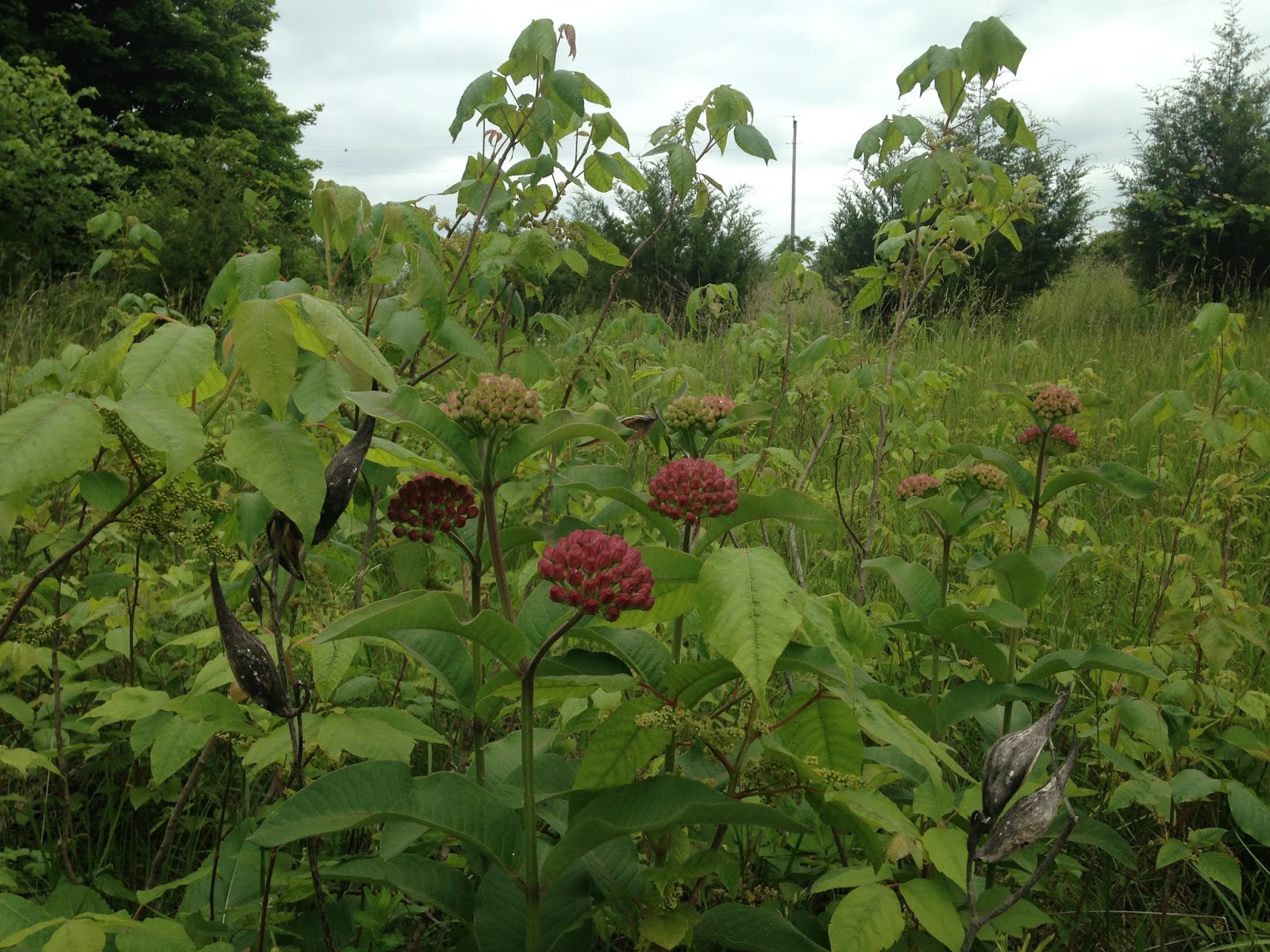
In my savanna/soon-to-be-rainforest, I have been keeping track of the milkweed population. Above is a photo of the purple milkweed in its usual spot. It has been flowering there for the past three years. You can see the old dried out seedpods right next to the fresh new flowers about to bloom. But that area is overrun with poison ivy, and there is no way to kill the poison ivy without also killing the milkweed. My common milkweed that grows by the oak in the pasture has already been strangled by poison ivy.
This is where the common milkweed used to grow
from this blogpost: Selective Stewardship
This year, I have looked in vain, and all I can see in that spot are very tall poison ivy plants. I am thinking that if the trend continues, the same will happen to the purple milkweed in its usual spot. However, the good news is that the purple milkweed has also propagated itself in a new spot with very rich soil: the little oasis of the Something Else Flowers.
In this part of the pasture, every flower blooms a darker, richer, brighter color than anywhere else.
The purple milkweed is just that much more purple here. The Something Else Flower is a richer shade of pink.
What is the secret that makes this ground so fertile? I think it has something to do with the leaves composting on the ground.
Don't stop watching the video of the insects enjoying the flower above until you have also seen the leaves on the ground and the ants swarming among them. If you want to see how an ecosystem really works, don't mow your pasture for fourteen years! Then you'll understand that change, not sustainability, is the first rule of nature!
In disturbed areas, such as by the side of the road, we see the most beautiful, delicate flowers bloom. This puff of a flower, which I have always called a mimosa, is also quite aptly named the sensitive briar, I learned from my friend Kathy.
The pollen on the edges makes the flower look like a lit firecracker or fireworks in the sky on the fourth of July. It grows there at the edge by the outer fence, and not in the middle of the woods, because every once in a while the mowers come and cut everything down by the side of the road.
It is also at the side of the road, where things are periodically mowed, that the purple milkweed is already blossoming, attracting bees, other insects, and an occasional motorist.
If we want to maintain an environment that is most inviting and sustaining for certain plants, then we have to destroy others. But destroying those others sometimes entails periodically killing off also the flowers that we most desire to foster. You can't get rid of poison ivy without getting rid of milkweed. It's only after the general devastation of a fire or a mowing that the milkweed gets a leg up over the poison ivy.
To create anything, you must first destroy something else. Our very lives are an unsustainable jaunt from birth till inevitable death. Civilizations rise and fall. Only a mighty oak survives the periodic brush fires that keep the entire wood from becoming a deep, thick black forest. But even oaks can be felled, sometimes brought low by the tiniest insects that prey on them.
Each flower fends for itself
It would be so arrogant to think that we control anything but the smallest part of our environment, or that any mistakes we make will be devastating to anyone but ourselves. Local devastation is not a global problem. It never was! Each flower fends for itself. And the balance of nature is quite inscrutable to the tiny ant.
Every day, Bow gets a wide variety of foods, most of them pretty natural, but some more on the junky side of the menu. None of it is food he has grown or hunted for or caught or picked. It's "unnatural", but it is also life in the lap of luxury.
Bow enjoying a strawberry
Meanwhile, on my ten acre property, lots of other animals are dining, too, al fresco, from things that grow here naturally. Some of them are even feeding on each other, and most of the drama and color of their lives is something that takes place when I am not looking.
I do patrol my land daily, and I take note of many things, like new flora that I have not noticed before. Did you know there are wild grape vines growing in my woods?
I will stop and take pictures of little bees as they enjoy the dandelions.
It is harmless voyeurism on my part.
But the majority of what goes on on my own property is not known to me, and that is just as it should be. Should I mourn the passing of every little sparrow? I am not cut out for that. Anyway, yesterday, late in the afternoon, I was chasing a colorful beetle, because I wanted to take its picture, but the beetle got away and it led me to the barn. I opened the door to the barn, and I forgot all about the beetle.
There, inside my daughter's old stroller, a tiny orange kitten was cowering.
As I tried to come in closer, to get a better look, it hissed at me. It was at once so tiny and helpless, yet so fierce. At first, I thought: "An abandoned kitten!" But then I realized it was probably not abandoned at all. Its mother was probably lurking just out of sight.
There is no way that a human being -- of the evil sort we imagine when we think of abandoned animals -- trekked all the way through my tick and flea infested pasture through the brambles and the briars in the dead of night when no one was looking just to very conveniently dump this kitten in the padded stroller in my barn. It is much more likely that a feral cat gave birth to the kitten on my property and chose the stroller for its safe place. And if I were to even so much as touch the kitten, the mother, who might be watching from the loft, would pounce on me.
I bought that stroller before my daughter was born, in preparation. We took it to Taiwan, where it proved to be way too broad to navigate the narrow, teeming streets without sidewalks. It was built for sturdy American notions of safety, but it was not practical for a country such as Taiwan. Nevertheless, it was the only stroller I had, so Sword used it for two years in Taiwan, and we brought it home to the United States where, in time, even Bow got to use it. Eventually, we didn't need it anymore, and it has been sitting vacant in the barn for many years until now, when another mother has found a use for it.
The animal rights activists think that being tame or wild is a genetic issue. The cat is a species that has been "domesticated". The chimpanzee is a wild species that has not been domesticated. But there are wild cats and tame chimpanzees, and it all depends on how they were raised. For intelligent species like cats and chimpanzees, it's nurture as well as nature, and culture is just as important as biology.
I'm not telling my daughter about the kitten in the barn, because she will want to adopt it. But as long as the kitten has a mother, I think I had best leave it to its mother's care. I put out a bowl of milk in the barn, not for the kitten who probably can't drink it, but for the mother who might like to know that I pose it no danger. As long as it stays in the vicinity of the barn and hunts for mice, I have no quarrel with the cat.
Sometimes it seems that the world is getting warmer and warmer, This summer, for a while, it looked that way to me. And then one day it got very cold, and the wind blew, and it rained, and everything was wet and dreary.
We have had some very hot days recently, almost unseasonably hot. But yesterday when I went for a walk in the pasture, there were no bumblebees on the thistle flowers, only cold little droplets of rain. It was so cold, I had to wear a jacket. What happened to the weather?
Even the spiders could no longer ply their trade. Their delicate little webs were full of sparkling droplets, looking like rare jewels in the dreary light.
The goldenrod, till now unnoticed, seemed to shine out against its dull surroundings.
If I did not know any better, I would say the world was coming to an end! But then I remembered that it's almost fall. And nature works in cycles. And so it's actually going to be okay. These things are supposed to be happening. Summer will come again, but first we have to get through fall, winter and spring.
Is the globe getting warmer? It's entirely possible. And that trend will continue, until the next ice age! Our planet lives on cycles. Some of the cycles are small, like day and night. Some are bigger, like the seasons. And some are bigger still, so big that you can't even observe them in a single lifespan.
You can watch the days grow brighter and longer and project that trend far, far into the future and call that progress, and then be totally undone when growth and warmth come to a screeching halt. Or you can recognize that it's a cycle. Unlimited growth is not possible. Growth and decay come each in its turn.
But there is even more at play here. Unlimited growth with limited resources is not possible. There are conservation laws in place. More of one thing always means less of something else. Reduce infant mortality and you get more abortions. Raise more cattle and you get fewer wolves. Start to use tools to enhance your prowess, and your muscles will shrink. It's not progress. It is this for that. There's an equilibrium in place that you cannot escape.
Bow can crack a hazelnut with his teeth. That's because he comes from a long line of beings that use their teeth as weapons and as tools and who have not resorted to nutcrackers or swords. Yes, I know that really big nuts are cracked on stones by resourceful chimpanzees, and that they can use sticks as weapons. But by and large their failure to develop a higher technology has left their bodies strong. We come from a common source. We, too, used to be that strong. We did not develop technology to make up for our physical inferiority. We lost our prowess when we started relying on implements. The selective pressure was lifted, so weaker individuals were not eliminated.
Should we choose one path, or should we choose another? Is there one way that leads to heaven and the other to hell? Does eating from the tree of knowledge cast us out of paradise? Or is it simply that there is a natural price for every choice we make?
There are conservatives who think everything should stay the same all the time. There are progressives who think we should have endless progress. They are both wrong. What we have always had, and always will have, is cycles.
We can change certain aspects of the way we live, and in so doing, we change ourselves. We can sometimes have more of one thing, if we are willing to have less of something else. Less of natural disease means more of genetic degeneration. More prosperity means less wilderness. More security means less freedom. We can change our preferences, but we can't change the laws of the universe.
They say that simply hearing natural ambient sounds, the wind in the trees, soft repetitive birdsong, the chirping of crickets, can help our bodies reenergize and heal themselves. Bow spends a lot of time immersed in the sounds of nature.
He relaxes outside on his bench, and because we are surrounded by open fields, woods and a pasture that has been left wild, there are natural sounds in all directions.
After lunch, every day I go for a walk. Yesterdsay, here is what I saw when I looked to the north.
The neighbors' cows were grazing peacefully in the field. Puffy white clouds hung in the azure sky. I went for a walk down the path in our pasture that leads south, and I saw the wild persimmons ripening.
Nobody planted them. They just grew there themselves. Some conservationists say "plant a tree." They imply that nature is like an underprivileged child, and it needs our charity. But nature is rich with its own wealth. I say: "Get out of the way, stop interfering, and the trees will plant themselves."
There is a great bounty to be had, if only we would get out of the way, make ourselves scarce and appear only in small numbers. My five acres of pasture in a natural state might not be enough to feed Bow, but five thousand acres just might do the trick!
I stopped for a moment to watch a bumblebee harvest nectar on a thistle flower. Somebody keeps telling me that the thistle is a noxious weed that needs to be eradicated. But the bumblebee did not seem to think so. It was doing its very best, hanging on despite the wind, trying to get as much as it could before the weather changed.
By evening, the skies had turned grey over the woods to the east. The wind moved the branches to and fro and dry leaves came tumbling to ground, occasionally seeming to stop for a moment in midair, as the wind changed.
Whenever I get back from my walks out of doors, I share the pictures and videos that I shot with Bow. He saw the bumble bee on the flower yesterday and suggested that I trim the video, because it ran too long. But then he fumbled with the iPhone and showed me what he really wanted.
The thing that Bow most enjoys about the iPhone is not watching nature videos -- it's taking selfies. And so I humor him.
Someday, I want Bow to be able to go on those walks with me again. That would require building a force field or at least a moat around the pasture. But the purpose is not to "liberate" Bow from an unhappy "captivity". It is just to expand his domain!
In nature, every being is an exploiter and every being is exploited, and the balance comes from the struggle of each individual to exist. The sense of harmony that we feel when we allow ourselves to experience nature comes from that, but it is a curious thing about humans, that as much as we enjoy the beauty, we are not really willing to pay the price.
Yesterday was father's day, and as Bow was making his usual displays of strength outside, I noticed that right under his feet, tiny little plants were sprouting.
Should I allow the little plants to grow there? Or should I sweep up the dirt and clean the outer pen, for hygiene's sake? It's a tough call. I have seen criticism on the web of concrete floors in enclosures for chimpanzees and other primates. The latest thing seems to be to grow grass inside the enclosures, because that is supposed to be more comfortable to walk on and more natural.
Natural? Do you know that grass grows high and attracts fleas and ticks? Do you know that we have to use insecticide on our lawn to keep the dogs in the backyard flea and tick free? The insecticide would not be good for Bow, so it seems safer just to keep the pen clean.
This reasoning is a constant conflict in my mind, and I can hear it echoed in the discussions of others. On the one hand, we all love nature. But when it comes to the parasites and the diseases and the predators and the risks involved, we don't like nature so much. Take all the rainfall we have been having. It seems more than sufficient for the needs of my pasture, which is green and lush and full of living things.
To me, it looks like almost a tropical paradise. But friends of mine who have horses have told me that we have not had nearly enough rain to maintain the hay and alfalfa needed to support the livestock that everyone depends on.
There's enough rainfall for what naturally grows here. But for purposes of agriculture there is not enough. So how about it? Is the problem not enough rain or too much agriculture? It is a really hard question to answer. In order to feed all the world's people, we need agriculture. And among the left wing contingent, there seems to be a real lack of consensus as to whether we have too many people or not enough farming.
Take this article by a former vegetarian who now admits that eating meat is kind of good for us, and who believes that agriculture is the problem.
Notice that the article makes a certain amount of sense, until it gets into politics. Then all of a sudden it's the wealthy that we have to fight against to save the planet. But whenever someone owns a lot of land and allows everything to grow fallow, that is wealth. Activists don't seem to understand that land ownership is the greatest wealth that there can be, because in order to live like hunter-gatherers and enjoy that healthy lifestyle, each person would have to be able to control a much higher acreage per capita than any of us currently have. We would all need to get to be much more wealthy to revert to that lifestyle. The reason we don't is that we can't afford to. In order to save the bees, we need to grow more flowers and fewer wheat fields.
There are plenty of bees on my land
It's not really just about the evils of GMOs or pesticides. It's about how many humans can we feed and still not lose the ability to sustain the ecosystem that we all depend on. It's a game of numbers. And when it comes to chimpanzees, it's also about the numbers.
I went for a walk in the pasture this morning, and on my way I had brief encounter with a rabbit. A little further on, I met a shy turtle.
The shell of this turtle was damaged, and there were mosquitoes swarming around it. As I was trying to take a picture of the turtle, mosquitoes landed on my hand and took a drink of my blood.
I proceeded to take my walk in the pasture, which now supports a lot of life. But it would not be enough to support the life of a single human or single chimpanzee. We would need a lot more acreage than that.
On the way back I ran into the turtle again.
One of the benefits of being a natural turtle is that you get to decide where you go, instead of being told. It soon decided that it wanted to walk away.
The down side of being a free turtle is that if you get injured or are sick, no one will take care of you. It's survival of the fittest. There is nothing more Darwinian than nature. That's why I wonder sometimes at people who say they want everything to be natural and then support mandatory healthcare. How can they be so inconsistent? What are they really thinking?
As long as I am responsible for Bow's health, I have to keep the ticks and the fleas away, and in order to do that, we can't have wild grass growing on the floor of the outer pen. But the moment I find a large enough ecosystem to support Bow, then he will need to be able to withstand the ticks and fleas on his own, even if it means that some members of his family may succumb to disease because of this. Which is why in nature there is a higher birth rate and higher death rate than the civilized world allows, and populations are kept healthy and fit by the parasites and the predators that feed on them. There is no better health insurance for a population than nature, but the premiums, in the form of infant mortality and death upon disability, are rather high!
When the weather is nice, Bow enjoys being outdoors so much that he chooses to stay out most of the day. Yesterday was warm, there was a gentle breeze, and the birds were serenading all day long. Bow came in for meals and snacks, but other than that, he just wanted to stay outside, even during nap time.
There are many health benefits to taking a nap. It's a way to recharge and de-stress, and if you take a short nap in the afternoon, then it will eventually also help you to sleep better at night. Bow does not need to be told this. He takes a nap every afternoon. But there is nothing like a nap outside in the very lap of nature!
When the birds are serenading, repeating the same line of music over and over again, this is the perfect ambient noise, the one we evolved to sleep to.
Even if you start out wide awake, eventually as the breeze caresses your face and the birds repeat the same flourish of notes, your lids will grow heavy.
You will be lulled into a sense of security, knowing that if any predator were to approach, the birds and the dogs who are keeping watch over you will sound the alarm.
There is nothing to worry about. You are safe and snug and loved and cared for. The birds are telling you that.
Yesterday afternoon was the perfect day for an outdoor nap. Conditions were optimal. There was nothing to worry about and nothing to fear, as the birds stood watch over Bow.
Bow took full advantage of the opportunity, as who wouldn't?
Today is another day. The skies are overcast and dark clouds are threatening. The birds in the front yard are still singing, but they are not saying "all is well".
Instead, they are chirping: "It's going to rain! It's going to rain!" I predict that Bow will take his nap indoors today. But while it lasted, yesterday was the perfect day for a nap in the lap of nature.




 Posts
Posts


