I am a primatologist who spends twelve hours most days in the company of a thirteen year old chimpanzee named Bow. I am also an editor with Inverted-A Press.
Yesterday morning, the chickens from across the fence were back. But this time, they were bolder. And they brought reinforcements.
I could see the chickens from a great distance, and they seemed to have made it quite far into my yard from their initial illegal border crossing.
I could hear the neighbors calling to them from the distance: "Here chick--ee chickee. Here chick-ee chick-ee, chick-ee!" But if I had not herded them toward the fence, they probably would have stayed right there.
Shortly afterwards, they came right back. I was watching them from my kitchen window, and I thought I saw two dogs run right through the spot where the chickens were crossing and then disappear into my unmown pasture, which right now is more like a wildlife preserve than a pasture.
By the time I approached the chickens, the dogs were nowhere in sight, but they were on my property and not the neighbors'. And this fact seemed to embolden the chickens.
Now the chickens were not running so fast to get away from me. They were strolling at a leisurely pace.
They even paused for a short while by the new apple tree in the orchard. And even when they had crossed over to their own side of the fence, they just stood there and looked at me.
They seemed to be saying to themselves:"Let's wait right here until she leaves. Then we go back in!"
On my stroll back to the house, I was suddenly confronted by the neighbors' dogs, who came out of my overgrown pasture. One of them was my old friend Cowboy the Neighbor Dog. He is very well behaved. But his young and much bigger friend was much less socialized, and he actually dared to bark at me on my own land, as if I were the one who was trespassing.
When I glanced over at the other fence line, I saw the chickens were still there, on the other side of the fence, watching and waiting for the chance to cross back over. Were the dogs and the chickens from my neighbors' yard acting in concert? Was this a planned invasion?
Dogs and chickens can coexist and even work together. But it's not always the case. When I had chickens who were kept separately from my dogs, the dogs eventually got to them and killed them. Yet where chickens and dogs are allowed to roam free, coexistence does not seem to be such a problem.
Why is that? What can we learn from this about humans and chimpanzees?
Early in the morning after breakfast, Bow is sleepy.
Later as he wakens, he will ask to go outside. There Bow gets to strut his stuff.
He flexes his muscles and is king of all he surveys.
Meanwhile, I looks at the dayflowers while they are still open.
I have been spending a lot more time in the backyard, lately, because that is the only part of my outdoor property where the kitten cannot go.
The backyard is guarded by ferocious dogs -- Leo and Brownie -- and no cat may enter there. But late in the afternoon, Bow expects me to go for a walk, and if I do not go of my own accord, he tells me to go in no uncertain terms. He likes his alone time.
There are many more opportunities to meet butterflies in the front yard than in the back.
There are crescent pearls on sunflowers, silver-spotted skippers on wildflowers in the pasture.
Bumblebees share the blossoms with the skippers.
But just as I am most immersed in nature, I suddenly here that familiar meowing.
And I see that the kitten is right there at my heels.
I would probably never even venture out of the house, anymore, if it were not that Bow needs his alone time.
Yesterday it rained all day, and today does not look to be very different. While flooding has occurred in the nearest large metropolis, on my property the most that has happened is that the ditch running alongside my internal road has turned into a peaceful babbling brook.
For Bow, however, all this rain has led to a certain amount of boredom. He enjoys going outside every day, but when it is raining, even very slightly, he will not venture out.
You can lead a chimpanzee to water, but you cannot make him cross the threshold.
There he sits, with a bemused expression, seeing the rain fall, but refusing to budge.
Set him free! the heckling animal rights people often say, when they post comments on my videos. But where would he go? How would he find shelter from the rain?
The rain is good for the flowers and the trees, By extension, this is good for the butterflies and the bees.
But none of them seem to like it when it actually rains. If they had direct control over the weather, it might never rain, they dislike it that much. You don't see them outside when it rains.
I regret that I did not excavate the perimeter of my pasture this year, because this would be a good year to fill the moat that would create Bow's island. Other years there will be much less rainfall. We have experienced droughts before. We will have droughts again. Variability is built into the weather. People find reasons to complain, no matter what the weather brings.
The question is: Once he has that island of his own, how will Bow keep from ever getting wet?
When I bought this property, the grass in the pasture, about five acres, was mowed short with only a few oak trees and the big twin pines standing out of what otherwise seemed like a very flat field.
You might say that it was an artificially induced oak savanna. According to the wikipedia, before Europeans came to this area, oak savannas were a dominant part of the landscape.
Fires, set by lightning or Native Americans, ensured that the savanna areas did not turn into forests. Only trees with a high tolerance for fire, principally certain oak species, were able to survive. On sandy soils, black oak (Quercus velutina) predominated. On rich soils bur oak (Quercus macrocarpa) was the major tree in Midwestern North America. These savanna areas provided habitat for many animals, including American bison, elk, and white-tailed deer. European settlers cleared much of the savanna for agricultural use. In addition, they suppressed the fire cycle. Thus surviving pockets of savanna typically became less like savannas and more like forests or thickets. Many oak savanna plant and animal species became extinct or rare.
Now that is a story you don't usually hear. I always imagined that the European settlers cut down trees and destroyed forests to create farmland. But instead, they seem to have created too much forest by preventing brush fires. What would Smokey the Bear say about that?
Things have been changing on my land since I showed up and stopped mowing the pasture, and the savanna is heading toward forest. It's a savanna still, but unless we have a fire soon, the trees that I never planted will grow into a forest. That is a strange thought for me. I don't want to mow, and I don't particularly want a fire. But fires are natural, and they are part of the life cycle of the land.And yet that does not seem to be direction in which things are headed at the moment.
Trees I never planted
It rains almost every day now, and when it does not rain, the sky is full of clouds and the air is full of mist and so a spontaneous fire is unlikely to get started. If anything, we seem about to grow a mighty rainforest.
Did you know that one of possible outcomes of our changing climate would be that the African savanna may turn into a forest? According to a letter by Steven I. Higgins and Simon Scheiter published in Nature, atmospheric changes in carbon dioxide can force abrupt vegetation shifts locally, but not globally. High accumulations of carbon dioxide actually shift a change from savanna to forest. It all comes out in the wash. So the destruction of the Amazon rainforest would be compensated for by the change of the African savanna into a rainforest. Devastating for local wildlife and people in both areas, but it's the case of the earth's ecosystem balancing itself.
Don't cry for Mother Earth. Cry for yourself. That seems to be the overarching theme. Sustainability does not necessarily mean local stability, when you look at things from a long term global perspective. And I think this is one of the many ways that the average tree hugger fails to consider the inexorable rules of nature.
When people talk about sustainability, they sometimes seem to envision a kind of stability that is not too different from stagnation. When they see change they think that if we caused it, it must be bad. But nature itself changes things all the time, in a none-too-gentle way. A wildfire is a devastating event that kills everything in its wake. And from that death emerges new life. But if you insist on putting out all the wildfires, then nature will find another way to balance things out. "Only you can prevent forest fires!" says Uncle Sam, the central planner, dressed in a bear costume. How arrogant is that?!
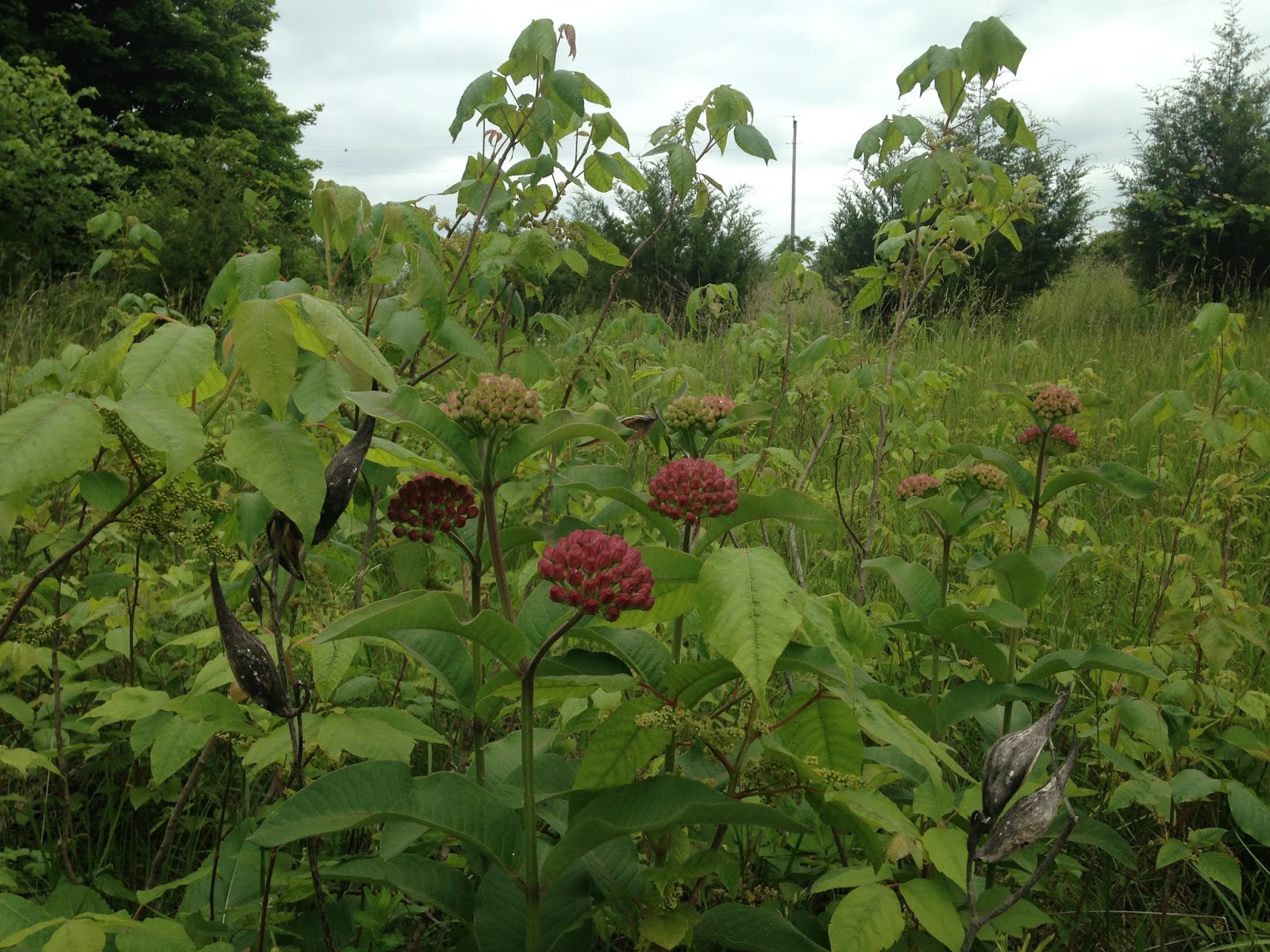
In my savanna/soon-to-be-rainforest, I have been keeping track of the milkweed population. Above is a photo of the purple milkweed in its usual spot. It has been flowering there for the past three years. You can see the old dried out seedpods right next to the fresh new flowers about to bloom. But that area is overrun with poison ivy, and there is no way to kill the poison ivy without also killing the milkweed. My common milkweed that grows by the oak in the pasture has already been strangled by poison ivy.
This is where the common milkweed used to grow
from this blogpost: Selective Stewardship
This year, I have looked in vain, and all I can see in that spot are very tall poison ivy plants. I am thinking that if the trend continues, the same will happen to the purple milkweed in its usual spot. However, the good news is that the purple milkweed has also propagated itself in a new spot with very rich soil: the little oasis of the Something Else Flowers.
In this part of the pasture, every flower blooms a darker, richer, brighter color than anywhere else.
The purple milkweed is just that much more purple here. The Something Else Flower is a richer shade of pink.
What is the secret that makes this ground so fertile? I think it has something to do with the leaves composting on the ground.
Don't stop watching the video of the insects enjoying the flower above until you have also seen the leaves on the ground and the ants swarming among them. If you want to see how an ecosystem really works, don't mow your pasture for fourteen years! Then you'll understand that change, not sustainability, is the first rule of nature!
In disturbed areas, such as by the side of the road, we see the most beautiful, delicate flowers bloom. This puff of a flower, which I have always called a mimosa, is also quite aptly named the sensitive briar, I learned from my friend Kathy.
The pollen on the edges makes the flower look like a lit firecracker or fireworks in the sky on the fourth of July. It grows there at the edge by the outer fence, and not in the middle of the woods, because every once in a while the mowers come and cut everything down by the side of the road.
It is also at the side of the road, where things are periodically mowed, that the purple milkweed is already blossoming, attracting bees, other insects, and an occasional motorist.
If we want to maintain an environment that is most inviting and sustaining for certain plants, then we have to destroy others. But destroying those others sometimes entails periodically killing off also the flowers that we most desire to foster. You can't get rid of poison ivy without getting rid of milkweed. It's only after the general devastation of a fire or a mowing that the milkweed gets a leg up over the poison ivy.
To create anything, you must first destroy something else. Our very lives are an unsustainable jaunt from birth till inevitable death. Civilizations rise and fall. Only a mighty oak survives the periodic brush fires that keep the entire wood from becoming a deep, thick black forest. But even oaks can be felled, sometimes brought low by the tiniest insects that prey on them.
Each flower fends for itself
It would be so arrogant to think that we control anything but the smallest part of our environment, or that any mistakes we make will be devastating to anyone but ourselves. Local devastation is not a global problem. It never was! Each flower fends for itself. And the balance of nature is quite inscrutable to the tiny ant.
The mowers came again yesterday, as the grass had been getting quite tall again. They hurried to get all done in one day this time, because as usual, we are expecting rain. Bow asked to go outside into the outer pen after they came, but when I opened the door, he gestured for me to come with him. I told him I would come, but I had forgotten to bring my phone to film with, so I went back inside
Alone in the pen with all that noise from the mowers, Bow looked unsure of himself.
When I came back out with the phone, I was surprised by a sight that I never expected to see: Bow was apologizing to Leo. I was not really ready -- it was so unexpected, that I not able to get pictures of the entire apology, so this is just the tail end of it.
Leo did not quite know what to make of Bow's apology, but even as the dog walked away, Bow was still trying to make up to him, with friendly faces.
This may look silly, but this is the face Bow makes when he is trying to ingratiate himself with someone
In case you want to refresh your memory as to what Bow's full apologies look like, you can read this post from 2013:
Now why would Bow feel he needed to apologize to Leo? What was he apologizing for? You may well ask. He was probably not apologizing for any specific thing, so much as trying to get into Leo's good graces. Bow had wanted me out there for moral support against the mowers. When I left, he felt a little abandoned. Rather than displaying at Leo, the way he usually does, Bow was trying to get Leo to help him against the mowers, in case he needed extra support. He was not saying "I am big and strong and I can beat you up!" as he usually does. He was saying: "If I was mean to you, I am sorry. Now please help me."
Bow's apologies, even when they are to Lawrence or to me, are extremely pragmatic in motivation. He does not really apologize because of heartfelt remorse. He apologizes because he's in trouble, and he is trying to get out of it. That's really not so different from most humans I know.
Even after I was out there and Bow did not need Leo's help, he still was not as aggressive as he usually is toward the dog. His focus was more on the mowers, and he did not seem to be able to decide whether he wanted to court them or warn them. In the video above, the gently rocking up and down dance that Bow initially does on top of the bench is not an aggressive move. He does break into a kind of display afterwards, but it, too, is less aggressive than usual, and you can see that he has no problem with Leo, showing only friendly regard to the dog, while he worries about the "mower problem."
Later, the head mower came in the house, and Bow said hello to him. He has known the man many years and actually seems to like him. He's just not crazy about the machinery that is used to mow the grass and the noise it makes.
When the mower and Bow were communing, I mentioned to him that the next plant about to bloom by the lagoon was the yucca, and I needed the poison ivy cleared away from around it, so I could admire the blossoms. Only just at that moment, I could not remember what the yucca plant was called. So I fumbled around for words to describe it, and here's what came out: "Spiky leaves. Tall tower of flowers. Cactus." Now, I knew that was wrong when it came out of my mouth. A yucca is not at all a cactus. But I needed a fast way to say what I wanted, and I could not think of the right classification: succulent. However, this shorthand, inexact description was good enough for the mower, and he got the job done! It's funny how faulty phylogenetic classification is good enough to communicate with another human being.
Poison ivy spreads everywhere, and I am allergic to it, so I have been trying to think of ways to get rid of it that would not harm the other plants. The last time we spoke, the mower said that he had heard of a spray that gets rid of poison ivy. But on further inquiry, he informed me yesterday, that spray would kill everything else, too. "Well, we don't want that," I commented. And he agreed.
In the evening, I enjoyed resuming my favorite walk on the newly mown trail. I got to see flowers that have only just now bloomed on either side of the path.
However, I saw no new wildlife until I got back to the mowed portion of the yard.
I spotted a rabbit from afar. But the rabbit disappeared into the underbrush by the lagoon, and then I heard a sound and saw a deer leap across my fence, and into the neighbors' field. I went toward the fence line to look.
The deer stood there for a while looking at me and twitching its tail, so that I wondered whether it was waiting for a companion to follow. But when no one else came, it went into the woods.
And just as the deer disappeared, I heard some rustling from the underbrush by the lagoon. I thought it was the rabbit coming out again. But no, it was an armadillo!
The armadillo did not seem to be aware at first that I was watching him. He went out to the newly mown grass and started digging at once.
I wanted to get a better look at its face, but when I drew closer it suddenly noticed me and initiated a program of armadillo evasive maneuvers, which are quite different from rabbit evasive maneuvers.
He went straight for the woods and took a very short break there. After taking a short rest among the cypress spurge plants at edge of the woods, he continued on his way in a more or less straight line trajectory -- no zig-zagging for him -- until he hid for a while under the storage building.
The armadillo did not stay there for long, though. Soon I could see that he had crawled out from under the storage building and was going as fast as he could toward the barn, where he seemed to think he would be able to take shelter. However, no sooner had he gone into the barn than he came out again. I think the kitten scared him away! I watched as he went into the woods by the barn and pursued him no further.
The coming of the mowers causes a temporary disruption in the normal flow of events around here, but that subsides pretty fast. The grass starts to grow again. The wildlife goes back to its usual habits, and so do the rest of us. This morning, Bow was displaying aggressively at Leo again, and Leo was bounding up in the air and barking at him. Everything is back to normal.
After many, many days of incessant rain, the sun has finally come back out. Bow is happy.
On Wednesday Lawrence stayed with Bow while I ran errands. When the delivery person brought a new man with her, Bow was at first wary, but then he warmed up to the new man. It turned out he really liked him. Bow gestured to Lawrence excitedly that he wanted to say something. Then he took Lawrence's hand and spelled: "I want him to come in."
Bow can go for a long time without saying anything new or surprising. But when he needs to say something in order to express himself, he knows how.
Someday, we will develop new ways to test intelligence and learning. Instead of expecting a subject to be compliant, we will test what they can do when they are actually engaged by the subject and are initiating a communication rather than responding to one.
Successful employers have already noticed that a high GPA predicts little about future performance by a employee, besides coming to work every day. Soon they will realize that standardized testing does not tell you much about creative use of intelligence in real life. Once we develop a way to determine knowledge and ability without cooperation, when we distinguish compliance from intelligence, Bow's achievements will shine, and people will see that he is much smarter than that dog who can identify objects by name on command.
In the meantime, Bow and I continue with our routines. There's a new review of Theodosia and the Pirates: The War Against Spain on Amazon. Bow and I are spending more time outdoors. In the video below from yesterday, Bow and I were just sitting peacefully on the stoop together, when I noticed an injured wasp on the floor. I asked Bow if he caused that.
Right after lunch, I went out for a walk and noticed a butterfly sunning itself on the road. I stayed and looked at it until a car drove by and the butterfly flew away.
On my way back to he house, I spotted several colorful butterflies enjoying the milkweed flowers in our pasture.
In the evening, I went to a local carnival with my daughter and her friend. It was Friday the 13th, and people had made up a rumor that there was a murderer at large at the carnival. Of course, we saw no sign of a murderer. But I did get a great shot of the sun setting at the carnival grounds.




 Posts
Posts


