I am a primatologist who spends twelve hours most days in the company of a thirteen year old chimpanzee named Bow. I am also an editor with Inverted-A Press.
The first living being I saw when I went out for my walk yesterday afternoon -- after being greeted by the kitten, of course -- was a three-toed box turtle on the grassy area in the middle of my internal road.
The turtle kept its head out, but it seemed a little traumatized, and it had white damaged areas on the top of its shell. The kitten pretended at first not to be interested at all, but it did walk by a couple of times.
"I am just minding my own business," the kitten seemed to be saying. "Do not pay any attention to me."
The turtle is alert and wary
The turtle looked alert, wary and concerned. The kitten affected ennui and rolled up in a ball on the road behind me.
The Kitten Pretending not to be Interested
However, every time I backed away from the turtle, the kitten went to examine it.
The Kitten Moves In
And when the turtle finally worked up the courage to walk away, the kitten followed it.
So I picked up the kitten by the scruff of its neck, as a mother cat would, and I let the turtle continue with its progress. But the turtle only tried to hide in the longer grass under the oak trees in the tear drop turn, and I realized it would not really go where it wanted to go until I was out of sight. And yet I could not go back in the house and leave the kitten out there, because there was no reason to suppose it would leave the turtle alone.
The Kitten in Storage
So again, as I had done once before, I deposited the kitten in the little storage shed, and after that I realized I could go for a long walk in the pasture without being followed by the kitten, while the turtle could do it its own thing.
I checked on the turtle on more time. It was still in the same spot, and then on my way to the pasture, I saw a Common Buckeye.
Even though I had seen a common buckeye up close before, this was the first time I was struck with how the markings on the back of its wings make a face, if you just look at it the right way.
Can you see the image of the face on the wings of the Buckeye?
You have to be facing it from just the right angle before it looks like a face. The big circles are like eyes, the medium-sized circles in the center are like nostrils, and the smaller circles on the sides are like ear holes. I don't know what animal the buckeye is pretending to be, but I have read that the circles are meant to confuse predators. So though butterflies predate vertebrates on the evolutionary scale, they must have evolved later to mimic their faces, so as to frighten other vertebrates away. And the intelligence that drives the design on the back of the butterfly is not that of the butterfly itself -- it's ours! Not necessarily humans, but any animal capable of making out that face drawing on the back of the wings, is the true author of the design. Now there is a twist on the theory of intelligent design: that later developed animals shape designs on the back of less evolved animals. It's our ability to recognize the gestalt that made it useful to the butterfly!
The butterfly does not need to think the design looks like a face. But if predators do and are scared, the design will be replicated. And then multiple copies will be available, just as in the case of a best selling book.
As a writer, this idea is very discouraging to me, since it means that it's not the story I wrote that is important, but only what readers are able to understand from the story I wrote. It is not my intelligence that limits the effect of my efforts: it is the intelligence of readers.
Later in my walk I came across a much plainer butterfly. It seemed to be trying to look like a dead leaf. I think it might be called a Clover Looper. Looking like a leaf is a good strategy right now, as fall is almost upon us.
It's thistle season again, and though many of the flowers are still closed, a few have already opened for business and are attended by very busy bees.
My property is like a park, a nature preserve of sorts.
I go for a walk here the way some city dwellers go to the park. And I get to decide what exotics will share this paradise with me, even if they are not native to the area and do pose a threat to the wildlife.
Letting the Kitten out of Storage
After I got back from my walk, I let the kitten back out of storage. The turtle was long gone by then. Some people say cats belong indoors all day. Some people say humans should not own animals. No matter what you do, there is going to be somebody to criticize it. But I did not ask for this cat. I found a kitten in a stroller in my barn, and I did not want it to die, so I fed it. This does not mean I am a cat lover, but I am not a cat hater, either. I am trying to find some kind of balance between what is right for the kitten and what is best for me and all the rest of the animals on my property.
Bow happily engages Leo
When I returned to the pens, Bow asked to go outside, and immediately went to engage Leo in play. He looked happy.
When I bought this property, the grass in the pasture, about five acres, was mowed short with only a few oak trees and the big twin pines standing out of what otherwise seemed like a very flat field.
You might say that it was an artificially induced oak savanna. According to the wikipedia, before Europeans came to this area, oak savannas were a dominant part of the landscape.
Fires, set by lightning or Native Americans, ensured that the savanna areas did not turn into forests. Only trees with a high tolerance for fire, principally certain oak species, were able to survive. On sandy soils, black oak (Quercus velutina) predominated. On rich soils bur oak (Quercus macrocarpa) was the major tree in Midwestern North America. These savanna areas provided habitat for many animals, including American bison, elk, and white-tailed deer. European settlers cleared much of the savanna for agricultural use. In addition, they suppressed the fire cycle. Thus surviving pockets of savanna typically became less like savannas and more like forests or thickets. Many oak savanna plant and animal species became extinct or rare.
Now that is a story you don't usually hear. I always imagined that the European settlers cut down trees and destroyed forests to create farmland. But instead, they seem to have created too much forest by preventing brush fires. What would Smokey the Bear say about that?
Things have been changing on my land since I showed up and stopped mowing the pasture, and the savanna is heading toward forest. It's a savanna still, but unless we have a fire soon, the trees that I never planted will grow into a forest. That is a strange thought for me. I don't want to mow, and I don't particularly want a fire. But fires are natural, and they are part of the life cycle of the land.And yet that does not seem to be direction in which things are headed at the moment.
Trees I never planted
It rains almost every day now, and when it does not rain, the sky is full of clouds and the air is full of mist and so a spontaneous fire is unlikely to get started. If anything, we seem about to grow a mighty rainforest.
Did you know that one of possible outcomes of our changing climate would be that the African savanna may turn into a forest? According to a letter by Steven I. Higgins and Simon Scheiter published in Nature, atmospheric changes in carbon dioxide can force abrupt vegetation shifts locally, but not globally. High accumulations of carbon dioxide actually shift a change from savanna to forest. It all comes out in the wash. So the destruction of the Amazon rainforest would be compensated for by the change of the African savanna into a rainforest. Devastating for local wildlife and people in both areas, but it's the case of the earth's ecosystem balancing itself.
Don't cry for Mother Earth. Cry for yourself. That seems to be the overarching theme. Sustainability does not necessarily mean local stability, when you look at things from a long term global perspective. And I think this is one of the many ways that the average tree hugger fails to consider the inexorable rules of nature.
When people talk about sustainability, they sometimes seem to envision a kind of stability that is not too different from stagnation. When they see change they think that if we caused it, it must be bad. But nature itself changes things all the time, in a none-too-gentle way. A wildfire is a devastating event that kills everything in its wake. And from that death emerges new life. But if you insist on putting out all the wildfires, then nature will find another way to balance things out. "Only you can prevent forest fires!" says Uncle Sam, the central planner, dressed in a bear costume. How arrogant is that?!
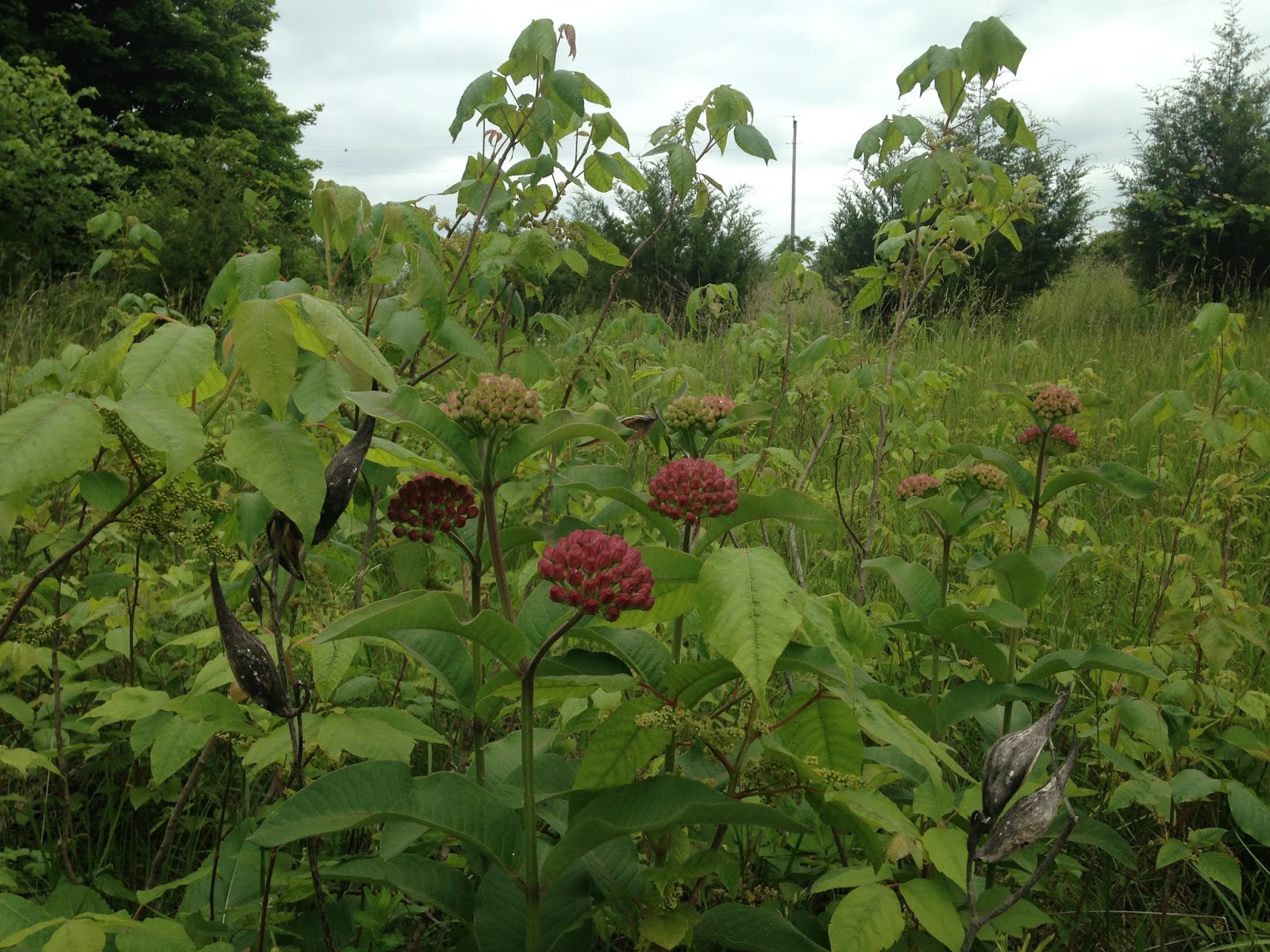
In my savanna/soon-to-be-rainforest, I have been keeping track of the milkweed population. Above is a photo of the purple milkweed in its usual spot. It has been flowering there for the past three years. You can see the old dried out seedpods right next to the fresh new flowers about to bloom. But that area is overrun with poison ivy, and there is no way to kill the poison ivy without also killing the milkweed. My common milkweed that grows by the oak in the pasture has already been strangled by poison ivy.
This is where the common milkweed used to grow
from this blogpost: Selective Stewardship
This year, I have looked in vain, and all I can see in that spot are very tall poison ivy plants. I am thinking that if the trend continues, the same will happen to the purple milkweed in its usual spot. However, the good news is that the purple milkweed has also propagated itself in a new spot with very rich soil: the little oasis of the Something Else Flowers.
In this part of the pasture, every flower blooms a darker, richer, brighter color than anywhere else.
The purple milkweed is just that much more purple here. The Something Else Flower is a richer shade of pink.
What is the secret that makes this ground so fertile? I think it has something to do with the leaves composting on the ground.
Don't stop watching the video of the insects enjoying the flower above until you have also seen the leaves on the ground and the ants swarming among them. If you want to see how an ecosystem really works, don't mow your pasture for fourteen years! Then you'll understand that change, not sustainability, is the first rule of nature!
In disturbed areas, such as by the side of the road, we see the most beautiful, delicate flowers bloom. This puff of a flower, which I have always called a mimosa, is also quite aptly named the sensitive briar, I learned from my friend Kathy.
The pollen on the edges makes the flower look like a lit firecracker or fireworks in the sky on the fourth of July. It grows there at the edge by the outer fence, and not in the middle of the woods, because every once in a while the mowers come and cut everything down by the side of the road.
It is also at the side of the road, where things are periodically mowed, that the purple milkweed is already blossoming, attracting bees, other insects, and an occasional motorist.
If we want to maintain an environment that is most inviting and sustaining for certain plants, then we have to destroy others. But destroying those others sometimes entails periodically killing off also the flowers that we most desire to foster. You can't get rid of poison ivy without getting rid of milkweed. It's only after the general devastation of a fire or a mowing that the milkweed gets a leg up over the poison ivy.
To create anything, you must first destroy something else. Our very lives are an unsustainable jaunt from birth till inevitable death. Civilizations rise and fall. Only a mighty oak survives the periodic brush fires that keep the entire wood from becoming a deep, thick black forest. But even oaks can be felled, sometimes brought low by the tiniest insects that prey on them.
Each flower fends for itself
It would be so arrogant to think that we control anything but the smallest part of our environment, or that any mistakes we make will be devastating to anyone but ourselves. Local devastation is not a global problem. It never was! Each flower fends for itself. And the balance of nature is quite inscrutable to the tiny ant.
In the pens, we are having a bit of a battle of wills.
Bow keeps gesturing to me that he wants me to give him my hand, and I keep telling him that he can spell by himself. I want things to change, and he wants everything to remain exactly the same.
When you are in a state of equilibrium, sometimes you don't notice when a major status changing crisis is right around the corner. Things seem the same day after day.
The wildflowers in the woods are blossoming, and in the unmown lawn what look like tiny, miniature irises are springing up.
Soon the mowers will come, and this flower will be no more, and the entire state of equilibrium that it was counting on to grow will be gone. Things may seem like a steady state, but there are cycles that come and go.
When something cataclysmic is about to happen to us, we don't always know. It may seem to come out of nowhere, but there are usually signs.
The ants have been on patrol for three days and counting on the peony by the lagoon.
They have not harmed the flower head, but they clearly have some objective in mind, something not known to me.
Bow is not angry with me, and I am not angry with him. We just each want something different. To try to cajole me, he picks up tiny specks of dust and hair from the corners of his pen and throws them into the potty. See, he seems to be saying, I am keeping it tidy. I am good. But still I will not give him my hand to use as a pointer. So he takes it and grooms it, instead,
Then he takes my hand and leads me to the letters on the glass. "But I want you to spell by yourself, Bow!" I slip out from his grasp. "Write 'give' by yourself," I tell him. In Hebrew, when Bow is speaking to me, it is just a three letter word תני. He spells it many times each day, when he is requesting things. But always he uses my hand as a pointer.
I try to bargain with him, just as he earlier tried to bargain with me. "If you spell 'give' by yourself, I will let you use my hand for the rest of the sentence." But he is not swayed.
He keeps offering me his hand, but when I ask him to spell by himself, he turns away.
We can go on like this for hours. Nobody gets angry, but the status quo will not change.
It's a delicate equilibrium, but eventually something has got to give.
Just on the edge of the woods, where the lawn meets the trees, the delicate clover flowers sway in the breeze. Their life seems the same every day, but one day the mowers will come.
Just inside the woods, where it is no longer lawn, the cypress spurge is blooming. They say it is an invasive, and it grows in transition areas, that are neither fully wooded nor fully open. The balance of woods and fields on my land is changing. While it may seem that everything is always the same with me and Bow, that is also a delicate balance. Someday the status quo may change, and we might have our next big breakthrough.
You never know when a delicate flower is about to push up from the ground and bloom, not because you planted it yourself, but just because the seeds were there.
As I may have mentioned before, I don't particularly like flowers. I am not a gardener, and I don't have the patience to nurture them or to help them grow. When I write poems, they are not about flowers. When I paint, flowers are not the subject matter -- except in art class once, and that was assigned. But I like flowers when they just appear like magic and grow on their own, and show up unexpectedly to beautify the landscape. As far as flowers are concerned, I am an opportunist.
I think chimpanzees are like that about the bounty of nature, and I see nothing wrong with it. Sometimes life is all about us and what we do and what we make, and sometimes it's about the natural world and all its wonders. I think most chimpanzees are opportunists when it comes to exploiting their habitat. The conservationists are doing us a disservice when they try to paint them as noble savages at one with nature. In order to appreciate nature, we have to look at it through our own eyes and see what it has to offer to us personally.
Most of the flowers I see, I have no names for. Take, for instance, these yellow puffs that grow on the shrubs or small trees along the fence-line: Last year I did not even recognize them as flowers. But this year I looked close up, and I noticed that they consisted of tiny little individual blossoms clustered together into a ball of fluff.
Some people say that society is everything, and some say that the individual is primary. But it's not really a question of either/or. It depends very much on your point of view, and what you are concerned about at the time. Are you studying the big puffs of fluff or the individual blossoms? What magnification are you using? What is the scale of your canvas?
Weigela buds yesterday
These are budding Weigela blossoms. I learned their name a couple of years ago. When they are in full blossom, they will look like this:
Blooming Weigela from 2013
Each little bloom is just like its sisters, only a little bit different And each will compete for the attention of suitors. They have some interests in common, but they also have competing interests.
In my orchard yesterday, a single bee was found enjoying a pear blossom. While this was going on, the other pear blossoms in the cluster waited patiently for their chance. Would some be overlooked? Could their beauty go to waste? Does every flower get a bee?
Even the smallest flowers underfoot have story to tell, full of drama and conflict and individual differences. When the conservationists speak of balance, they forget that balance implies conflicting forces at play. Just like peace, balance is a fragile equilibrium. You do not achieve it by disarming one side of the conflict.
Open Redbud blooms
The redbud blooms are much more attractive to insects once they have opened. Bow, too, finds them more appealing at this time. Since Bow could not go look at the flowers with me yesterday, I brought him back a bouquet.
I was brought up thinking that it was wrong to pick wildflowers. In Israel, there used to be many anemones -- beautiful red flowers that people picked freely until there were practically none. I was told it is better to just look at wild flowers and appreciate them than to pick them. In Texas, also, I was cautioned not to pick the bluebonnets. This socialization about flowers that I received made me resent the flowers. It was as if the flowers were teases -- coming on strong with their beauty -- but complaining if you touched them. Don't pick the flowers. Don't walk on the grass. Preserve nature!
But what if nature was meant to be sampled? What if beauty was meant to be experienced by all the senses?
What if it is not exploitation but the deepest possible appreciation that makes us want to touch and smell and even taste the blossoms?
If there are too many people and not enough flowers, then to preserve the flowers you have to rein in the people. But no primate actually enjoys feeling less important than a flower. It is better when there are fewer primates and more flowers.
This is my land, so I can decide whether to pick the flowers or not. And that is another reason why territory is more important than labor! In the city, flowers represent human labor and must be paid for in cold cash. But out here in the country flowers are just a joyful windfall that can be exploited without guilt.




 Posts
Posts


