Search This Blog

Wednesday, June 3, 2015

Our Changing Landscape

When I bought this property, the grass in the pasture, about five acres, was mowed short with only a few oak trees and the big twin pines standing out of what otherwise seemed like a very flat field.


You might say that it was an artificially induced oak savanna. According to the wikipedia, before Europeans came to this area, oak savannas were a dominant part of the landscape.

 Fires, set by lightning or Native Americans, ensured that the savanna areas did not turn into forests. Only trees with a high tolerance for fire, principally certain oak species, were able to survive. On sandy soils, black oak (Quercus velutina) predominated. On rich soils bur oak (Quercus macrocarpa) was the major tree in Midwestern North America. These savanna areas provided habitat for many animals, including American bison, elk, and white-tailed deer. European settlers cleared much of the savanna for agricultural use. In addition, they suppressed the fire cycle. Thus surviving pockets of savanna typically became less like savannas and more like forests or thickets. Many oak savanna plant and animal species became extinct or rare.
Now that is a story you don't usually hear. I always imagined that the European settlers cut down trees and destroyed forests to create farmland. But instead,  they seem to have created too much forest by preventing brush fires. What would Smokey the Bear say about that?


Things have been changing on my land since I showed up and stopped mowing the pasture, and the savanna is heading toward forest. It's a savanna still, but unless we have a fire soon, the trees that I never planted will grow into a forest. That is a strange thought for me. I don't want to mow, and I don't particularly want a fire. But fires are natural, and they are part of the life cycle of the land.And yet that does not seem to be direction in which things are headed at the moment.

Trees I never planted

It rains almost every day now, and when it does not rain, the sky is full of clouds and the air is full of mist and so a spontaneous fire is unlikely to get started. If anything, we seem about to grow a mighty rainforest.


Did you know that one of possible outcomes of our changing climate would be that the African savanna may turn into a forest? According to a letter by Steven I. Higgins and Simon Scheiter published in Nature, atmospheric changes in carbon dioxide can force abrupt vegetation shifts locally, but not globally. High accumulations of carbon dioxide actually shift a change from savanna to forest. It all comes out in the wash. So the destruction of the Amazon rainforest would be compensated for by the change of the African savanna into a rainforest. Devastating for local wildlife and people in both areas, but it's the case of the earth's ecosystem balancing itself.

Don't cry for Mother Earth. Cry for yourself. That seems to be the overarching theme.  Sustainability does not necessarily mean local stability, when you look at things from a long term global perspective. And I think this is one of the many ways that the average tree hugger fails to consider the inexorable rules of nature.


When people talk about sustainability, they sometimes seem to envision a kind of stability that is not too different from stagnation. When they see change they think that if we caused it, it must be bad. But nature itself changes things all the time, in a none-too-gentle way. A wildfire is a devastating event that kills everything in its wake. And from that death emerges new life. But if you insist on putting out all the wildfires, then nature will find another way to balance things out. "Only you can prevent forest fires!" says Uncle Sam, the central planner, dressed in a bear costume. How arrogant is that?!
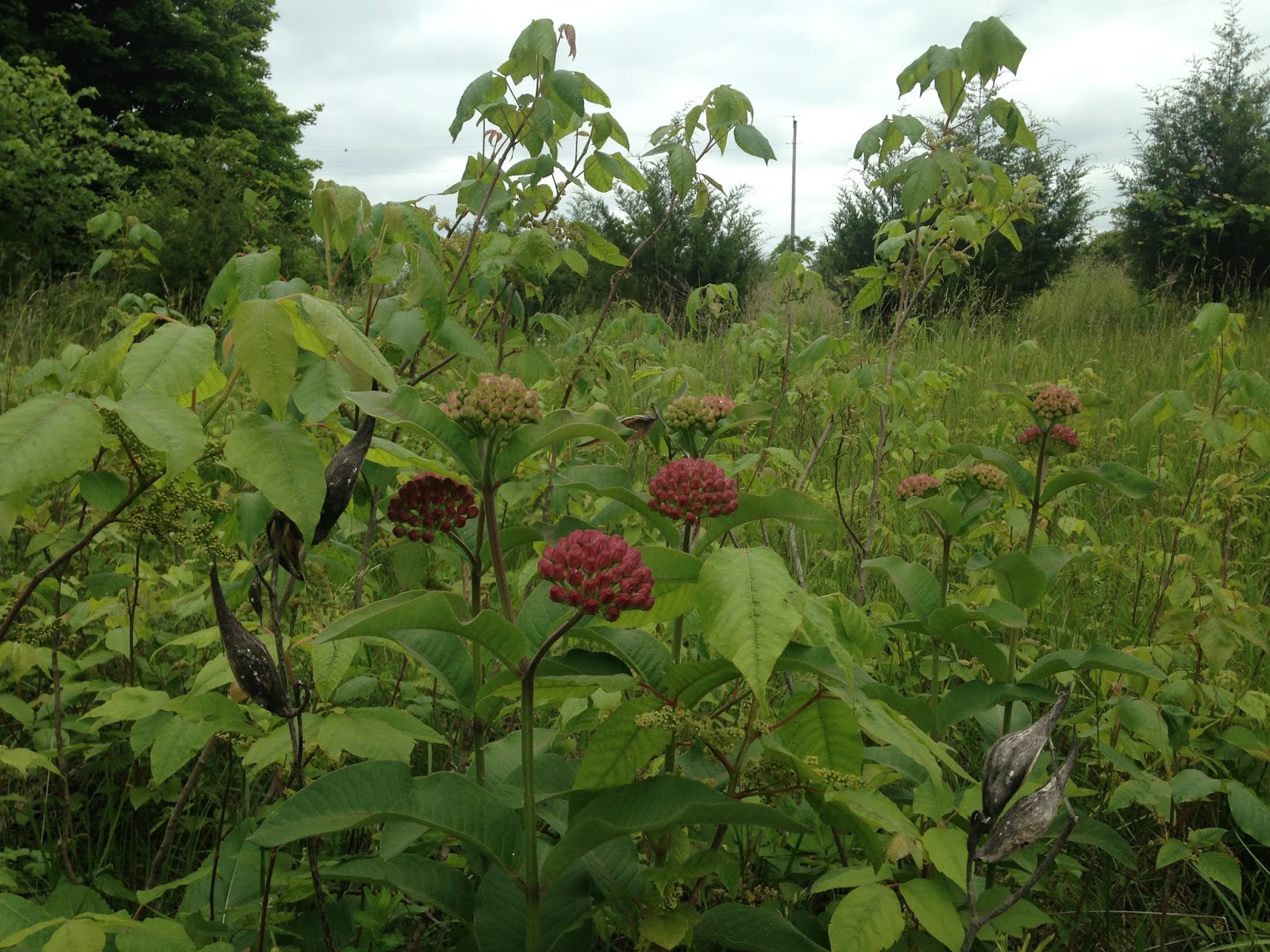


In my savanna/soon-to-be-rainforest, I have been keeping track of the milkweed population. Above is a photo of the purple milkweed in its usual spot. It has been flowering there for the past three years. You can see the old dried out seedpods right next to the fresh new flowers about to bloom. But that area is overrun with poison ivy, and there is no way to kill the poison ivy without also killing the milkweed. My common milkweed that grows by the oak in the pasture has already been strangled by poison ivy.

This is where the common milkweed used to grow
from this blogpost: Selective Stewardship

This year, I have looked in vain, and all I can see in that spot are very tall poison ivy plants. I am thinking that if the trend continues, the same will happen to the purple milkweed in its usual spot. However, the good news is that the purple milkweed has also propagated itself in a new spot with very rich soil: the little oasis of the Something Else Flowers.


In this part of the pasture, every flower blooms a darker, richer, brighter color than anywhere else.


The purple milkweed is just that much more purple here. The Something Else Flower is a  richer shade of pink.


What is the secret that makes this ground so fertile? I think it has something to do with the leaves composting on the ground.


Don't stop watching the video of the insects enjoying the flower above until you have also seen the leaves on the ground and the ants swarming among them. If you want to see how an ecosystem really works, don't mow your pasture for fourteen years! Then you'll understand that change, not sustainability, is the first rule of nature!


In disturbed areas, such as by the side of the road, we see the most beautiful, delicate flowers bloom. This puff of a flower, which I have always called a mimosa, is also quite aptly named the sensitive briar, I learned from my friend Kathy.


The pollen on the edges makes the flower look like a lit firecracker or fireworks in the sky on the fourth of July. It grows there at the edge by the outer fence, and not in the middle of the woods, because every once in a while the mowers come and cut everything down by the side of the road.


It is also at the side of the road, where things are periodically mowed, that the purple milkweed is already blossoming, attracting bees, other insects, and an occasional motorist.


If we want to maintain an environment that is most inviting and sustaining for certain plants, then we have to destroy others. But destroying those others sometimes entails periodically killing off also the flowers that we most desire to foster. You can't get rid of poison ivy without getting rid of milkweed. It's only after the general devastation of a fire or a mowing that the milkweed gets a leg up over the poison ivy.


To create anything, you must first destroy something else. Our very lives are an unsustainable jaunt from birth till inevitable death. Civilizations rise and fall. Only a mighty oak survives the periodic brush fires that keep the entire wood from becoming a deep, thick black forest. But even oaks can be felled, sometimes brought low by the tiniest insects that prey on them.

Each flower fends for itself

It would be so arrogant to think that we control anything but the smallest part of our environment, or that any mistakes we make will be devastating to anyone but ourselves. Local devastation is not a global problem. It never was! Each flower fends for itself. And the balance of nature is quite inscrutable to the tiny ant.

Monday, June 1, 2015

Strange Fruit

I was walking along on my property, looking at wildflowers and trees and bushes, when suddenly I spotted something orange up in a small tree in the pasture.

Can you see what that is up in the little tree?

Was it a flower? Too large to be a flower. A fruit?


No. It was the kitten, and it was just sitting there looking at me. It did not make a sound. It did not move. It was just watching.

 I panicked, All this time, when I had been going on these long hikes by myself, taking pictures of wildflowers and rabbits, butterflies and bees,  I had been under the impression that I was alone. The kitten was safely hidden away in the barn, out of harm's way. It never showed up where I was. I thought it must sleep all day, coming alive only when I opened the barn door. But it had been spying on me, unobserved, all this time. I felt as if my privacy had been violated. The kitten knows my business!


"It's been watching me all along,"  I thought. "It's not blind at all, even though it could not even seem to find its way to the food bowl without trial and error." So I did the only thing I could. I pretended I had not seen it, and went back in the house. The kitten watched me silently from its perch.


 But thirty minutes later, I decided to come back to see if it was still there. And strangely enough, it still was!


When I approached this time, the kitten stopped pretending that it did not know me. It began to climb down from its high perch, meowing all the time in a helpless routine that seemed to say: "I can't get down, and I need your help."


I

It was making lots of progress on its own climbing down to the lower limbs of the tree.


 I did not want to touch it or encourage it to rely on me, so I went away again, thinking that by the time I came back to feed it in the evening, it would be waiting for me in the barn.


But when I returned in the evening with the canned dog food, the kitten was up in the tree, and it did not come down even though I laid out the food and water in the barn in the usual place. What if it really did not know its way down?


This called for drastic measures. I still did not want to touch the kitten. I am allergic to cats, and I have also heard that feral kittens can scratch or bite people trying to help them. So I brought a S'mores contraption from the front porch and offered the kitten a chance to climb down on that. However, that was not something the kitten was willing to do, so eventually I lifted it out of the tree by hand and placed it gently on the ground.


Even though I had never touched it before, the kitten neither scratched nor clawed me. I only had a few bumps on my arm afterwards as an allergic reaction. Still, I minimized contact as much as possible. It was the kitten who seemed to want to rub against my boots over and over again.


Once the kitten was down, it pranced around happily, and eventually followed me to the barn for its dog food. Going in through the front door was not its style, however. It came through another, more private entrance.


Encouraging Diversity by Doing Nothing

When we first moved here, there were a number of cultivated flowers growing  by the lagoon that were very pretty to look at. Irises and daffodils, and peonies and yucca all had been planted by the previous owners of the property. We also noticed some daisies growing wild by the fence line, and all of these flowers occasionally made beautiful arrangements.


Sword and Bow in 2002 by the lagoon when the irises still bloomed
I have not been tending the flowers, but the daffodils have been coming up every year, anyway, and the peony still manages to bloom helped by the black garden ants. The yucca plant is going strong, but the irises have not bloomed in years. Some plants need work to make them grow and bloom. And other plants prosper in neglect. If you are looking for beauty free of charge, your best bet is the natural beauty that no one has to work at.


I have been preoccupied by other matters besides gardening, and I have let things go. Meanwhile in my pasture, which used to be a monoculture of well mowed grass, all sorts of things have planted themselves, trees and shrubs, and many, many different kinds of flowers.


This blue and yellow flower is sometimes found in cracks in my cement driveway as well as in the woods.


By the path in the pasture you can see the Something Else flower in all its multitude of incarnations. Sometimes it grows side by side with honeysuckle.


I think the Something Else flower is just as lovely as any other rose, and quite possibly more radiant.


No two of them are exactly alike.


Is this closed center a different stage in the flower's development or a different variety of the flower?


Is the darker coloring on these petals due to nutrients in the soil where the seeds happened to fall? Or is it a genetic variation?


It's been raining a lot lately, so they have all received plenty of water -- and it was free of charge!


Different varieties of clover flowers bloom side by side.


One of the things that struck me while on my walk today is that if I had had to plan a garden of wildflowers, I would never have been able to include so many different varieties. Many of these flowers are the same, but different, sometimes in small  gradations, like the colors of the rainbow which imperceptibly change and blend into one another.


Others, like the yarrow above, are very different from most anything else.


There are daisies everywhere, no two alike. Some are more different than others.


These flowers look like daisies, too, but how different they are, and the difference is not a matter of color.


You can recognize the center of the daisy, even when someone has eaten all its petals.


Some insects are pollinators, and some are not.


The butterfly helps select the best daisies from the consumer's point of view. It is a kind of quality control.


But some insects are not interested in what a flower offers in exchange for propagation. Some just want to devour its flesh.


 Is it exploitative when they eat the petals and give nothing in return?


Is it only all right if they go straight for the pollen?


I like that nature is so non-judgmental. Anything that works is okay. Anything that does not is automatically eliminated.


Even when the Something Else flower has been denuded of all its beautiful petals, some insect might still come by and pollinate it. Even in extreme devastation there is hope.


Sometimes I wonder whether I am exploiting the beauty of my flowers. After all, I don't pay them anything to grow, not even minimum wage!


Certain moralists believe that we can only reap what we sow. But I did not sow any of this. It sowed itself. Or if it had a little help, it was not from me.


Central planning is what produces monocultures. Diversity is what results from letting things sort themselves out. I wish more nature buffs understood this, as it applies to both ecology and economy.

Bow looking at an old photo album

One of the ironies of the current conservative versus liberal dichotomy of outlook is that conservatives believe in central planning when it comes to speciation, and hence many deny evolution could have happened, since they think it requires planning to come up with different species, and they cannot conceive of it happening without a central designer. Liberals believe in evolution, but they think that central planning is the only way to run an economy or to save for the future or to secure good health for a population, while conservatives understand that allowing those things to evolve organically works better. The problem with both views is the lack of integrity -- not in the sense of ethics -- but in reference to the ability to integrate information from different areas of life to come up with a world view consistent with itself.

Some wildflowers for Bow

The beauty that we find in flowers is not magnified when they are cultivated -- the flowers get bigger, but the smaller sized wildflowers are actually prettier. When we cultivate fruits and berries and try to plan for speciation by genetically modifying them, the fruit gets bigger, but the flavor is often reduced, I have eaten wild strawberries in Idaho, and they taste so much better than the kind we get in the supermarket, though admittedly they are tiny in comparison.


Life does not get better with central planning. It may get bigger in some cases, but that's not the same thing. You can feed more people on modern grain than on a hunter-gatherer diet, the experts will tell you. but each of these many people will be less healthy as a result. They used to tell us to eat a high carb diet for our health. It was in the dietary guidelines. Then studies showed it was not healthy at all. Lately the gloves have been coming off in the departments of food planning, (HHS and USDA) and we are told we should eat less meat out of reasons of sustainability, not nutrition.  In a natural ecology, sustainability takes care of itself.


I could put in a big effort to plant a garden full of cultivated plants, but I prefer the wildflowers that grow by themselves. They don't cost me anything, and they're also prettier. And they smell good, too! Have you ever noticed that flowers in a florist's shop seem to have no fragrance?


I may not be the one who selects the varieties planted, but I trust the creatures who do, because of their inherent interest in the matter. It's precisely because they do exploit the flowers that the flowers they plant smell so sweet.


 The less I interfere in the process and the more I allow the insects and the wildlife to decide what flowers to plant, the greater the variety I find in my garden.