I am a primatologist who spends twelve hours most days in the company of a thirteen year old chimpanzee named Bow. I am also an editor with Inverted-A Press.
Admittedly, our cherry crop was very small this year. We used to get bowls and bowls full of cherries. This year, only two. Not bowls -- cherries, one of which I gave to Bow.
Bow ate the cherry very slowly.
When he was done with it, he gave me the pit back, even though I did not have another cherry to give him. This is what the cherry looked like when it was still on the tree.
It had rained that morning, so the cherry was wet, a drop of rain was still hanging off of it.
The yucca plant was also dripping with rainwater when I went to look at it by day.
I noticed that there were many insects gathered on the flowering yucca plant, even the black garden ants that used to work on the peony before it bloomed.
It is good to have alternate sources of food and not just depend on a single plant to feed you. That's why I am still pondering what is going on with the Monarch butterfly. Whatever possessed it to become dependent on a single kind of plant -- milkweed -- and if it needs the milkweed to survive, why does it not help with its propagation?
Every day I check to see what insects are pollinating the milkweed. I see Great Spangled Fritillary Butterflies and I see Skipper butterflies.
A Skipper and a friend on the Purple Milkweed
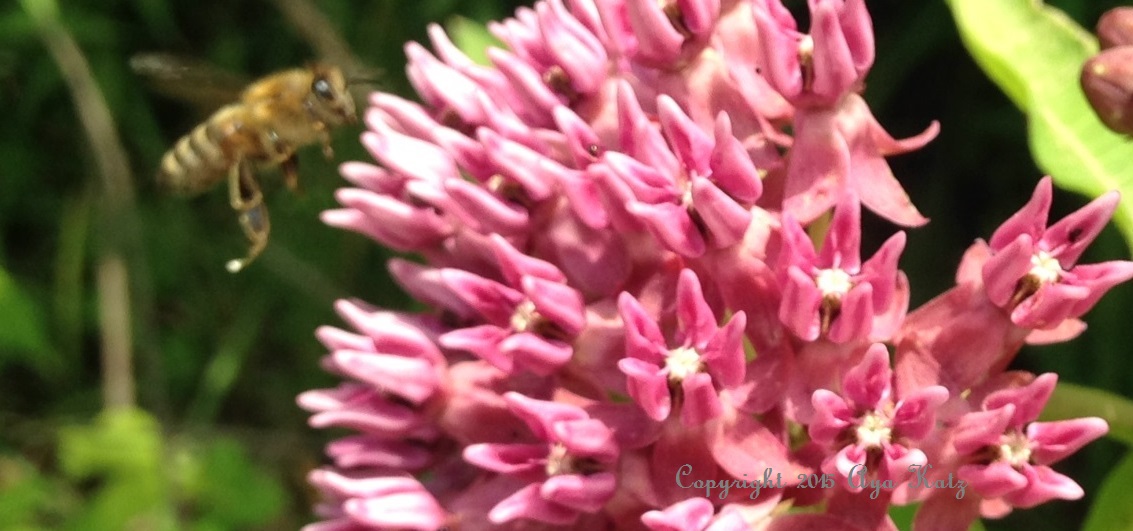
I see honey bees and Great Spangled Fritiallary Butterlies trading places on the purple milkweed blossoms.
But I see no Monarch butterflies helping out. And yet this plant is so important to their very existence! What is up with that? It's like the Irish during the potato blight. Who depends on a single type of crop for his very existence?
Not Bow and me. We know that if the cherry crop is bad, the service berries that planted themselves on our land might actually be more plentiful and equally nutritious.
I picked some this morning and gave Bow to sample. (We don't have a Hebrew word for service berry yet. I suppose I will have to invent one.)
Bow liked the service berries just fine, but they are small.
However, down by the orchard, against the fence line, there is a service berry tree whose berries are still green and measure as large as cherries. I know not to count my chickens before they hatch, but that may turn out to be a very good deal, considering that I never planted them, watered them or did anything to help them grow! Bow and I are as sinfully idle as the Monarch, but a little more opportunistic in our eating habits.
It's raining this morning, and it is dark and murky outside. But yesterday was a sunny, warm day, and I went for many walks on my property.
I was going to invite my readers to go hiking down the trail with me, but then I remembered that I can't seem to upload longer clips any more, so I settled for a full turn that allows a view in every direction. This is the five acre plot of land that could become Bow's island someday. It is full of rich vegetation and is well on its way to becoming wooded, but it is still just a savanna at the moment. Perfect for chimpanzees.
Bow on the blooming dogwood tree in 2005
One of the things I used to ask myself, and still do sometimes, is how would the trees and shrubs and flowers in my pasture survive the onslaught of the destructive forces that Bow would unleash. I used to limit Bow's time in the backyard, because I worried that if I left him to play unchecked, he would destroy the dogwood tree. He used to break off branches as if... well, as if they grew on trees! And I kept thinking: "We only have one dogwood tree. Who knows how long it took to grow to this size! I can't let Bow destroy it. We're not rich."
My Maternal Grandparents, Sarah & Isaac Minkowitz
I had grown up with the idea that trees are rare and expensive and took a very long time to grow and needed massive cultivation. My maternal grandparents were farmers in Israel. They made the desert blossom by the sweat of their brow. With that example in mind, I tended to think of trees as a very expensive commodity. But have you ever asked yourself how that land of milk and honey had come to be a desert in the first place? Could it be because that was the cradle of civilization and the spot where agriculture first flourished in place of the nomadic herding life?
Sword (right) and a friend in walking down the path in the pasture in 2005
I also believed that European settlers were guilty of cutting down forests in North America, and that what we needed to do was plant more forests. How naive I was! The Europeans prevented forest fires and caused the savanna to be replaced by forest. But the fact is that it was four years into my ape language experiment, and I had been keeping my pasture unmown, and yet no trees were growing in it. See the picture of Sword and her friend walking down the path? I was still thinking at the time that maybe I needed to plant a few trees in the pasture!
Bow and I 2005
Bow played outdoors every day, but he spent most of the time riding on my back indoors, where he could do the least amount of mischief. In the picture above, you can see that Sword and a friend were playing hopscotch out in the back yard, in the area where the outer pen now stands, while Bow and I are in the sun room, which is now the inner pens. I was protecting the environment from the destructive force that Bow is! I was afraid no tree would remain standing if I let him play out there all day. And trees cost money, right?
Mulberries growing on a tree in our pasture yesterday (June 2015)
Fast forward ten years. Trees planted themselves. Right now in the pasture, there are mulberries ripening on branches of fruiting trees that I never planted and never watered, never sprayed against insects and never shooed the birds away from. And yesterday, in that pasture, I picked a few berries for myself.
What would happen to all the new trees in the pasture if Bow lived there? Would he denude the land and leave it sandy and bare, the way the fertile Middle East became a desert once agriculture was practiced there for a while? Would he create a new Dust Bowl where he lived, the way the American farmers did in the Great Depression because they were growing too much wheat to sell to Europe? Just maybe, by cutting down some of the trees, Bow would actually be making a valuable contribution to his ecosystem. He would be ensuring that the savanna would not turn into a forest. Because it's not supposed to be a forest, it turns out. It's supposed to be only moderately wooded. There should be tall grasses growing and waving in the breeze. Who knows, maybe even poison ivy!
Milkweed growing freely in a field of poison ivy
What if everything the conservationists have been telling us is wrong? What if they are actually infected with the protestant work ethic, which suggests that it is by the sweat of our brow that we make a paradise out of a desert, when in fact the sweat of our brow makes deserts out of paradise?
A Great Spangeled Fritillary Butterfly enjoying the milkweed
I have been obsessed with the milkweed flowers and the butterflies lately. What especially confuses me is how people tell me we should plant milkweed to help the Monarch butterfly, because that is all the Monarch caterpillar can eat, and the Monarch butterfly will go extinct if we don't help it. But what exactly is the Monarch butterfly doing to help itself? How come I never see it sitting on the milkweed flowers and pollinating them? How come it leaves all that work to the Great Spangled Fritillary Butterflies, the bumblebees, the honey bees, the beetles and the nameless bugs that I have observed there? Every insect I know enjoys the milkweed bloom. But not once a Monarch!
The one time I spotted a Monarch, it flew in circles, mocking me, and did nothing to pollinate the milkweed. Freeloader! I wanted to shout at it. After all, if all it does is eat the flesh of the milkweed and expect other people to grow it, what is the Monarch's contribution to the ecosystem? Why is everyone so concerned that it might go extinct? Who cares? It's not like the honey bee (and all the other kinds of bees) that we need to pollinate our fruit.
A honey bee on a milkweed flower
And then it struck me: maybe the Monarch butterfly is just like Bow! Maybe it's supposed to keep the milkweed population in check. Maybe destroying milkweed plants is the Monarch's job. Ask not what your ecosystem can do for you, ask what you can do for your ecosystem! What if we are each designed to do whatever it is we do best? And what if destruction is just as important as creation in the cycle of life?
Bow lounging around this morning while it rains outside
When Bow was little, I used to have these arguments with my interns about whether Bow was creative or destructive. We would give him a toy, and he would tear it apart, and the interns, always politically correct, would say: "Maybe he's not destroying. Maybe he's creating something new." But he didn't build something new out of the ashes of the old thing. He pounded it till it was pulverized! He smashed it to smithereens!
A Painting I created to Taunt Vegetarians
And maybe that's not always such a bad thing. Maybe we are not all supposed to be creative. Maybe we are not all supposed to conserve every little thing in our environment, like packrats. Maybe forest fires and locusts and plagues and chimpanzees serve a purpose, too! Maybe if we just let things sort themselves out, it will all work out for the best.
We are surrounded by conservationists who are vegetarian. But if they really want to conserve nature, why don't they acknowledge the part that one creature preying on another plays in the natural cycle of life? Why do they sound like farmers when they tell us we should plant trees to save the animals and milkweed to conserve butterflies -- and why won't they ever just leave well enough alone? They make taking care of trees and butterflies and wildlife sound like welfare work. Like we are supposed to feel sorry for the wildlife and plant trees to assuage our guilt. But in paradise there is no guilt. There is only pleasure and internal compulsion to make everything work. And with no central planner.
Late yesterday afternoon, I came across an odd looking turtle. At first I thought it must be very young, because it seemed somehow unformed.
I could not understand what was so odd about it. It seemed as if someone had forgotten to fashion part of its face. All I could think of was some lines of Omar Khayyam as translated by Fitzgerald:
And strange to tell, among that Earthen Lot
Some could articulate, while others not
And suddenly one more impatient cried:
"Who is the Potter, pray, and who the Pot?"
On one side of its face it seemed perfectly normal.
But if you looked at the other side closely, you could see there was nothing where the eye should be.
How did this happen? How could the turtle survive when it could not see anything from one side?
My friend Pam says this is a male who is about thirty years old. From the domed, pyramid-like rear of the shell, she deduced the turtle may have been kept in an aquarium as a pet for some portion of its life. I felt a little sorry for it, so I went to get it some food, but by the time I returned it was gone. Even with its disability, the turtle was not looking for a handout.
Creatures in nature are as tenacious and stubborn as a Great Spangled Fritillary butterfly clinging to a milkweed flower in the wind. They know what they are supposed to do, even though they never consider how it fits into the great scheme of things. I was told as a child that I should not pick the flowers, because what if everybody did that? But maybe we're not supposed to consider what would happen if everybody did what we do -- because not everybody does! Not everybody is a turtle. Not everybody is a flower. Some creatures are born to build, and others are made to destroy. And it all comes out all right in the end, if you let it.
Conservationists are so busy worrying about species losing their habitats, that they sometimes forget to ask what the species contribute to the ecosystem they depend on. If we really believed in natural balance, though, we would not be too quick to intervene.
I had been so preoccupied with the milkweed plants in the field all day yesterday, that I almost forgot to check whether the yucca had bloomed. So it was past sundown when I finally went to see. Sure, enough, it had, and already there were bugs crawling all over the flower. Should I do something about that? No, I don't think so. I think I will let it sort itself out.
Yesterday, the Great Spangled Fritillary butterflies returned to my purple milkweed. And there was much rejoicing!
Great Spangled Fritallary Butterflies on my Purple Milkweed
They were here last year at about this time, and now they were back.
I would have liked to get closer to get a better picture, but two factors were at play to keep me from doing so: the purple milkweed is surrounded by poison ivy plants, and butterflies -- even the Great Spangled Fritillary -- are flighty. They will seldom sit around posing for pictures if you insist on getting close. Not like bumblebees, who will let you come in for a tight shot and let you film them for hours.
In this rather long video starring a bumblebee, even a dragonfly makes a brief guest appearance. But no, that was not the guest I was longing to see.
Happy as I am to be reunited with the Great Spangled Fritillary butterflies, and to see the bumblebees and the honey bees and all the many other insects enjoying the milkweed, there was one guest that I especially longed to have take refreshment on the milkweed. But every time I went to check what was going on there, I saw many other insects, and not that special one.
I was able to stick my head in between the fence boards to get really close to the bumblebee.
But still there was no Monarch butterfly, the guest for whom all this milkweed is supposed to serve as a special incubator. I went for a walk after seeing the Great Spangled Fritillary butterflies, and I actually managed to locate the lost Common Milkweed that I thought had been eradicated. It was pushed up right against the fence, and its buds were looking underdeveloped.
My Common Milkweed Yesterday
Because it was surrounded by poison ivy and honeysuckle, the plant had somehow sprung up right against the wooden fence to the pasture.
The Common Milkweed is pushed up against the fence and late to bloom
But this could not account for the failure of the Monarch butterfly to show up. All these conservationists have been telling us for years: "Monarch butterflies only lay their eggs on milkweed, and the caterpillars only eat milkweed." (Source: http://www.monarch-butterfly.com/monarch-conservation.html) So whether the plant ever flowers or not should not be the issue for Monarch propagation, as long as the leaves and stems are there. Where had all the Monarch butterflies gone? Didn't they like my milkweed? I was disappointed.
And then, across the pasture, I spotted what looked remarkably like a Monarch butterfly. It flew in my direction, and I started filming it, but even though it was very close, it kept flying around, dancing circles around me at high speed, and when I looked at the video, all I could see was that I had been moving the camera erratically -- but no butterfly visible! It was as if the butterfly had been taunting me, offering evidence of its existence that only I could see! Watch the video above at normal speed, and you will probably come to the conclusion that I was imagining the whole thing!
If you stop the video at this spot, you can catch a glimpse of the Monarch butterfly
Just like the rabbits on my land, the Monarch butterfly was showing itself to me, while using highly evolved evasive maneuvers to ensure I could never catch it. To see how very fast it was going, we need to take account that in the above still from the video I had my camera pointed at an easterly angle. But a few seconds later, the Monarch appears in a shot aimed due south.
The Monarch by the ripened service berries
Even though I was facing south now and it had just come in from the east, already the Monarch had reversed its direction and was heading back the way it came.
A few seconds later, I caught a glimpse of it with my camera facing north, but the butterfly was already headed east. This is what flying around in circles at high speed looks like! In between these relatively clear shots, the butterfly was moving faster than my camera could follow. If I had not thought to pause the video on my computer and take screenshots, I would probably have ended up discarding this video, like many previous attempts to film fast moving butterflies.
So yes, there was a Monarch butterfly on my property all along, but it would not stop and pose for me on the purple milkweed, like my more cooperative guests, the Great Spangled Fritillary butterflies and the bumblebee. Sometimes the speed of a subject will prevent us from seeing what is going on right before our very eyes. We had the same problem with Bow before he started using our hands as a pointing device. Our intern Carrie Stengel discusses the problem in the video below.
I have been characterized by some people who read this blog as "an innocent" with a rich "inner life", implying that I imagine everything that goes on with Bow, and in particular his ability to spell words. But did you know that the first time Bow spelled out what he wanted, instead of pointing at lexigrams, it was not with me?
It was with our new Project Bow intern, Eden Michaelov.
It was Eden who decided to put the letters up on the glass that day. And it was with Eden that Bow first spelled.
When I realized that Bow would not point on his own, and that this was going to be characterized as a Clever Hans effect by anyone who saw it, I could have given up. It would have been the smart thing to do, because there is no profit in what I am doing now. I could just pretend I did not see the pretty butterfly, and all would be well with the social world. I could maybe have gotten a job doing something else. That's what Herbert Terrace did the moment his funding ran out. But the kind of madness that I suffer from is that when I see a butterfly that no one else can see, I keep trying to think of ways to make them see it. The facts do not change, just because people cannot see.(And in fact, others have seen what I saw: everyone who worked with Bow since 2007 has seen him spell.)
It is not a crime against society to fail to fall into line with the current consensus. The greater crime is to recant under pressure, like Joan of Arc or Galileo. Rather than being an innocent who sees visions that are not there, I am a scientist who has an open mind to the existence of uncooperative butterflies.
This beauty we found in our horse
corral. It must be a she, not only for her beautiful smile, but
because females are known more than males to travel overland in the
spring to lay their eggs. Males leave their pond when they are
forced to relocate because the pond has dried up. Most of us are
familiar with the snapping turtle, because we see them dead in the
middle of the road. People have little sympathy for these creatures, not only because some consider them ugly, but because they have been
known to bite and tear a cow’s udder while she is refreshing
herself in the pond.
Snapping turtles eat insects, crayfish,
snails, earthworms, snakes, small mammals, birds (how they catch them
I do not know) and aquatic plants and carrion. You can hunt them,
but will need a permit from Fish and Game. I am surprised to learn
that snapping turtle make a great soup or stew, and they offer a
variety of meat tastes…some say seven different tastes.
When I posted these pictures on
Facebook, I received many responses ranging from how prehistoric they look to
“Don’t pick a snapping turtle up by its tail.” It is true that
you must be careful. Missouri Fish and Game suggest a professional
should remove a snapping turtle from your property, because you can’t
be too safe as these turtles have strong necks and a nasty bite.
There is no differentiating core from outer layer.
There is no concern over seeds or less tasty fibers.
Bow likes to examine every part of the apple, to see what is there, but when it gets small enough to slip it into his mouth, he does so, and the apple disappears.
There is only one part of the apple that Bow does not eat: the stem.
When he is done with the apple, Bow hands me the stem.
To many, the apple can be divided into slices and eaten in parts, or even shared among friends. But a little apple is too small for Bow to subdivide. Portion size will vary.
To most of us, the milkweed flower is an indivisible whole, a poof of color in an otherwise drab field.
But to the bee, the contents of each individual floret of which the complex flower consists is the meal being attacked.
The bee can visit more than one floret per feeding, but it can't possibly finish harvesting the contents the whole flower. And this is true even though the bee is bringing food home to the hive, and not consuming it all on the spot.
I have stood there and watched a bee flit from one floret to the next.
But as many times as it comes in for that landing, it still cannot cover the entire flower.
There is enough food in a single milkweed flower for a whole hive full of bees.
One size does not fit all, and the portions you purchase or consume are an individual matter. But there is a movement afoot among government officials to suggest that portion size is something that is immutable and dictated from above.
A couple of recent items made me think of that. One was a picture of a school assignment, in which a math problem was posed: "Luis ate 2/3 of his pizza and Marty ate 1/2 of his, but Marty ate more pizza that Luis. How is that possible?" In a childish handwriting, the student replied: "Marty's pizza was bigger." Then in a green marker, an adult -- presumably the teacher -- wrote: "That is incorrect. Marty could not have eaten more pizza, because 2/3 is always more than 1/2."
Now I don't know if this was a real example of a teacher/student interaction or a hoax, but it would not surprise me if there are teachers who don't realize that pizzas can vary in size. We are fast approaching a world where everything is standardized, and portions are set by the government.
Then there are officials who want to ban super-sized sodas on the ground that they are "not healthy", but if you want to drink that much, you should have to buy two regular sodas. Or the federal regulator who forbade a manufacturer from labeling a low carb snack bar as "healthy" because it had "too many calories."
Portion size varies. How much of anything you eat also varies. How much you need to eat varies. How do the regulators know if the soda or the snack bar are going to be shared with a friend or not? How do they know you won't save some for later? Do they know how big you are or high your metabolism? They don't! It varies.
My daughter and I regularly ask for doggy bags every time we eat out. Yes, restaurant portions seem to be designed for people at least twice our size. But this does not upset us or cause us to waste the food or eat until we burst. We just have the other half the next day, and it makes the meal more economical.
Even a bee knows when it has had enough, and their food is loaded with sugar! Why on earth do they assume portion control is something individual humans cannot manage?
In the past few weeks, I have slowed down for squirrels crossing the road, rabbits that could not seem to decide which way they were going, a turkey who just had to get to the other side of the road at the moment when I was driving through, and a couple of deer. I avoided hitting them, though sometimes it was close. Usually I cannot slow down enough to allow a turtle to get all the way to the other side, and if it is a busy road, I cannot afford to stop and help it across. The most I can do is try to drive around it. But today I saw a turtle in the road that I could help, because it was in a quiet village street and not on the highway.
I parked the car on the side of the road by somebody's house, and I went to get a closer look at the turtle.
It had beautiful markings, much more vivid than those on the turtles that I come across on my own property.
I picked it up and placed it on the grass on the side that was in the direction it was headed,
I could not linger long, though, as another car was coming.
I showed the pictures to my friend Pam Keyes, and she said this was an Eastern Box Turtle, which would not normally be found in the wild this side of the Mississippi. Is this a lost pet? Or has there been a new migration, I wonder? Either way, I hope the turtle found its way to the intended destination.
Was it a good deed to help the turtle across the road? Some people think it is not a good deed unless the doer sacrificed something. I disagree. Here are the values I was raised on:
Help when it easy for you to do and would be of great value to the person helped.
Don't sacrifice a higher value to a lower.
Don't help habitually, but only every once in a while, when the good you do far outweighs the cost.
I learned these frugal values from my father. I would never sacrifice another human being in order to spare the life of a turtle. I would not swerve and hit another car to save that turtle. I would not feel obliged to help the same turtle cross the same road if I saw it in the same predicament yet again. And I always weigh the cost to me versus the benefit to the turtle. I do the same thing when helping other human beings.
These values are quite different from those in the culture that surrounds me. Some people think it is not a good deed unless you sacrifice a greater value to a lesser. In a young adult novel that I borrowed from my daughter, a man swerves to avoid hitting a deer and gets almost his entire family killed. (This results in his surviving daughter developing paranormal powers, which naturally catapults her into a teen occult romance. ) The action of the father in swerving is supposed to show what a good man he was. In my book, that's not a good man. That is deeply, deeply flawed.
In a movie I started to watch one night, a bleeding heart, pregnant animal rights activist trespassed onto a neighbor's property to feed a chained pitbull that she believed was being mistreated by its owner. The pitbull mauled her, caused her to miscarry and lose the ability to have children, and because of her actions, trespassing and inciting the pitbull to attack her, the pitbull himself was put to death by the authorities. The woman was portrayed in the movie as if she were heroic. But whom did she help? Not herself, not her unborn child, not her husband -- and certainly not the dog that she got killed!
First do no harm. That should be everybody's motto. Good intentions are useless when they cause nothing but harm. But the entire "Rescue" movement has made that woman a heroine to be emulated.
Historians forget that it is the fact that he saved the nation that makes Laffite's contribution valuable. That it cost him less than it cost the inept Navy under Commodore Patterson is just another of Jean Laffite's many virtues. Think how much money he saved the taxpayers! You get credit for helping others to the extent that you do it at your own expense and initiative and that it does not cost anyone else anything. You get zero credit for sacrificing yourself, and you earn demerits for sacrificing others.
Goodwill to all makes us stop to help another living being, when all other things are equal. I hope that Eastern Box Turtle made it safely to its destination, whatever that may be, and that the world is a better place for my action. But if I see that same turtle in the middle of the road again, and I cannot stop without harming someone else, I will not save it again. Helping others is good, but it is more important to do no harm.


 However, down by the orchard, against the fence line, there is a service berry tree whose berries are still green and measure as large as cherries. I know not to count my chickens before they hatch, but that may turn out to be a very good deal, considering that I never planted them, watered them or did anything to help them grow! Bow and I are as sinfully idle as the Monarch, but a little more opportunistic in our eating habits.




 Posts
Posts


