Search This Blog

Showing posts with label Weigela. Show all posts

Saturday, April 25, 2015

Calmer Pointing and Persistence

I have been persisting in giving Bow only my smallest finger to hold onto when he spells, and this is working well, although not necessarily from the perspective of actual proof. A side effect of his having only a very small part of me to hold onto is that Bow is gentler and more calm when he writes. Before, he had started to squeeze my hand a lot, when he was asking for something he really wanted and thought he might not get. Now Bow is calmer and seems more responsible in his pointing. It creates more of a clear differentiation between him and me, what he wants, and what I want.

Bow enjoying a salad that consists of peas in the pod, cherry tomatoes, feta cheese and Texas toast croutons
He had gotten to the point, as a teenager, where he did not even want to say anything, anymore,  unless he was sure he would get what he wanted, so that asking and receiving became one and the same thing. He would spell "give me an X" and then for good measure he would spell  "Yes". As if by saying that, he would get me to say "yes." But now he has stopped doing that.


I don't know whether you have noticed in the videos, but both Bow and I are right handed, and when he spells on the glass, he takes my left hand in his right. Now that he only gets a very small part of that hand to work with, it is even more obvious that I cannot be the power behind the movement.

Bow enjoying a homemade brownie
I baked some brownies for the high school choir concert bake sale, and Bow watched me at work in the kitchen. But when he asked to sample the brownies, he was very gentle and not at all frantic or impatient.


Bow loves chocolate, but whenever he gets to eat anything with chocolate in it, he eats very slowly and savors it.


That's pretty much all that is happening here right now. The Weigela  blossoms are spent. They shed their petals all over the lagoon.


Only a few stray late bloomers remain.


Most of the flowers are bare now and trying to form fruit.


Beside the lagoon, the black garden ants are still hard at work on the peonies, which have not opened yet.


In the woods, the cypress spurge is forming tiny orange flowers which are very hard to see. I think this is the first time I have noticed them at all.


By the side of the walking trail, the mustard flowers are practically radiant.


It requires much patience and persistence to get results. We are persisting. We are persisting beyond what anyone expected. Normally, by the time a chimpanzee is thirteen, he is considered too old to be useful for ape language research, and normally, researchers who do not get recognition for one experiment move on to something else.

 For years, I heard perseverance hailed as a virtue. Then I read the literature on autism, and they had "perseveration"  down as something bad.  Is it bad that we persist? Should we just give up? I don't see how we can, though, because how else would we communicate with each other?
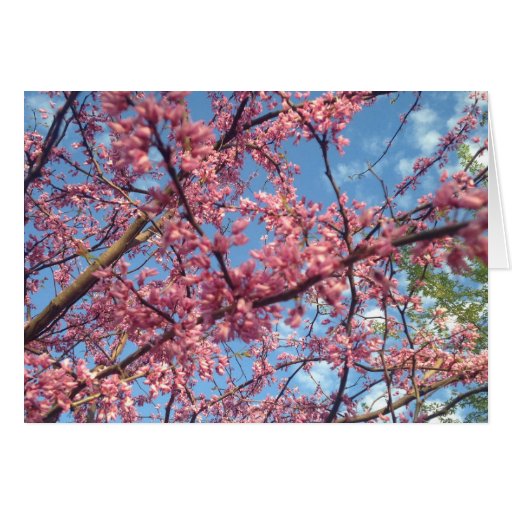
If you would like to help Project Bow, please consider purchasing a card based on one of my photos
Redbud Against Blue Sky Mother's Day Card


Friday, April 17, 2015

Caught in Midair

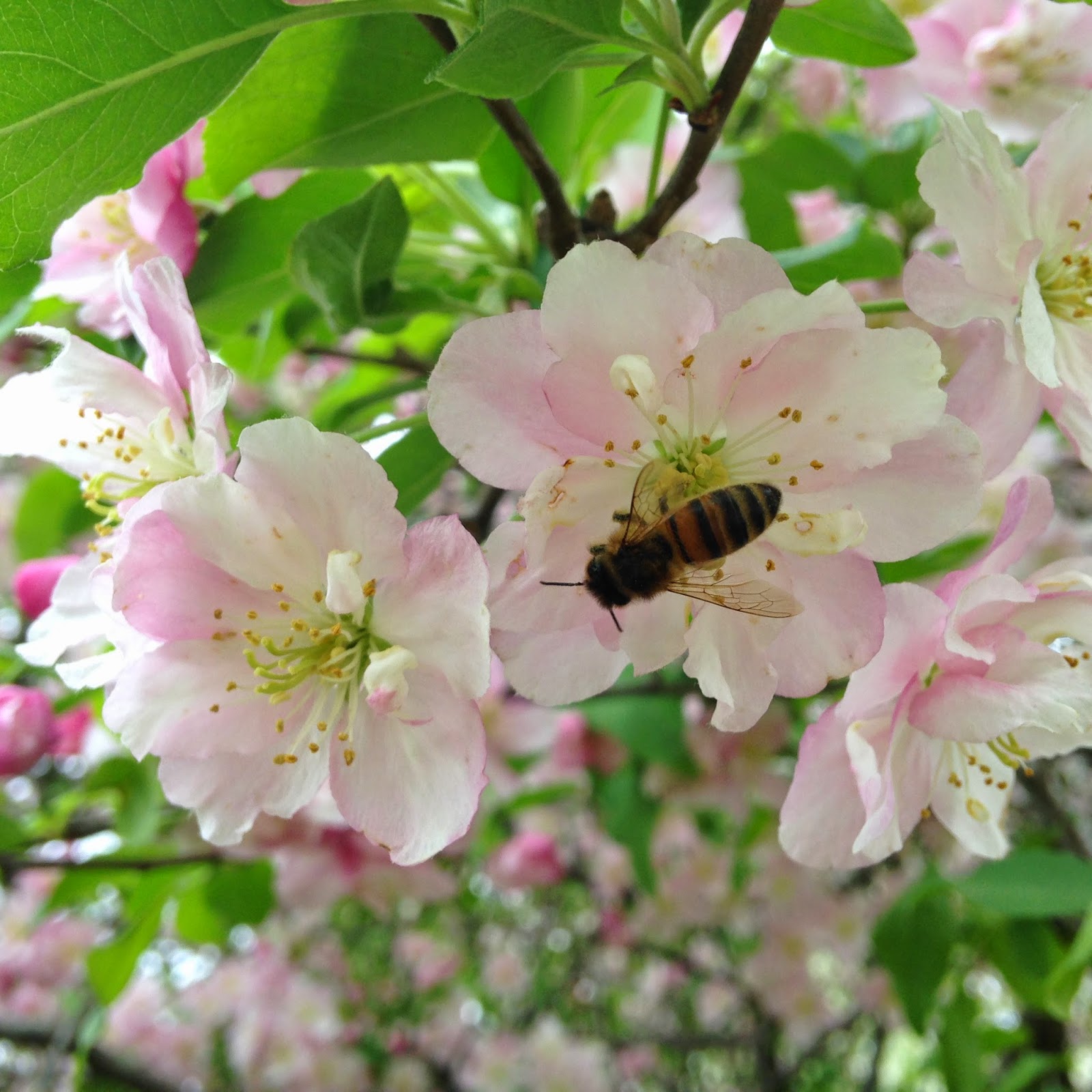
What is the most typical pose for a bee on the Weigela?


Is it dead center in the middle of the flower with its wings spread out?


Is it more typical for them to be up in the air and about to land on a blossom?


Or is it with its rear end toward the camera and its head inside the flower?


Or is this a more typical view?


Whichever way we look at the bee, it presents a different side to us.


Or do they hang around like this?


Or is it more often found in midair, in a holding pattern, waiting for a landing?


The days of the Weigela blossoms are numbered, but while they yet bloom, the bees  hovering around them abound. And not just bees. A wasp or two has been sighted.


They look much like bees, but their silhouette is not as plump.


Meanwhile, by the lagoon, the black ants are not even waiting for the peony blossoms to bloom.


And the backyard the tiny flower heads in the center of the dogwood blossom look about ready to open.


At the end of the day, bumble bees still buzz around the overripe redbud blossoms.


The smaller bees have all moved on the Weigela blossoms, but there are bumble bees that persist by the redbud, even as the sun is about to go down and the sky turns a rich blue.


Only after the sun finally set did the bumble bees disappear from the redbud.


Before I put Bow to bed tonight, I had washed his blanket, and it came out of the dryer very warm.  "Look Bow, your blanket is clean and warm, and it smells good." He sniffed the blanket appreciatively, laid it down on the floor carefully, lay over it, spread his other blanket over his lap, and gestured to me that he was happy, so he wanted to groom my hand.

There's a lot that happens every day, but most of it is not important, except in a momentary sort of significance,  like a bee hovering over a blossom before it can land,

The View from the Outer Pen

There is an eight foot fence surrounding our back yard, That is mostly for privacy for Bow. It means that delivery people and others who mistakenly drive onto our property don't immediately have to spot Bow and start gaping at him, if he happens to be outside. But the privacy fence does not keep Bow from seeing things that are going on in the outer yard, if he wants. He can climb high and get a view of what is going on in the world beyond.


From the top of the bench rim, you can see the nearby tulip tree and the Weigela bush in the distance.


The tulip tree is getting ready to flower.


The old, dried out blossoms are still there, but this year's green flower heads are already visible and getting ready to open.


When I go to check on the Weigela blossoms, I know that Bow is watching me, and he sometimes vocalizes in my direction to let me know.


The Weigela blossoms have been open for a while now, and they are getting a little droopy. Their petals are falling one by one to the ground.


Still there are insects who find them attractive.


Sometimes I have trouble putting a name to the insect.


But sometimes they are just the familiar honey bee.


Back in the pen, Bow has a clear view of the flowering dogwood.


You can see the orientation of the pen toward these trees in the short video embedded below.


When I go for my afternoon walks, Bow also gets to be outside, if he wants to be.  Our grass has not been mowed yet, and so I get glimpses of tiny little flowers shooting up that I might otherwise never have gotten to see.


The clover flowers are so delicate and fresh.


Dandelions, both young and old, are making a nice showing.


These little tiny yellow flowers are so pretty, whatever they are called!


To make the flowers grow, sometimes all you have to do is not mow the grass for a while. The same is true for trees. Much as I hope that the new fruit trees we planted in the orchard will make it, there is a very good chance that some of them will not. When you "plant a tree" you are doing a very unnatural thing. It's not at all what the tree huggers would have you believe. You are not planting, but transplanting. You are tearing out roots and making them grow someplace else. It's a shock for the tree. Some survive and some don't.


But if you just don't always mow the lawn, you will be amazed at what shoots up all on its own, without any work on your part. On the other side of the driveway from our majestic tulip tree, a baby tulip tree is growing.


Nobody planted it. It just volunteered. But already it is getting ready to blossom. This little tulip tree, if left undisturbed, is better than any tulip tree I might buy in a nursery to plant, because it already has strong roots here.


Of course, just because a plant is growing, that does not mean its survival is guaranteed. Predation takes place at every level of the trophic pyramid. This peony by the lagoon is getting ready to blossom, but will those black ants let it?


When I get back from my walk, Bow usually wants to go back inside, and he tells me so.


Bow needs my help to unlock the metal door, but he opens the glass door all by himself.

Tuesday, April 14, 2015

After the Rain

It is raining again now, but after the last rain, there was a short respite, and I went back out and looked at the flowers.

Service berries by the fence line

After the rain, in that strange light that lingers in the air, everything looks greener, even the service berries by the pasture fence.

apple blossoms against a cloudy sky
 The blossoms on the new apple tree all seemed to be opening at once.

apple blossoms close up

It was hard to capture a clear picture of each blossom, because they would not stand still. The branches of the new apple tree were towering up into the sky and swaying in the breeze.

apple branches swaying in the breeze
But where were the bees? Didn't they want to take advantage of the opening apple blossoms? No. They had all gone to call on the Weigela blooms by the woods.


The Weigela blossoms, more numerous that the apple blooms, and just as pretty, drew my entire bee population into their midst.

a bee comes to call on a Weigela bloom
The bees were so confused by the embarrassment of riches before them that they flitted too quickly from flower to flower to flower.


Which Weigela blossom is best? Which is the prettiest? Which offers the sweetest nectar? It is very hard for me to tell, and gauging by the bees' reactions, they don't know, either. Every one is beautiful in its own way -- and they are very hard to tell apart!

Saturday, April 11, 2015

A Bouquet for Bow

As I may have mentioned before, I don't particularly like flowers. I am not a gardener, and I don't have the patience to nurture them or to help them grow. When I write poems, they are not about flowers. When I paint, flowers are not the subject matter -- except in art class once, and that was assigned. But I like flowers when they just appear like magic and grow on their own, and show up unexpectedly to beautify the landscape. As far as flowers are concerned, I am an opportunist.


I think chimpanzees are like that about the bounty of nature, and I see nothing wrong with it. Sometimes life is all about us and what we do and what we make, and sometimes it's about the natural world and all its wonders. I think most chimpanzees are opportunists when it comes to exploiting their habitat. The conservationists are doing us a disservice when they try to paint them as noble savages at one with nature. In order to appreciate nature, we have to look at it through our own eyes and see what it has to offer to us personally.


Most of the flowers I see, I have no names for. Take, for instance, these yellow puffs  that grow on the shrubs or small trees along the fence-line: Last year I did not even recognize them as flowers. But this year I looked close up, and I noticed that they consisted of tiny little individual blossoms clustered together into a ball of fluff.


Some people say that society is everything, and some say that the individual is primary. But it's not really a question of either/or. It depends very much on your point of view, and what you are concerned about at the time. Are you studying the big puffs of fluff or the individual blossoms? What magnification are you using? What is the scale of your canvas?

Weigela buds yesterday

These are budding Weigela blossoms. I learned their name a couple of years ago. When they are in full blossom, they will look like this:

Blooming Weigela from 2013

Each little bloom is just like its sisters, only a little bit different And each will compete for the attention of suitors. They have some interests in common, but they also have competing interests.


In my orchard yesterday, a single bee was found enjoying a pear blossom. While this was going on, the other pear blossoms in the cluster waited patiently for their chance. Would some be overlooked? Could their beauty go to waste? Does every flower get a bee?


Even the smallest flowers underfoot have story to tell, full of drama and conflict and individual differences. When the conservationists speak of balance, they forget that balance implies conflicting forces at play. Just like peace, balance is a fragile equilibrium. You do not achieve it by disarming one side of the conflict.

Open Redbud blooms
The redbud blooms are much more attractive to insects once they have opened. Bow, too, finds them more appealing at this time. Since Bow could not go look at the flowers with me yesterday, I brought him back a bouquet.


I was brought up thinking that it was wrong to pick wildflowers. In Israel, there used to be many anemones -- beautiful red flowers that people picked freely until there were practically none. I was told it is better to just look at wild flowers and appreciate them than to pick them. In Texas, also, I was cautioned not to pick the bluebonnets. This socialization about flowers that I received made me resent the flowers. It was as if the flowers were teases -- coming on strong with their beauty -- but complaining if you touched them. Don't pick the flowers. Don't walk on the grass. Preserve nature!


But what if nature was meant to be sampled? What if beauty was meant to be experienced by all the senses?


What if it is not exploitation but the deepest possible appreciation that makes us want to touch and smell and even taste the blossoms?


If there are too many people and not enough flowers, then to preserve the flowers you have to rein in the people. But no primate actually enjoys feeling less important than a flower. It is better when there are fewer primates and more flowers.


This is my land, so I can decide whether to pick the flowers or not. And that is another reason why territory is more important than labor! In the city, flowers represent human labor and must be paid for in cold cash. But out here in the country flowers  are just a joyful windfall that can be exploited without guilt.