Search This Blog

Friday, April 17, 2015

The View from the Outer Pen

There is an eight foot fence surrounding our back yard, That is mostly for privacy for Bow. It means that delivery people and others who mistakenly drive onto our property don't immediately have to spot Bow and start gaping at him, if he happens to be outside. But the privacy fence does not keep Bow from seeing things that are going on in the outer yard, if he wants. He can climb high and get a view of what is going on in the world beyond.


From the top of the bench rim, you can see the nearby tulip tree and the Weigela bush in the distance.


The tulip tree is getting ready to flower.


The old, dried out blossoms are still there, but this year's green flower heads are already visible and getting ready to open.


When I go to check on the Weigela blossoms, I know that Bow is watching me, and he sometimes vocalizes in my direction to let me know.


The Weigela blossoms have been open for a while now, and they are getting a little droopy. Their petals are falling one by one to the ground.


Still there are insects who find them attractive.


Sometimes I have trouble putting a name to the insect.


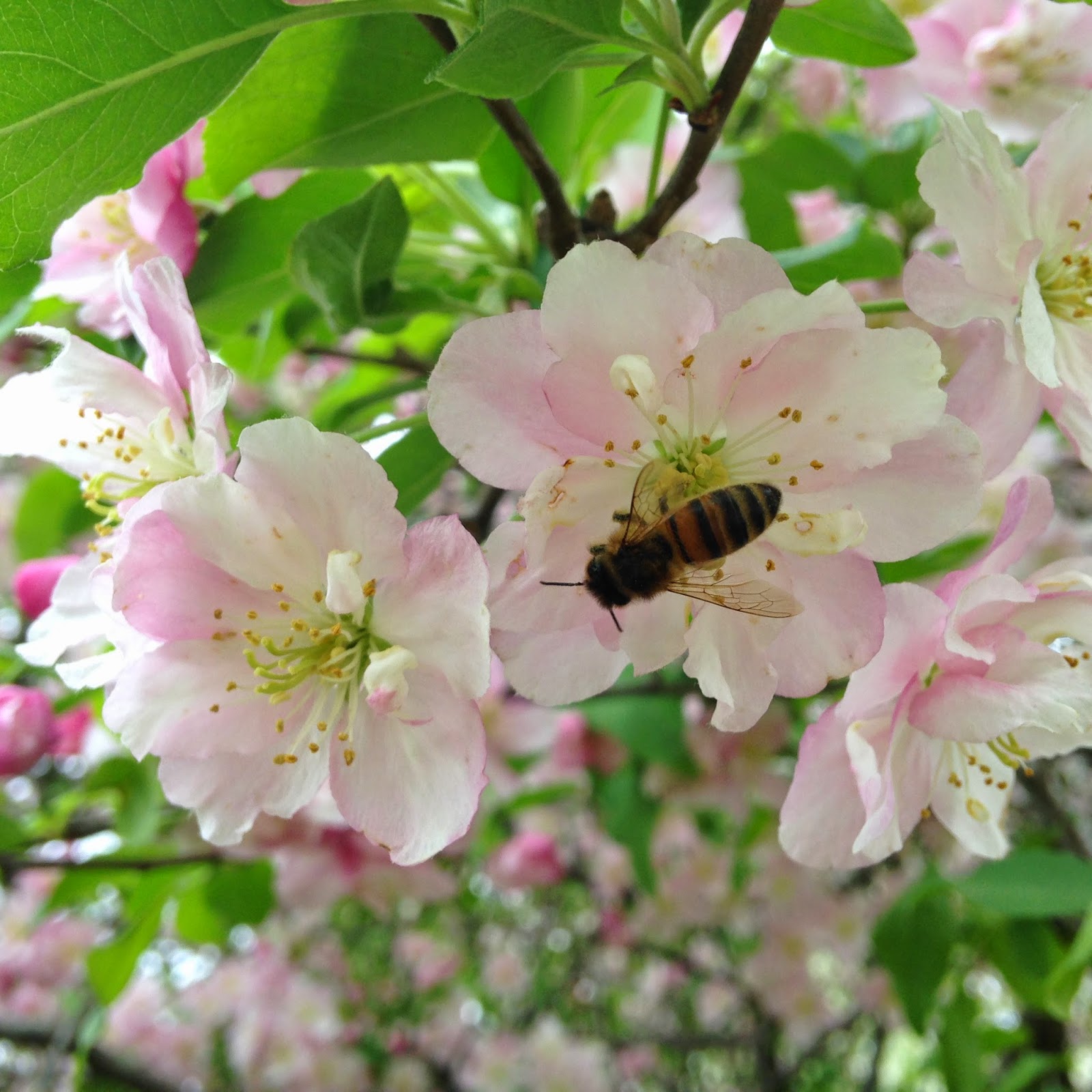
But sometimes they are just the familiar honey bee.


Back in the pen, Bow has a clear view of the flowering dogwood.


You can see the orientation of the pen toward these trees in the short video embedded below.


When I go for my afternoon walks, Bow also gets to be outside, if he wants to be.  Our grass has not been mowed yet, and so I get glimpses of tiny little flowers shooting up that I might otherwise never have gotten to see.


The clover flowers are so delicate and fresh.


Dandelions, both young and old, are making a nice showing.


These little tiny yellow flowers are so pretty, whatever they are called!


To make the flowers grow, sometimes all you have to do is not mow the grass for a while. The same is true for trees. Much as I hope that the new fruit trees we planted in the orchard will make it, there is a very good chance that some of them will not. When you "plant a tree" you are doing a very unnatural thing. It's not at all what the tree huggers would have you believe. You are not planting, but transplanting. You are tearing out roots and making them grow someplace else. It's a shock for the tree. Some survive and some don't.


But if you just don't always mow the lawn, you will be amazed at what shoots up all on its own, without any work on your part. On the other side of the driveway from our majestic tulip tree, a baby tulip tree is growing.


Nobody planted it. It just volunteered. But already it is getting ready to blossom. This little tulip tree, if left undisturbed, is better than any tulip tree I might buy in a nursery to plant, because it already has strong roots here.


Of course, just because a plant is growing, that does not mean its survival is guaranteed. Predation takes place at every level of the trophic pyramid. This peony by the lagoon is getting ready to blossom, but will those black ants let it?


When I get back from my walk, Bow usually wants to go back inside, and he tells me so.


Bow needs my help to unlock the metal door, but he opens the glass door all by himself.

Thursday, April 16, 2015

The Yellow Jacket on the Dogwood Bloom

Yesterday was a Wednesday. It was also April 15. If you live in the US, you know what that means. It's too ugly a thing for me to spell out, but the upshot was that I needed to have Lawrence sit with Bow for the whole day. And while he was here for that long, I asked him to  also weed-eat the backyard and spread the insecticide, because tick and flea season is upon us, not just on the Federal level, but at the grassroots, so to speak.

Bow  in a friendly mood
.
Bow is always happy and excited to see Lawrence, but that does not keep him from displaying at him for about ten minuted before he will allow Lawrence to come into the pen with him. Fortunately, Lawrence understands Bow very well, and he does not hold this territorial display against him.

Brownie lets Leo do just about anything to him -- except eat his food

I don't like using insecticide, but we do have dogs in the backyard, and if they get fleas and ticks, they could spread to Bow and to me, and that would not be good. So while most of my ten acres are a haven for insects of all sorts, the backyard does get treated. The insecticide comes as a powder that is spread on the lawn, and then it gets wet and sinks into the ground. As this is the rainy season, I am counting on nature to help me with that last part.

This is how the front yard looked yesterday morning

Lawrence told me that he asked Bow to come outside with him to see him work on the lawn, and Bow even said he wanted to go out into the outer pen, but when he got to the door, he realized it was still cold out and changed his mind. Then they went back in, and when Lawrence asked Bow why he didn't want to go out, Bow just spelled. "You go out." Which meant Lawrence had permission to go, and Bow would not play a trick on him when he got back. There was no mess.

The dogwood petals have turned white
When I went out into the back yard late that afternoon, I wanted to inspect Lawrence's handiwork, but I was drawn to the blossoms of the dogwood tree, whose petals by now have turned white.

A lone yellow jacket on the dogwood
I noticed an insect on one of the blossoms, and tried with difficulty to identify it.

The yellow jacket focuses o a little black dot in front of it
It turned out to be a yellow jacket, which my friends warn me can sting very badly. But this lone yellow jacket was not interested in me. It was focused on a little black speck in front of it. Could that have been another, even smaller insect that it wanted to eat?

Yellow jackets look a little like bees, but they do not gather pollen, and they are in fact predatory wasps. No bees are attracted to our beautiful dogwood in bloom, because even though these look just like flowers,the white petal-like things are really bracts, and  the middle part is composed of flower heads that have not opened yet, and there's no pollen there to be had, I wondered if the yellow jacket seemed so passive because of the insecticide we had just scattered on the lawn. I felt a little guilty about that. Yellow jackets may be disliked for their sting, but they do help us by eating other pests.


Part of the end of semester handout for biology


My daughter is taking biology this semester. Looking at her review handout, it reminded me of the weird use of  "community" that certain artistic types make. One of my artist friends criticized some of the artists in her community for being too competitive -- as if there were no place for competition in a community. But the very first concept under "community interactions" in the biology handout is competition. Competition is normal. It is part of what makes a community healthy.

While none of us like parasites, some symbiotic relationships are healthy, as both sides benefit. The trick is to recognize which is which. Sometimes we err. But whatever the community, the concept of balance requires competing forces to be in equilibrium.


It is not possible for everyone to love everyone. It is not possible for a human to give the same consideration to a flea or a tick as to his own children and other non-human dependents. Sometimes a useful yellow jacket may be harmed by an attempt to get rid of parasites. We try to make appropriate distinctions, but mistakes can be made.

Even the story of the helpful wolves introduced into Yellowstone National Park has another side to it.


I am not necessarily endorsing the content of the documentary above, any more than I did that other film sponsored by the establishment that I shared a while back, singing the praises of the wolves. I think it is important to consider many sides of every story.

I like wolves and trees and honey bees and yellow jackets. But I am not a tree hugger, either. I wonder about the agenda behind all these competing nature documentaries. Were the wolves introduced to improve the health of deer and elk? Or were they ultimately meant to trim down the herd of humans grazing on the land?

The real balance in nature comes when we each take care of ourselves and our dependents first. If there are wolves, then there also need to be wolf hunters. If there are parasites, there have to be anti-parasites. For every force there has to be a countervailing force. This is the only way to keep everything in balance.

Tuesday, April 14, 2015

After the Rain

It is raining again now, but after the last rain, there was a short respite, and I went back out and looked at the flowers.

Service berries by the fence line

After the rain, in that strange light that lingers in the air, everything looks greener, even the service berries by the pasture fence.

apple blossoms against a cloudy sky
 The blossoms on the new apple tree all seemed to be opening at once.

apple blossoms close up

It was hard to capture a clear picture of each blossom, because they would not stand still. The branches of the new apple tree were towering up into the sky and swaying in the breeze.

apple branches swaying in the breeze
But where were the bees? Didn't they want to take advantage of the opening apple blossoms? No. They had all gone to call on the Weigela blooms by the woods.


The Weigela blossoms, more numerous that the apple blooms, and just as pretty, drew my entire bee population into their midst.

a bee comes to call on a Weigela bloom
The bees were so confused by the embarrassment of riches before them that they flitted too quickly from flower to flower to flower.


Which Weigela blossom is best? Which is the prettiest? Which offers the sweetest nectar? It is very hard for me to tell, and gauging by the bees' reactions, they don't know, either. Every one is beautiful in its own way -- and they are very hard to tell apart!

Water Rights and Border Fights

It's raining outside right now. It rained yesterday, too, and while Bow is not too pleased with it, I am, because the rain is watering our fruit trees so that I do not have to.

Raindrops on the new apple tree
This is the rainy season here, and that's why we planted the trees here now. It's after the last freeze, but before the summer dry period.


The saying is "April showers bring May flowers," but around here, April showers fall on April flowers.

Can you spot the raindrops on the Weigela blossoms?

The Weigela blossoms have opened just in time for the rain.


I don't like to have to pay for water, when it is part of nature's bounty. I own my land so all the rainwater is mine, if it falls on my property. I own water rights beneath the land, so in my house, the tap water comes from my own well. I pay for electricity costs to have it pumped, but I don't pay for the water. I like owning my water source, because it also means I know what goes into it.

At least, on a local level, I know that my water is pure. But water is cycled, and yes, I am aware that  there is a public aspect to the water cycle. In fact, in my song, written with composer Daniel Carter, entitled "We All Share the Same World", that issue does come up.


This song is meant to be sung by two people, a  man and a woman, and it dramatizes the conflict between liberal and conservative voices when it comes to resource management. It is from the Carter and Katz libertarian musical, The Debt Collector.  Siren, the social worker, believes resources should be spread out to all based on need. Blood, the Debt Collector, believes that property rights should determine the division. Both of them are aware of the water cycle, but they have diametrically opposite views about what should be done about it. (There will soon be a new recording of this song with two singers, a man and a woman.)

One of my friends is like Siren, and she is concerned that Nestle may be siphoning away natural water supplies in the United States and selling them for profit, thus restricting the public water supply and causing a drought. This a serious concern.

http://www.mintpressnews.com/nestle-continues-stealing-worlds-water-during-drought/203544/

Another of my friends is concerned that the Federal government is planning to nationalize all the water, so that even if it rains on your land, all the puddles will belong to the Feds. He is afraid we are all very soon going to be faced with the choice of using the public water supply or pay Nestle for bottled water.

A third friend is concerned with the health dangers associated with fluoridation of the public water supply in certain neighboring municipalities. She spoke before one of the city councils about getting fluoride taken out of the public water supply. While she was speaking,  every one of the officials around that horseshoe shaped table -- the aldermen and women, the mayor, the city manger, and the attorneys -- were drinking bottled water! But they still did not vote to take fluoride out of the water supply.

I saw a commercial for Nestle water playing on a Youtube video I wanted to watch. It showed a beautiful young mother and two healthy, sweet children in their spacious kitchen with the kitchen sink plainly visible. They are drinking water from Nestle's plastic bottles, and the mother is talking about how the health of her children is paramount.

People campaigning against Nestle still don't understand the message embedded in that commercial: tap water is available, but who would let their children drink it, when it is full of deadly toxins such as fluoride?

When I pointed out to my friend who is concerned about the drought that if she wants to put market pressure on Nestle to stop selling off that water, she needs to campaign against water fluoridation, she was not convinced. People drink bottled water for convenience, she told me. Really? What could be more convenient when you are sitting in your kitchen than getting water from that tap over the sink? Has she watched that commercial? Does she understand what Nestle is selling?

She also pointed out that fluoridation is a local issue, which is up to the various municipalities. Well, yes, that is true, but did you know there are national special interest groups who campaign for fluoridation?

Like the ecological system, the economy is interconnected. Everything affects everything else. Restrict people from having their own water, decide publicly that toxins will be pumped into the water supply, and people will go out and buy bottled water. It's not that they love those plastic bottles and enjoy lugging them around. They are running scared. They need water in order to live, and they will pay any price to keep from being poisoned.

Everything in life is interconnected, even the ecology and the economy. You can't make a move in one area and not end up affecting everything else. When people act individually, they are more likely to make decisions that help themselves. But when decisions for many people are made collectively by a few "experts", the results can be quite different from what they intended.


So far, Bow and I are insulated from those distant concerns about poisoned water and water shortages. But the world is a ball, and we will no doubt suffer with the rest if things really get out of hand. Before you decide that you're going to side with Siren the social worker, check out what Blood has to say. It's your world, too. You deserve to know the facts.

Saturday, April 11, 2015

Busy as Bees

We have been busy as bees in the past twenty-four hours -- and so have the bees on the redbud tree.


Swarms of bees buzzed all day from branch to branch of the redbud, and overhead the hawks flew even higher than the bees. Some of the bees were unusually small and some were medium sized and some were giant bumble bees.


It's hard to see all the bees when you are trying to take everything in, but if you focus on a single bee you can see it more clearly, precariously perched on a delicate blossom and going at it with gusto.


In the orchard, the mystery tree is blooming.


I posted a video of it on Youtube, saying how I wondered what it was.


I also posted pictures of some of the blossoms on Facebook.


My friend Martyn, who lives in Greece, told me that his wife thought it might be a blackthorn or sloe or, in Latin, prunus spinosa. I do think that is more or less right, as it is some kind of plum-like tree. I once saw a single fruit on it, many years ago. I thought it was a small plum, but it did not taste much like one. I haven't actually noticed any spines or thorns on the tree, but everything else seems to fit.


Meanwhile, these little tiny flowers by the house have really opened up.


I planted them many years ago, but have not given them any care since. They come in two colors.


I think they might be related to impatiens, but I am not sure. As I was admiring these flowers, the gardener came by with my new trees.


He planted four of them, but he did not have the saw he needed to remove the dead apple tree, so one will have to wait.


This is the information on one of my new peach trees.


You can see there already are some tiny peaches on it, though I doubt they will amount to much this year.


The other peach tree is called a Harvester peach.


My new apple trees are Gala apples and Autumn Beauty. They are not native to Missouri, but guess what? Apparently no apple tree is native to Missouri.


They are all exotic.

Blossoms n the Autumn beauty apple tree

One of the new apple trees already has open blossoms. The other is much smaller.


I only meant to replace the missing fruit trees this year, not to expand the orchard. But who knows, if this succeeds, I could add five new trees every year for the next ten years and have an orchard that might actually fill Bow's needs. Wouldn't that be nice?

The question is: how much labor would be involved to care for the trees and pick the fruit? Does it really require ten ordinary men working full time to do the work of a single chimpanzee? And if it does, might it not be easier to let the chimp pick his own fruit?

Maybe ten years from now, there will be a force field capable of keeping Bow within the borders of our property. In that case, we would have no need for metal bars or grids,

A bee on the pear blossoms from yesterday

In any event, there is no fear of not having enough pollinators for our orchard. The bees are more than willing to do their share of the work.

A Bouquet for Bow

As I may have mentioned before, I don't particularly like flowers. I am not a gardener, and I don't have the patience to nurture them or to help them grow. When I write poems, they are not about flowers. When I paint, flowers are not the subject matter -- except in art class once, and that was assigned. But I like flowers when they just appear like magic and grow on their own, and show up unexpectedly to beautify the landscape. As far as flowers are concerned, I am an opportunist.


I think chimpanzees are like that about the bounty of nature, and I see nothing wrong with it. Sometimes life is all about us and what we do and what we make, and sometimes it's about the natural world and all its wonders. I think most chimpanzees are opportunists when it comes to exploiting their habitat. The conservationists are doing us a disservice when they try to paint them as noble savages at one with nature. In order to appreciate nature, we have to look at it through our own eyes and see what it has to offer to us personally.


Most of the flowers I see, I have no names for. Take, for instance, these yellow puffs  that grow on the shrubs or small trees along the fence-line: Last year I did not even recognize them as flowers. But this year I looked close up, and I noticed that they consisted of tiny little individual blossoms clustered together into a ball of fluff.


Some people say that society is everything, and some say that the individual is primary. But it's not really a question of either/or. It depends very much on your point of view, and what you are concerned about at the time. Are you studying the big puffs of fluff or the individual blossoms? What magnification are you using? What is the scale of your canvas?

Weigela buds yesterday

These are budding Weigela blossoms. I learned their name a couple of years ago. When they are in full blossom, they will look like this:

Blooming Weigela from 2013

Each little bloom is just like its sisters, only a little bit different And each will compete for the attention of suitors. They have some interests in common, but they also have competing interests.


In my orchard yesterday, a single bee was found enjoying a pear blossom. While this was going on, the other pear blossoms in the cluster waited patiently for their chance. Would some be overlooked? Could their beauty go to waste? Does every flower get a bee?


Even the smallest flowers underfoot have story to tell, full of drama and conflict and individual differences. When the conservationists speak of balance, they forget that balance implies conflicting forces at play. Just like peace, balance is a fragile equilibrium. You do not achieve it by disarming one side of the conflict.

Open Redbud blooms
The redbud blooms are much more attractive to insects once they have opened. Bow, too, finds them more appealing at this time. Since Bow could not go look at the flowers with me yesterday, I brought him back a bouquet.


I was brought up thinking that it was wrong to pick wildflowers. In Israel, there used to be many anemones -- beautiful red flowers that people picked freely until there were practically none. I was told it is better to just look at wild flowers and appreciate them than to pick them. In Texas, also, I was cautioned not to pick the bluebonnets. This socialization about flowers that I received made me resent the flowers. It was as if the flowers were teases -- coming on strong with their beauty -- but complaining if you touched them. Don't pick the flowers. Don't walk on the grass. Preserve nature!


But what if nature was meant to be sampled? What if beauty was meant to be experienced by all the senses?


What if it is not exploitation but the deepest possible appreciation that makes us want to touch and smell and even taste the blossoms?


If there are too many people and not enough flowers, then to preserve the flowers you have to rein in the people. But no primate actually enjoys feeling less important than a flower. It is better when there are fewer primates and more flowers.


This is my land, so I can decide whether to pick the flowers or not. And that is another reason why territory is more important than labor! In the city, flowers represent human labor and must be paid for in cold cash. But out here in the country flowers  are just a joyful windfall that can be exploited without guilt.